KEY POINTS
- Construction employment growth largely stalled in 2025, adding minimal workers while wages continued to rise.
- Heightened immigration enforcement threatens labor supply in an industry heavily reliant on foreign-born workers.
- Non-traditional labor pools and retention strategies offer potential solutions as traditional hiring markets slow.
Construction Employment Growth Stalled in 2025
Construction employment growth stalled in 2025, adding minimal workers while construction wages continued their steady rise. Heightened immigration enforcement adds further constraints to the labor pool in an industry with a high proportion of foreign-born workers.
For construction professionals facing this constrained labor environment, the path forward requires workforce investment. Firms that build strong recruitment, training, and retention programs can potentially protect against shrinking margins due to labor shortages or high turnover.
Labor Market Faces Pressure from Multiple Fronts
Construction employment closed December 2025, just 14,000 jobs higher than the previous year, according to the latest available Bureau of Labor Statistics data. Near-stagnant growth comes as construction wages continue to rise at close to 4% year-over-year, creating significant labor cost and availability challenges for firms.
These pressures are exacerbated by recent immigration enforcement trends. The National Immigration Forum estimates around 30% of construction workers are foreign-born, making the construction industry vulnerable to stricter immigration policy. Continued increased enforcement creates pressure on available labor supply in an industry already struggling to add workers.
With a weak outlook for the labor market in 2026, firms must vigilantly manage their workforces to protect against heightened cost pressures. These pressures compound as staffing shortages and constant turnover potentially disrupt project timelines and cut into profit margins.
Less-Traditional Labor Sources & Strategies Offer Path Forward
Despite overall employment stagnation, opportunities exist for firms willing to develop workforce strategies beyond traditional hiring approaches. For instance, the latest Bureau of Labor Statistics data shows female construction employment grew 1.1% compared to the same period a year ago, significantly outpacing overall construction employment growth of 0.3%.
Male construction employment fell 0.9% on the same basis, highlighting diverging workforce trends across demographic groups.
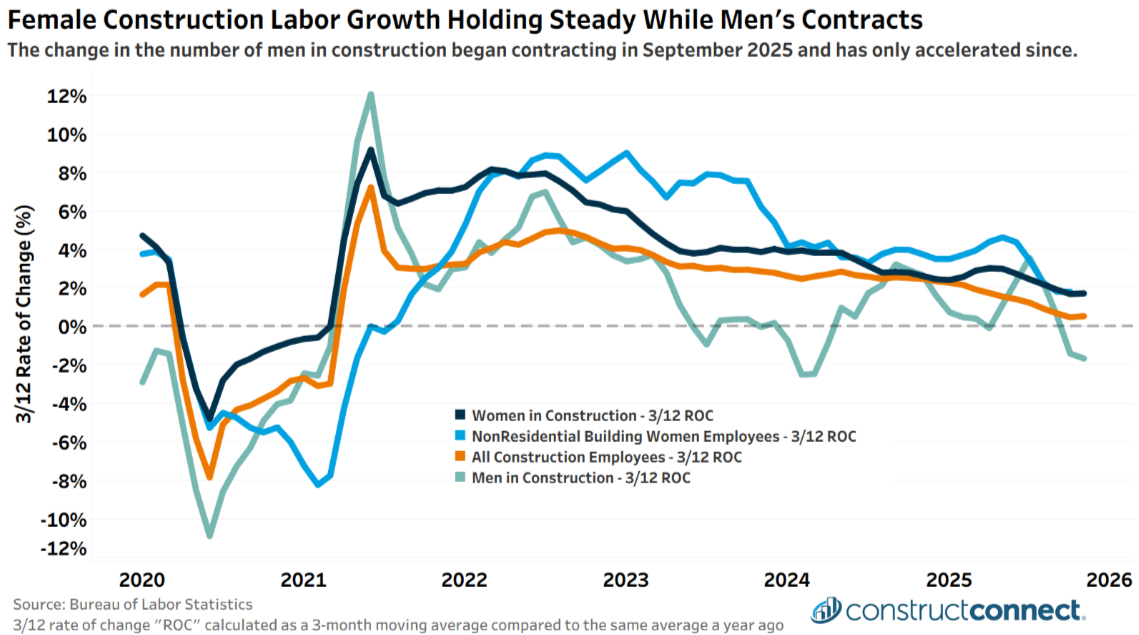
A chart illustrates the latest Bureau of Labor Statistics data, whereby female construction employment grew 1.1% compared to the same period a year ago, significantly outpacing overall construction employment growth of 0.3%. Image: ConstructConnect
Male construction employment fell 0.9% on the same basis, highlighting diverging workforce trends across demographic groups.
This pattern suggests that firms willing to use less-traditional labor sources, such as women, formerly incarcerated individuals, veterans, or career changers, could access labor pools with greater growth potential than traditional streams.
Just as important as building strong recruitment pipelines is developing and retaining talent once hired. Firms that invest in training programs, offer competitive compensation, and provide career advancement opportunities could reduce turnover while building a more productive workforce.
The alternative, constantly replacing skilled workers, becomes far more costly in the increasingly costly, scarce-labor environment we are in today.
Workforce Investment is Key
The combination of stagnant construction employment growth, steadily rising wages, and increased immigration enforcement pressures positions labor management as an imperative heading into 2026. Firms that invest in managing, developing, and retaining their workforce will potentially shield themselves from labor shortages that pressure both project timelines and profit margins.
Stay Connected
Stay connected with ConstructConnect News, your source for construction economy insights, market trends, and project news.