KEY POINTS
-
The NGA West megaproject showcases integrated security solutions and innovative building design on a grand scale.
-
Effective collaboration between agencies, contractors, and stakeholders was vital to staying on schedule and budget.
-
Lessons learned set an example for partnership and execution in large-scale military construction projects.
The U.S. Army Corps of Engineers (USACE) has marked a significant milestone with the completion of a new, state-of-the-art campus for the National Geospatial-Intelligence Agency (NGA) in St. Louis.
As reported by Christine Reinhardt on Army.mil, the massive $1.7 billion project, known as NGA West, showcases the power of partnership and provides a blueprint for future large-scale government construction. The National Geospatial-Intelligence Agency opened its new campus in St. Louis on Sept. 26, 2025.
%20gov.png?width=1031&height=675&name=rendering%20National%20Geospatial-Intelligence%20Agency%20(NGA)%20gov.png)
The 97-acre National Geospatial-Intelligence Agency (NGA) project site, shown in a rendering, sits in St. Louis’s historic St. Louis Place neighborhood at Jefferson and Cass avenues. The campus features a 700,000-square-foot office building, two parking garages, a visitor center, a delivery inspection facility, and secure entry and exit points. In 2026, about 3,150 staff members will relocate from the agency’s current 2nd Street location to the new facility. Image: National Geospatial-Intelligence Agency (NGA)
Managed by the US Army Corps of Engineers (USACE), Kansas City District, the project overcame significant complexity to deliver a vital national security asset.
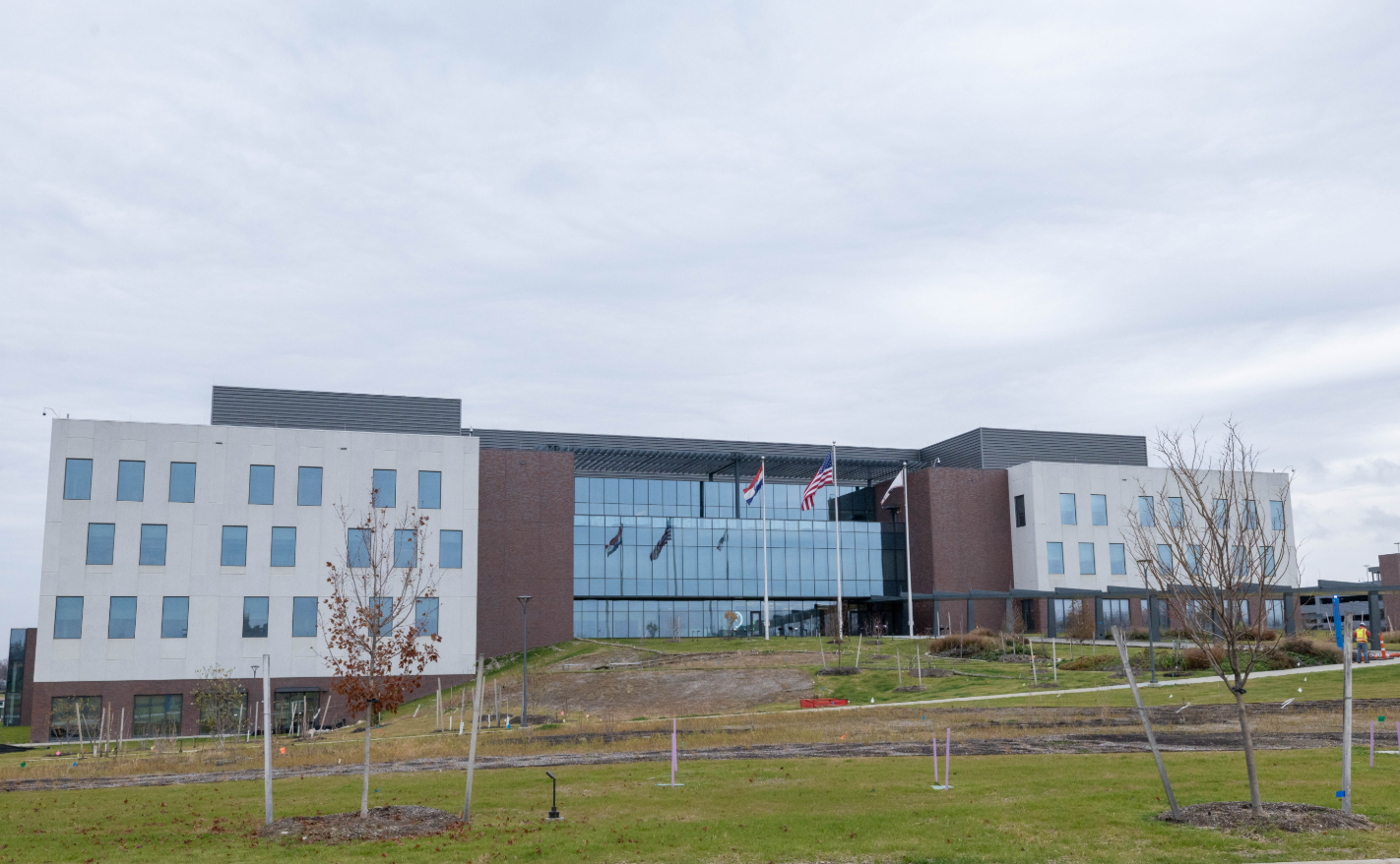
An exterior image of the National Geospatial-Intelligence Agency (NGA) in St. Louis. The 97-acre campus, a $1.7 billion megaproject, took over 10 years from design to construction. Image: US Army Corps of Engineers
Facility Details and Specifications
Spanning 97 acres, the new campus is a testament to modern engineering and construction. It features a main operations building of approximately 712,800 square feet, a 38,000-square-foot central utility plant, two parking garages, a visitor control center, and multiple access control points.
The facility replaces a century-old building, offering a modern environment for the more than 3,000 employees who will begin transitioning to the new site in early 2026.
Innovation in Integrated Security
A key challenge for the project team was integrating more than a dozen different security systems into the facility’s design and construction. According to Stacy Roettger, the N2W program management office chief, this complexity spurred innovation.
One unique aspect is the creation of secure and unsecure spaces within the same building module. The team developed creative solutions to manage transitions between these zones, a concept that required careful planning and execution.
This approach to integrated security offers a valuable case study for contractors and designers working on sensitive government or corporate projects.
Takeaways for the Construction Industry
The project’s success was not just about technical execution but also about effective collaboration. With multiple key partners, including the NGA, the U.S. Air Force, and the prime contractor, clear communication and strong relationships were essential.

Architectural wall panels in a teal camouflage pattern are shown covering a restroom access point at the National Geospatial-Intelligence Agency (NGA) in St. Louis. Image: US Army Corps of Engineers
Roettger noted that one of the biggest challenges was learning to work together to resolve issues promptly and keep the project on schedule. This long-term, multi-stakeholder partnership proved critical to navigating the complexities of a project that took over a decade from initial design to final construction.
Megaprojects as a Defining Force in the Construction Industry
To place NGA West in a broader industry context, megaprojects have become a defining force in nonresidential construction. According to Michael Guckes, Chief Economist at ConstructConnect, “This marks the fourth consecutive year of growth for billion-dollar-plus projects, averaging nearly $16.4 billion in new work breaking ground every month.” In 2025, megaprojects represented a remarkable 25% of all nonresidential construction starts, Guckes reported.
This trend highlights the growing reliance on complex, high-value projects across the sector, further underscoring the significance of the lessons and partnerships forged in undertakings like NGA West.
“Megaprojects have become pivotal to the industry, totaling $197 billion in construction starts for 2025. This marks the fourth consecutive year of growth for billion-dollar-plus projects, averaging nearly $16.4 billion in new work breaking ground every month.” Michael Guckes, Chief Economist, ConstructConnect
A Playbook for Partnering on Large-Scale Projects
The takeaways from the NGA West megaproject are already shaping how USACE approaches similar undertakings. The Kansas City District has used this experience to help develop a new playbook for partnering on large-scale projects.
As they prepare for another military construction megaproject in St. Louis, the team brings a wealth of knowledge from this successful endeavor.
The completion of the NGA West campus stands as an example of how strategic partnerships and innovative problem-solving can deliver even the most ambitious construction projects safely, on time, and within budget.
The National Geospatial-Intelligence Agency (NGA) is a combat support agency within the U.S. Department of Defense responsible for collecting, analyzing, and distributing geospatial intelligence (GEOINT) to support national security. Initially established in 1996 as the National Imagery and Mapping Agency (NIMA), it adopted its current name in 2003. The NGA is also a member of the United States Intelligence Community.
Stay Connected
Stay connected with ConstructConnect News, your source for construction economy insights, market trends, and project news.
About ConstructConnect
At ConstructConnect, our software solutions provide the information construction professionals need to start every project on a solid foundation. For more than 100 years, our insights and market intelligence have empowered commercial firms, manufacturers, trade contractors, and architects to make data-driven decisions and maximize productivity.
ConstructConnect is a business unit of Roper Technologies (Nasdaq: ROP), part of the Nasdaq 100, S&P 500, and Fortune 1000.
For more information, visit constructconnect.com