KEY POINTS
-
Megaprojects have become pivotal to the industry, totaling $197 billion in construction starts for 2025. This marks the fourth consecutive year of growth for billion-dollar-plus projects, averaging nearly $16.4 billion in new work breaking ground every month.
-
These massive undertakings now represent 25% of all Nonresidential construction spending, a dramatic increase from just over 5% in 2020.
-
This shift indicates that the industry's health is increasingly reliant on a smaller number of high-value jobs.
The Rising Scale of Construction Investment
In 2025, megaprojects—defined as Nonresidential projects with a construction value exceeding $1 billion—became an increasingly central component of the construction industry.
Analysis of ConstructConnect’s Project Intelligence database for the full year underscores the pivotal role these large-scale undertakings now play. Over the course of 2025, megaprojects accounted for $197 billion in construction starts.
This figure translates to a monthly average of nearly $16.4 billion in new megaproject work breaking ground. The year 2025 marked the fourth consecutive year in which the share of all Nonresidential construction spending directed toward megaprojects has grown.
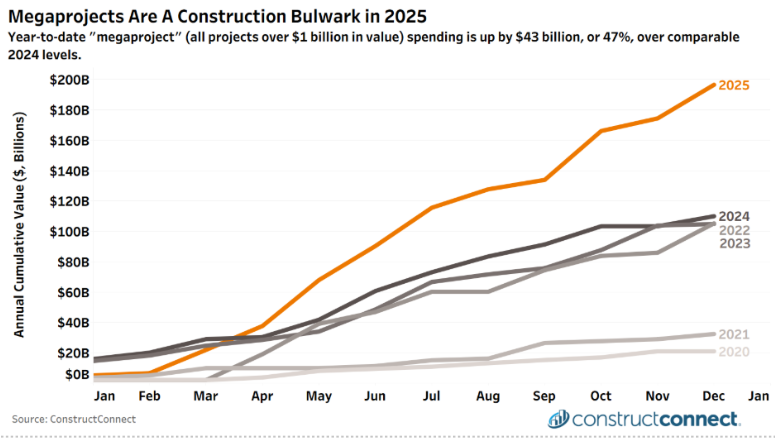
Over the course of 2025, megaprojects accounted for $197 billion in construction starts. Image and Data: ConstructConnect
One-Quarter of 2025 Nonresidential Construction Starts
The significance of these projects is evident when compared to the broader Nonresidential landscape. In 2025, one in every four dollars spent on Nonresidential construction starts was allocated to a megaproject.
This means approximately 25% of the entire Nonresidential market was concentrated in a relatively small number of very large jobs.
For comparison, megaproject spending accounted for just over 5% of all Nonresidential spending in calendar year 2020. This high concentration indicates that the industry's expansion is more dependent on the demand for megaprojects than ever before.
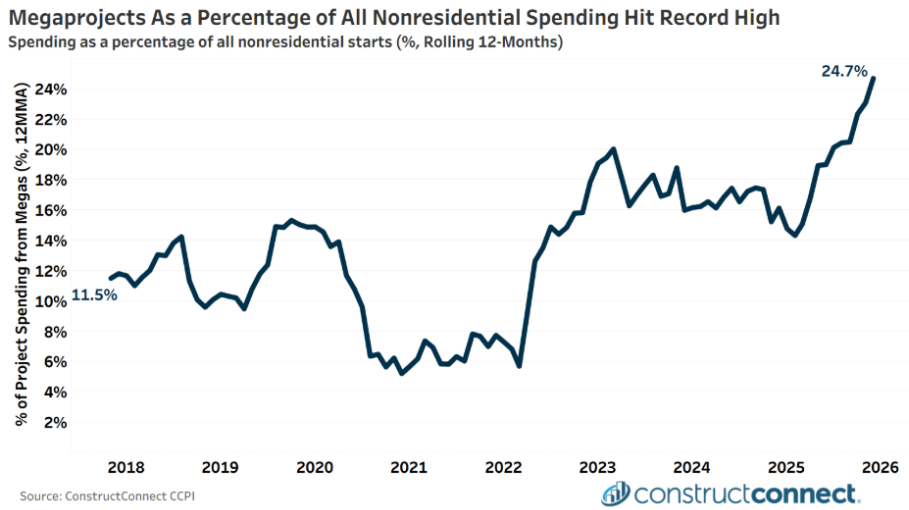
In 2025, one in every four dollars spent on Nonresidential construction starts was allocated to a megaproject. Image and Data: ConstructConnect
Sector-Level Breakdown of Megaproject Activity
A sector-level breakdown of this megaproject activity highlights an evolving demand structure.
Industrial: Roughly one-third of all megaproject dollars flowed into Industrial projects, making it the single largest recipient of billion-dollar-plus spending. This reflects the ongoing surge of large manufacturing, processing, and advanced production facility investments.
Commercial and Civil: Not far behind were Commercial megaprojects and Civil and Heavy Construction, with each category capturing a share of spending only slightly less than Industrial's.
Data Centers: Within the Commercial sector, activity was dominated by Data Centers, which have rapidly become a defining asset type of the current construction cycle. The scale of modern Data Centers—driven by cloud computing, artificial intelligence, and high-density storage needs—means that individual campuses often cross the billion-dollar threshold, with multiphase buildouts climbing to even higher valuations.
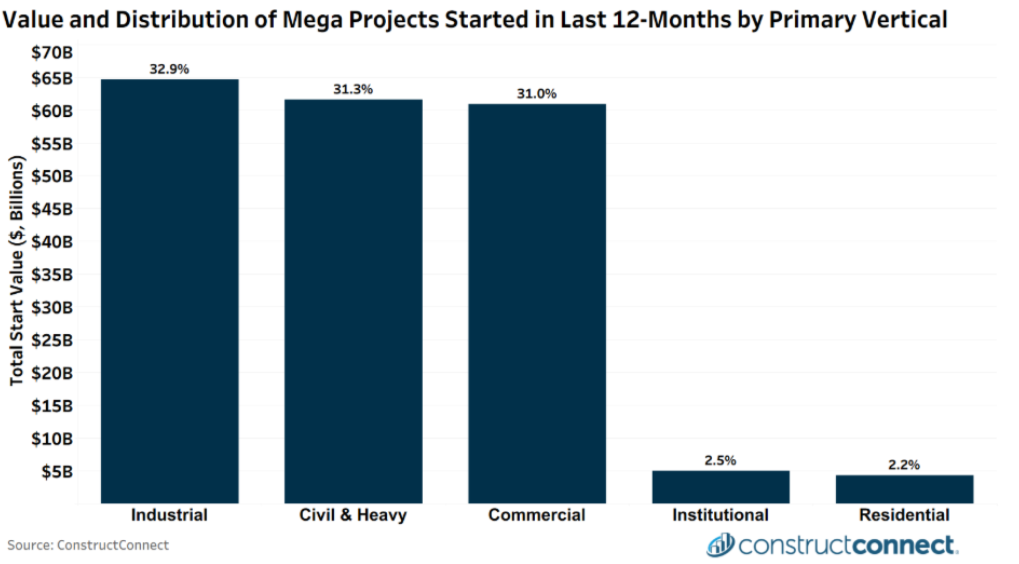
Roughly one-third of all megaproject dollars flowed into Industrial projects in the last 12-months, making it the single largest recipient of billion-dollar-plus spending. Image and Data: ConstructConnect
The 2025 data reveal an industry heavily influenced by a relatively small number of large-scale investment decisions. With $197 billion in megaprojects representing a quarter of all Nonresidential construction dollars, the fortunes of the broader market are increasingly tied to the timing, financing, and execution of these billion-dollar jobs.
For contractors, suppliers, and policymakers, tracking megaprojects is essential to understanding the future direction of Nonresidential construction.
Stay Connected
Stay connected with ConstructConnect News, your source for construction economy insights, market trends, and project news.
About ConstructConnect
At ConstructConnect, our software solutions provide the information that construction professionals need to start every project on a solid foundation. For more than 100 years, our keen insights and market intelligence have empowered commercial firms, building product manufacturers, trade contractors, and architects to make data-driven decisions, streamline preconstruction workflows, and maximize their productivity. Our newest offerings—including our comprehensive, AI-assisted software—help our clients find, bid on, and win more projects.
ConstructConnect operates as a business unit of Roper Technologies (Nasdaq: ROP), a constituent of the Nasdaq 100, S&P 500, and Fortune 1000.
For more information, visit constructconnect.com