KEY POINTS
-
Norfolk Southern’s new East Edge service opens a double-stack rail route between Chicago and Boston, significantly increasing freight capacity for the Northeast.
-
Completion of the $64 million project overcame complex engineering and regulatory challenges, including lowering the tunnel floor, raising bridges, and upgrading the track.
-
Running daily, the new double-stack trains offer shippers greater efficiency, resilience, and an alternative to truck transport in a high-demand region.
The U.S. northeast now has the edge – East Edge that is.
The goal of Norfolk Southern (NS), America’s number two Class 1 railway (after Canadian Pacific-Kansas City) by revenue and routes, is not only to give shippers faster freight movements between the Boston area and Chicago.
It literally describes the geography of one of the last major freight corridors to get such an overhaul.
“East Edge reflects both the eastern reach of our intermodal network and the operational edge this service creates by opening a fully double-stack corridor into New England,” NS spokeswoman Katelyn Byrd said.
Unlocking Capacity in a Congested Region
Despite the significance of both cities to commerce, shipping capacity had always been constrained by the fact that the railway – and its predecessors – couldn’t operate double-stacked freight trains.
The demand has now increased significantly due to e-commerce and expanding distribution hubs, forcing many shippers to rely more on trucks.
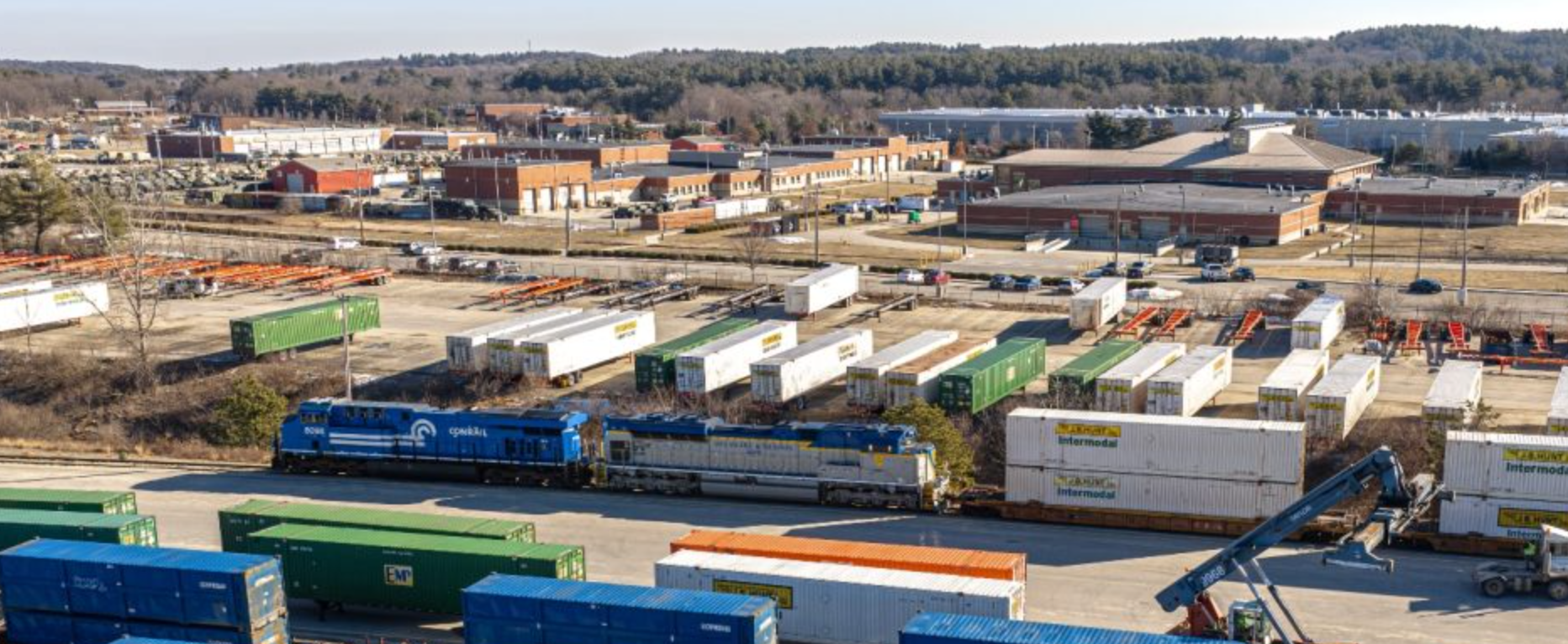
Shown is the intermodal terminal at East Edge’s eastern terminus in Ayer, Mass. Image: Norfolk Southern
As of Jan. 11, all that has changed. Now, seven days a week, one 9,000-foot double-stacked train operates in each direction.
“That unlocks capacity and resilience in a region where demand has outpaced rail options for years,” Byrd said.
A 40-Year Journey to Completion
The $64 million P3 completes three years of hard infrastructure upgrades and, figuratively, 40 years of transforming NS into a complete intermodal network, with double-stacks carrying containers or truck vans.
Specifically, the route connects the city of Chicago on the west to Ayer, Mass., New England’s primary intermodal hub, just outside Boston’s I-495 ring on the east.
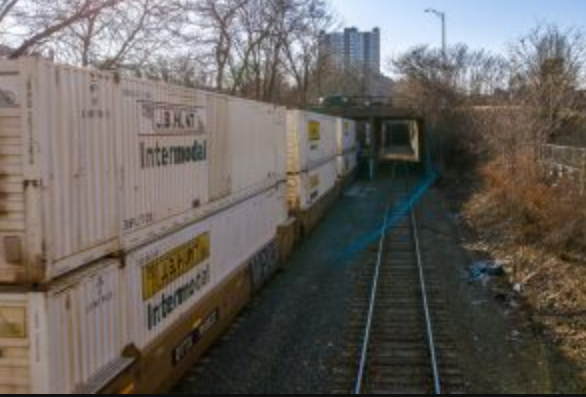
Several bridges in Massachusetts had to be raised to accommodate double-stacked trains for the new Norfolk Southern East Edge route. Image: Norfolk Southern
Why 40 years?
Complex challenges. The line crosses several states and government jurisdictions. The work required the cooperation of several other railroads and was simply the incremental process of addressing legacy infrastructure.
“Achieving full clearance required years of coordination, long-term agreements, and highly technical engineering work,” Byrd said. “You address one constraint at a time, over many years, until the entire corridor finally comes together.”
Engineering Feats by Lowering Floors and Raising Bridges
In fact, hardly any of the route was transformed; instead, it was essentially a series of choke points where bridges and tunnels had to be expanded, some track rebuilt, and new signaling installed.
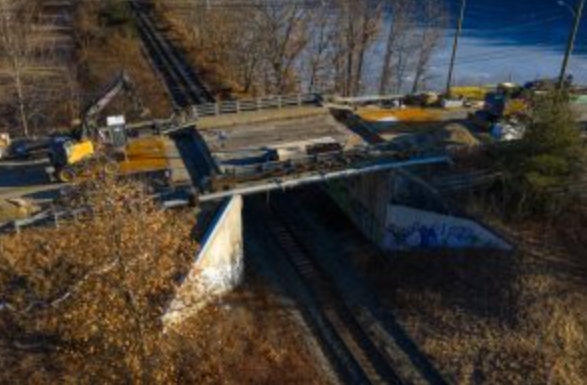
The tunnel at Worcester, Mass., had to be enlarged by lowering the floor and installing a new track base. Image: Norfolk Southern
“In railroading, you can have hundreds of miles of track that are ready to go, but a handful of pinch points can limit the entire route,” Byrd said. “Solving those constrained locations required custom engineering solutions and close coordination with public agencies and partners.”
The most crucial overhauls were in the corridors between Delanson and Voorheesville, N.Y, southwest of Albany, and between Worcester and Ayer, Mass.
In the first, 15 miles of limited-use dual tracks were replaced, 13,600 crossties installed, and 14 crossings upgraded. Meanwhile, in Massachusetts, three bridges were raised by 12 to 18 inches, and two legacy tunnels had their floors lowered, with stone track ballast replaced by a concrete base.
“Rather than raising the tunnel, crews lowered and re-engineered the track structure to create the necessary clearance, while maintaining safety and structural integrity,” Byrd said. “It’s a good example of the kind of precision engineering required on this project.”
While one of the last NS corridors to create double-stack “clearance,” it’s not the final one. That’s taking place in western Pennsylvania with completion set for 2028.
Stay Connected
Stay connected with ConstructConnect News, your source for construction economy insights, market trends, and project news.
About ConstructConnect
At ConstructConnect, our software solutions provide the information construction professionals need to start every project on a solid foundation. For more than 100 years, our keen insights and market intelligence have empowered commercial firms, building product manufacturers, trade contractors, and architects to make data-driven decisions, streamline preconstruction workflows, and maximize their productivity. Our newest offerings—including our comprehensive, AI-assisted software—help our clients find, bid on, and win more projects.
ConstructConnect operates as a business unit of Roper Technologies (Nasdaq: ROP), a constituent of the Nasdaq 100, S&P 500, and Fortune 1000.
For more information, visit constructconnect.com

.jpg?width=180&height=180&name=RON%20STANG%20(2).jpg)