KEY POINTS
-
Imani Village is a nearly 40-acre, eco-friendly, mixed-use intergenerational community in Chicago’s Pullman neighborhood, aiming to address health equity, economic justice, and social determinants of health.
- The development includes a 66,000-square-foot empowerment zone, a food hub with a vertical garden and farmers market, an athletic center, and plans for modular homes and a 90-room hotel.
- The project has been in development since 2009, with over $8 million raised and partnerships with private and public entities to support its ambitious goals.
A vast housing, medical, commercial, and manufacturing hub is taking shape in Chicago’s famed Pullman neighborhood, aiming to revive the city’s South Side, which has seen disinvestment and poverty.
A Vision Rooted in Justice and Community Well-being
The brainchild of Trinity United Church of Christ, where former U.S. President Barack Obama was a parishioner and which was once helmed by the controversial preacher Rev. Jeremiah Wright, the almost 40-acre campus combines a wide array of ambitious goals in an “eco-friendly mixed-use intergenerational community with a village environment, committed to life-long education, health, and economic development.”
The project is known as Imani Village, Imani being Swahili for “faith.”

A rendering depicts the massive Imani Village campus in Chicago’s Pullman neighborhood. Image: Imani Village
Taking its themes from Black power and social justice philosophies, its motto plays on the well-known political slogan with “By Any ‘Greens’ Necessary,” rooted in “economic justice, health equity, eco-justice, and redressing the impacts of mass incarceration,” its mandate says.
The project aims to combine physical structures and architecture in a way that promotes “spaces that nourish body and spirit” and “dignified work.” “One of the mission themes of Trinity is seeking to win the community’s heart,” Village President and legal attorney Patricia Eggleston said.
The “model” community has been in development since 2009, acquiring land and raising almost $8 million in funding. It now has a myriad of private and public partners.
“It really starts with health equity,” Eggleston said. “It’s not just the absence of disease but everything that makes a person healthy.”
So, a primary and preventive care center is there.
As well, the village addresses the “social determinants” of health, which includes housing, jobs, and lack of stress – “things that make a person healthy from every aspect,” she said.
“So, we said, what would it look like to have a multi-use community that reflects a response to these things?”
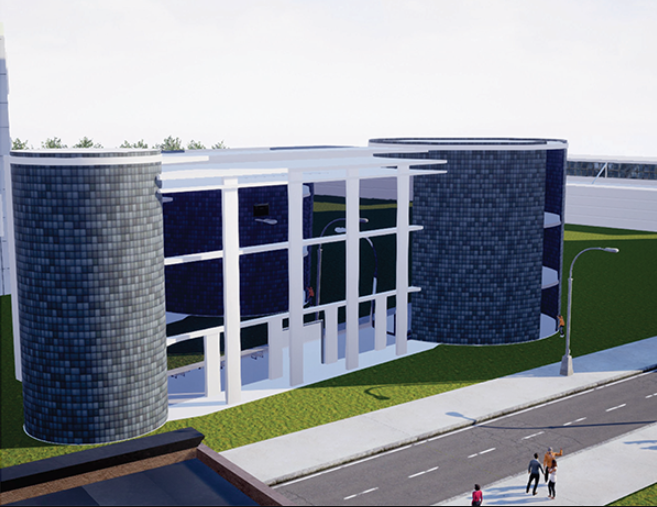
The food hub will incorporate a vertical garden, a farmers market, and a restaurant. Image: Imani Village
The entity known as Imani Village LLC is the property developer, and an affiliate, Imani Works, oversees on-site programs.
The Empowerment Zone: A Hub for Health and Opportunity
The actual physical center of the campus is an “empowerment zone,” a 66,000-square-foot building that includes the clinic and urgent care center.
Other tenants provide workforce development, environmental training, a child care network HQ, holistic health training, and even a partnership with Commonwealth Edison for clean energy skills.
Food Hub and Wellness Facilities
As well, there is a four-story “food hub” with a vertical garden, indoor farmers market, soul food restaurant, and healing garden. There is also an athletic and wellness center for “non-traditional” sports like girls’ flag football. A cardiac and stroke rehab facility is expected to join the three-floor building.
Meanwhile, using a former steel distribution site, Imani Works will be constructing 80 modular, two-story, 1,500- to 1,900-square-foot three-bedroom homes that will be located on the south end of the site “basically for first-time homebuyers,” Eggleston said.

The Imani Village healing garden reflects the development’s emphasis on holistic health. Image: Imani Village
Housing and Future Developments
The initial of five phases starts this year. The first major campus building opened last summer: a $36-million, 70-unit seniors residence co-developed with Chicago’s SPM Properties.
“It’s affordable but upscale – very, very modern,” she said. Phase two, likely starting this year, will add another 60 units.
Architecturally, “we’re building green from the ground up,” Eggleston said. This means energy efficiency, structures with “lots of windows, lots of light,” some in circular styles with green roofs and/or solar panels.
A 90-room hotel, already signed with a major brand that can’t be named as yet, is also set to go. Its five stories will match the height of the senior buildings.
About ConstructConnect
At ConstructConnect, our software solutions provide the information construction professionals need to start every project on a solid foundation. For more than 100 years, our keen insights and market intelligence have empowered commercial firms, building product manufacturers, trade contractors, and architects to make data-driven decisions, streamline preconstruction workflows, and maximize their productivity. Our newest offerings—including our comprehensive, AI-assisted software—help our clients find, bid on, and win more projects.
ConstructConnect operates as a business unit of Roper Technologies (Nasdaq: ROP), a constituent of the Nasdaq 100, S&P 500, and Fortune 1000.
For more information, visit constructconnect.com

.jpg?width=180&height=180&name=RON%20STANG%20(2).jpg)