KEY POINTS
-
Energy costs, tariffs, and the data center construction boom are squeezing margins as material prices for steel, aluminum, and copper remain volatile.
-
Data center growth is increasing demand for metals and power infrastructure.
-
Contractors may mitigate risks by diversifying portfolios, strengthening supplier relationships, and exploring alternative methods, while smaller firms focus on niche markets to stay competitive.
Mounting Cost Pressures Entering 2026
Construction firms entered 2026 under mounting cost pressure as tariffs, energy costs, and record data center demand keep key metal prices elevated, even after the sharp volatility of the past several years.
As 2026 gets underway, construction firms are contending with mounting cost pressures. Higher energy and input costs, tariffs, and surging demand from data center and power projects help keep many key metal and electrical equipment prices elevated and volatile.
This is leading to tighter profit margins, shorter bid validity windows, and greater risk for long-lead materials such as steel, aluminum, and copper.
Metals Stay Expensive
While overall construction input inflation has cooled from pandemic-era peaks, metals tied to large infrastructure and industrial work remain stubbornly expensive relative to pre-2020 norms.
Recent and proposed U.S. tariffs on various steel and aluminum mill products are pushing producer price indices higher, just as many in construction had hoped for relief.
Steel prices, after retreating from their 2021–2022 highs, began to edge higher again in 2025 as trade frictions, energy costs, and freight rates constrained supply.
Aluminum and copper, both critical to data center building envelopes and electrical systems, face additional pressure from decarbonization policies and electrification demand that continue to absorb global production capacity.
Data Centers Intensifying Demand
The data center sector has emerged as a force shaping materials demand, particularly for structural steel, electrical metals, and specialty mechanical systems.
ConstructConnect Chief Economist Michael Guckes reported that data center construction spending has “surged fivefold in two years,” with year-to-date starts through November 2025 hitting $53.7 billion, up 138.6% from the same period a year earlier.
In November alone, 22 data center projects broke ground with more than $9.8 billion in starts, nearly four times the prior year’s total for the month, according to the ConstructConnect January 2026 Data Center Report.
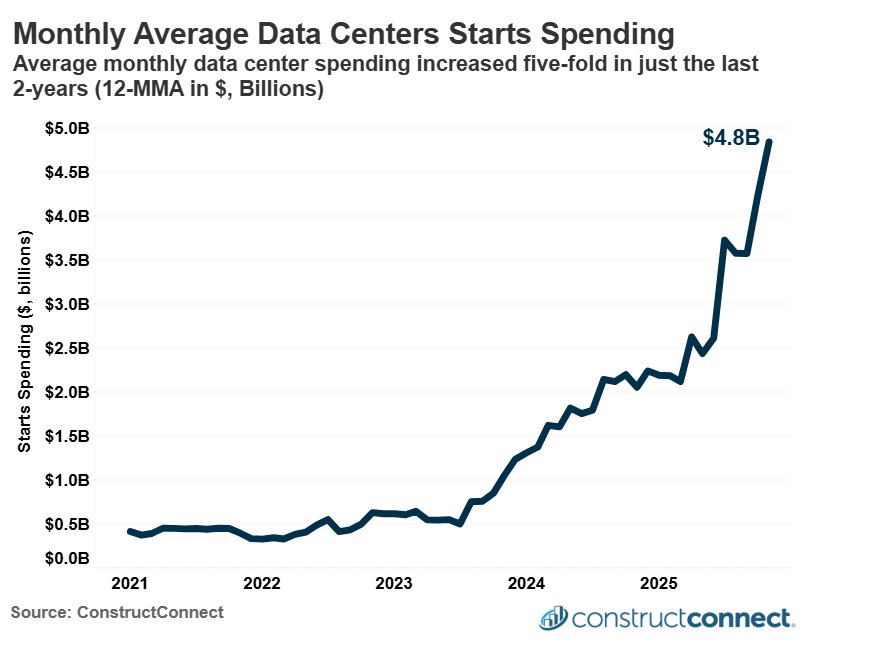
Chart of monthly average data center construction starts spending through November 2025. The line shown represents a 12-month moving average, in billions of dollars. Image and Data: ConstructConnect
The Link Between Data Centers and Metal Demand
The construction industry’s metals outlook appears to be increasingly tied to power infrastructure, which must expand quickly to support data center growth.
This connection stems from the energy-intensive nature of data centers, which require significant power capacity to operate. Where there’s power infrastructure, metals play a significant part in the construction specifications.
According to the U.S. Geological Survey (USGS), aluminum and steel are used extensively in transmission towers, cables, and transformers, making them core metals in modern power transmission infrastructure.
Over half of all mined copper ends up in electrical applications, according to some estimates. The USGS writes about copper, that “Building construction is the single largest market, followed by electronics and electronic products, transportation, industrial machinery, and consumer and general products.”
Demand Pressure on Metals is Expected
ConstructConnect anticipates that while Power Infrastructure starts spending declined in 2025 from record 2024 levels, the sector is expected to rebound strongly, with yearly starts projected to exceed $30 billion by 2027.
“Power Infrastructure has followed data center development, with many large-scale facilities now building dedicated onsite power generation capacity,” notes ConstructConnect Associate Economist Devin Bell.
This trend underscores the complementary relationship between data centers and power infrastructure, as the availability of energy supply will directly impact the pace of future data center expansion.
Without sufficient power infrastructure, the growth of data centers and the demand for metals like steel, copper, and aluminum used in transmission and generation systems could face significant constraints.
ConstructConnect expects power infrastructure spending to rebound to $27.8 billion in 2026, up from $16.5 billion in 2025, adding momentum to demand for steel, copper, and aluminum components.
Guckes remarked that the pace of new power generation and grid upgrades may ultimately limit future data center development unless off-grid and privately developed power solutions emerge at scale.
What It Means for Construction
Construction professionals are responding to metal price volatility with tighter commercial terms and more active materials risk management. Some are shortening bid validity periods, introducing escalation clauses, and locking in steel and electrical purchases earlier in the preconstruction process, especially on large, mission-critical, and industrial jobs.
Against this backdrop, near-term data center activity underscores how persistent these pressures may be. ConstructConnect Project Intelligence is tracking 65 potential data center projects worth $69.2 billion scheduled to start in the next six months.
Guckes expects the trend of fewer but more expensive facilities to continue into 2026. (It is worth noting that these projects are in various stages of preconstruction with no guarantee of breaking ground.)
“Contractors are facing a perfect storm of rising material costs, persistent wage growth, and tight labor markets,” according to Guckes. “Approximately 70% of a typical project’s total expenses are increasing substantially faster than bid prices, leaving firms with little room to absorb additional shocks. This is the third major margin squeeze in a decade, and it’s forcing the industry to rethink how it manages risk and pricing.”
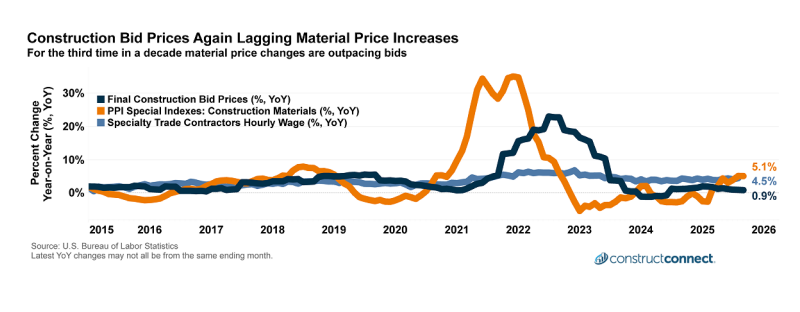
For the third time in a decade, ConstructConnect Chief Economist, Michael Guckes, notes that material price increases are substantially outpacing bid prices. Image: ConstructConnect Construction Economy Snapshot, December 2025
Competing While (Still) Navigating Price Uncertainty
For contractors of all sizes, the expectation around metal demand means markets could remain sensitive to even modest shifts in policy, power infrastructure, or megaproject timing, rather than returning to a more predictable pricing environment.
For smaller contractors wondering, “How can small contractors compete with larger companies?”, the answer may be in strategic focus and adaptability. “Smaller firms can differentiate themselves by offering unique expertise or by targeting smaller-scale projects that fall outside the scope of mega-contractors,” Guckes said.
To navigate this uncertainty, contractors may want to evaluate strategies such as locking in long-term supplier agreements to mitigate price volatility, investing in estimating tools to enhance bid accuracy, and diversifying project portfolios to reduce reliance on any single market segment.

Building stronger relationships with suppliers could also provide early insights into market trends and potential disruptions, offering a competitive edge. Contractors might explore alternative materials or construction methods, such as modular or prefabricated systems, to reduce exposure to high-cost metals.
Additionally, staying informed about policy changes, infrastructure developments, and megaproject timelines could help anticipate market shifts and adjust strategies accordingly. By taking these steps, contractors can strive to adapt to ongoing market challenges while remaining competitive in a rapidly evolving construction landscape.
Stay Connected
Stay connected with ConstructConnect News, your source for construction economy insights, market trends, and project news.
About ConstructConnect
At ConstructConnect, our software solutions provide the information that construction professionals need to start every project on a solid foundation. For more than 100 years, our keen insights and market intelligence have empowered commercial firms, building product manufacturers, trade contractors, and architects to make data-driven decisions, streamline preconstruction workflows, and maximize their productivity. Our newest offerings—including our comprehensive, AI-assisted software—help our clients find, bid on, and win more projects.
ConstructConnect operates as a business unit of Roper Technologies (Nasdaq: ROP), a constituent of the Nasdaq 100, S&P 500, and Fortune 1000.
For more information, visit constructconnect.com