KEY POINTS
- Data centers, boosted by AI demand, are fueling U.S. nonresidential construction growth.
- Growth is largest in low-cost power states, boosting infrastructure needs and opportunities.
- Megaprojects and private nonresidential spending rebound despite tariffs, labor, and cost pressures.
ConstructConnect and Oxford Economics expect the U.S. construction market to continue outpacing other advanced economies, even as firms face mounting cost pressures.
During a recent live presentation, Where Does the U.S. Construction Economy Go from Here?, ConstructConnect Chief Economist Michael Guckes and Dr. Nicholas Fearnley, Head of Global Construction Forecasting at Oxford, outlined how an AI-led investment cycle, demographic shifts, and tariff policy are reshaping construction in 2026.
What is driving demand for nonresidential construction?
On the demand side, an AI investment boom is driving nonresidential construction. Manufacturing value put-in-place, or the value of work actually installed, has surged on the back of CHIPS Act-related facilities, while data centers now account for roughly half of office construction activity.
But professionals shouldn’t just focus on what’s being built. Guckes advises they also need to consider where the activity is happening.
"Geography is the second probably most important factor in understanding the construction landscape right after major subcategories and verticals,” he says.
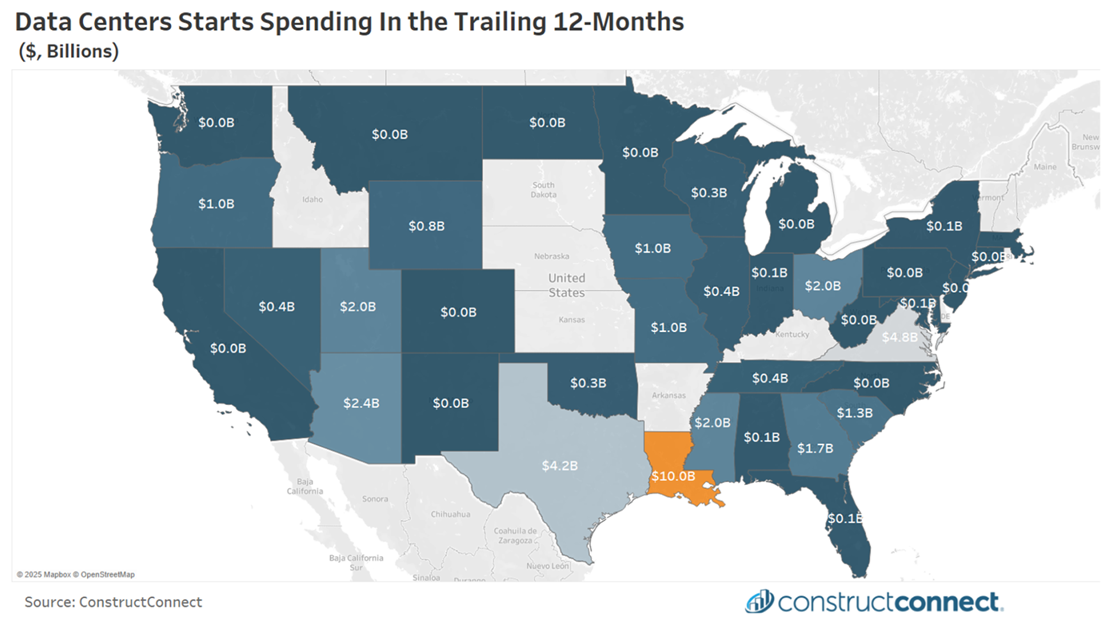
When it comes to data centers, the numbers show projects are clustered in states with lower electricity costs, particularly across the U.S. Southeast (Alabama, Georgia, Louisiana, Mississippi, and Texas, in particular) and in legacy hubs, such as Virginia. The increased demand here is also requiring significant power and water infrastructure work.
How can contractors, companies, and other pros stay on top of the increased demand for nonresidential construction?
Keeping updated on the “what” and “where” of construction spending trends is the purpose of ConstructConnect’s U.S. Construction Put-in-Place Forecasts. Built in partnership with Oxford Economics, the forecasts give a multi-year view of put-in-place spending by vertical and location so contractors, manufacturers, and suppliers can better target bids, staffing, and inventory. You can learn more about the forecasts and sign up for a forecast strategy call on this page.
How are megaprojects affecting construction spending?
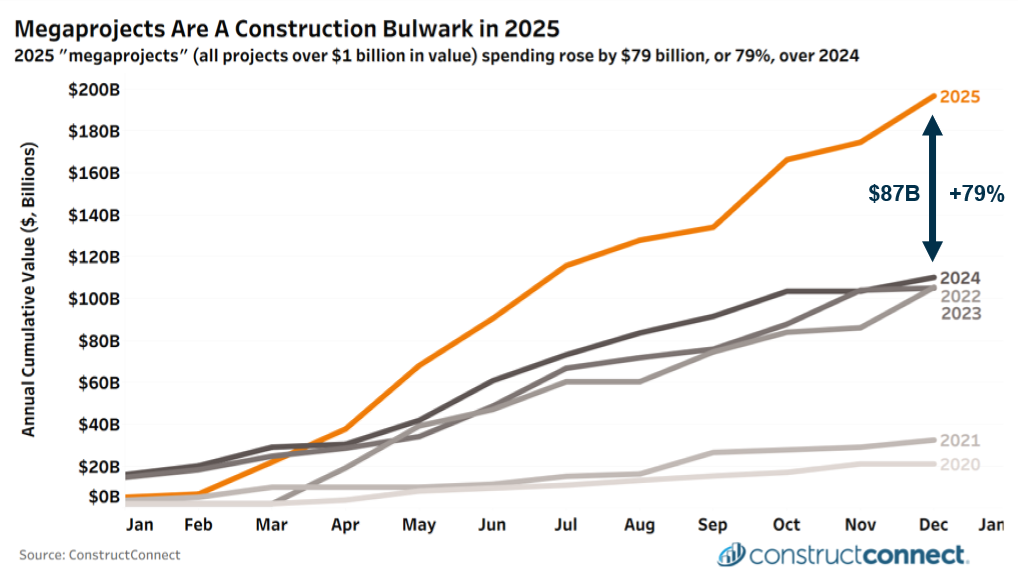
Another major contributor to construction spending this year will be megaprojects—those projects valued at $1 billion and up. Guckes notes that data provided by ConstructConnect Project Intelligence show U.S. megaproject spending grew by almost 80%, or $87 billion, last year. What’s more, he says $1 out of every $4 spent in construction in 2025 went to a megaproject.
“This continues to be a major area of interest to us,” Guckes said. “It's it is really a great example of showing us how megaprojects are changing the way that construction works.”
How is nonresidential construction expected to perform in 2026?
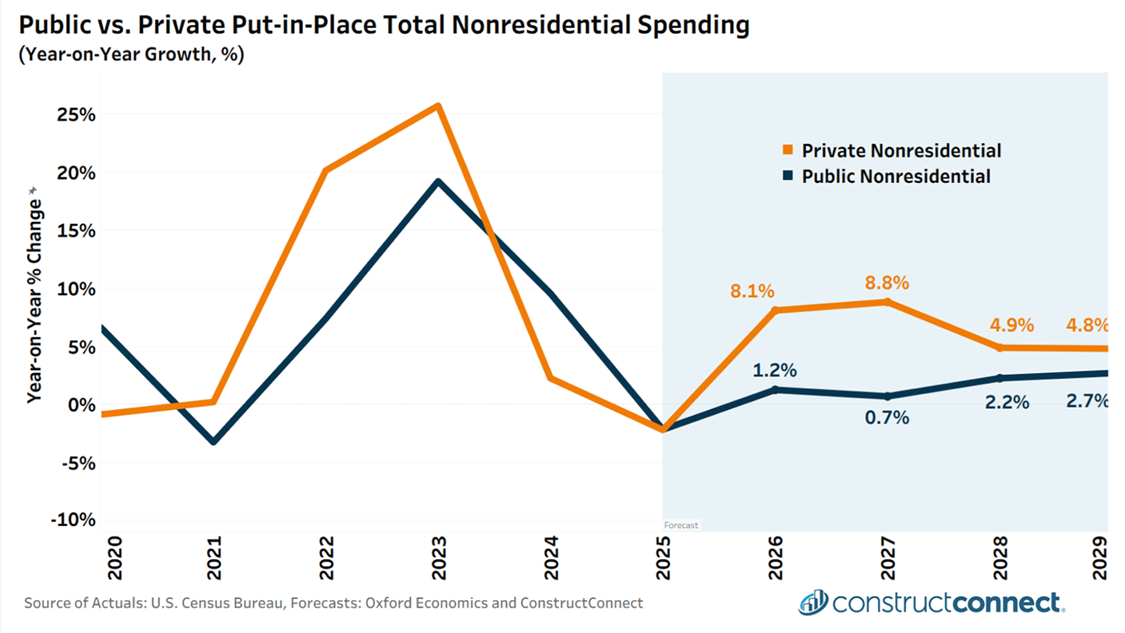
ConstructConnect’s forecasts call for a strong rebound in total nonresidential put-in-place after a 2.2% decline in 2025. Spending is projected to approach $1.3 trillion in 2026 (up 5.4% year over year) and just under $1.4 trillion in 2027 (up 5.8%), before moderating to growth near 4% annually. Private nonresidential put-in-place is expected to expand much faster than public, led by commercial and manufacturing.
With that in mind, Guckes suggests contractors and tradespeople cast a wider net on the types of projects to focus on.
“Consider the variety of opportunities that are out there in the construction space. Renovation is one of them,” he says. “Mega projects and data centers are all big opportunities, and they're all big trends that are changing and transforming the construction industry.”

How are tariffs impacting U.S. construction in 2026?
Cost-side risks remain in play, however. Fearnley noted that, under every recent tariff scenario, construction materials face 10% to 15% more tariff exposure than the broader economy.
“This makes sense because a lot of the commodities that are facing very specific tariffs, things like steel and also lumber, they are heavily used by the construction industry,” he notes.
At the same time, labor shortages are tightening the workforce, while material prices and wages are rising faster than bid prices. All of that contributes to pressuring industry margins.
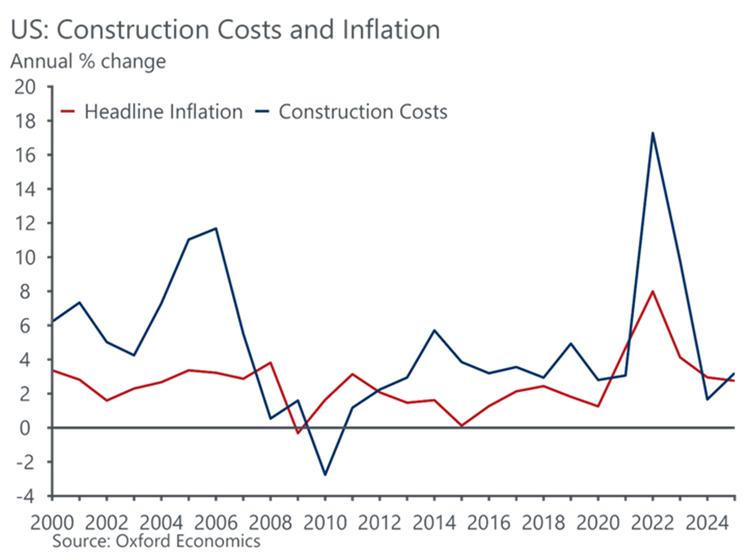
“It does look like construction costs are going to continue to grow faster than inflation, but this is not unusual,” Fearnley adds.
For a view of what this means for contractors, trades, and other business owners, read our companion blog: 3 Big Shifts Every Construction Pro Should Watch in 2026.
Stay Connected
Stay connected with ConstructConnect News, your source for construction economy insights, market trends, and project news.
About ConstructConnect
At ConstructConnect, our software solutions provide the information that construction professionals need to start every project on a solid foundation. For more than 100 years, our keen insights and market intelligence have empowered commercial firms, building product manufacturers, trade contractors, and architects to make data-driven decisions, streamline preconstruction workflows, and maximize their productivity. Our newest offerings—including our comprehensive, AI-assisted software—help our clients find, bid on, and win more projects.
ConstructConnect operates as a business unit of Roper Technologies (Nasdaq: ROP), a constituent of the Nasdaq 100, S&P 500, and Fortune 1000.
For more information, visit constructconnect.com