KEY POINTS
-
Data center construction starts surged to $77.7 billion in 2025, a 190% year-over-year increase, with Q4 alone accounting for $44.4 billion.
-
Average data center costs rose 70% in 2025, reaching $633 million per project and $1,033 per square foot, driven by surging demand.
-
With $88 billion in preconstruction projects and a forecasted 70% rebound in power infrastructure spending, 2026 could surpass 2025’s record growth.
This exclusive data center report was prepared by ConstructConnect Chief Economist, Michael Guckes, and Associate Economist, Devin Bell.
Data Center Construction Starts Spending
ConstructConnect reported that 19 data center projects broke ground in December 2025, with a total construction start value of $12.5 billion.
Project count and construction starts spending increased over December 2024 levels, with spending increasing 183% year-over-year.
Accelerating Pace of 2025
If one were to sum up the most significant trend in 2025 construction, it was the endlessly accelerating pace of data center starts. First-half 2025 data center starts showed strong promise after 80% growth the year before.
By July, year-to-date (YTD) data center starts had already reached $27.5 billion, exceeding the prior year’s total. The monthly pace of new data center starts at $3.9 billion was significantly faster than the $2.2 billion rate of 2024.
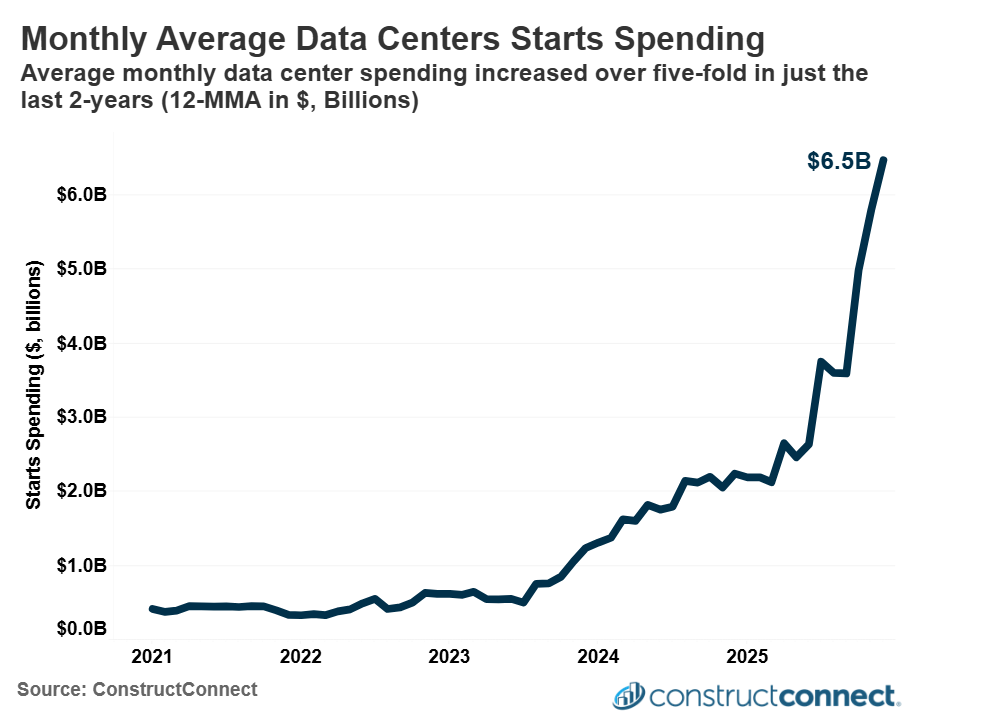
Chart of monthly average data center construction starts spending through December 2025. The line shown represents a 12-month moving average, in billions of dollars. Image and Data: ConstructConnect
At this accelerated clip, full-year growth was on pace to exceed $48 billion, or 74% growth. We were nervous but hopeful that the industry would be able to sustain such lofty expectations.
The following five months wouldn’t just meet those expectations but blow them away. The monthly pace of new starts surged to $10.0 billion.
In the fourth quarter alone, starts totaled $44.4 billion, more than 160% above the total 2024 starts. The fourth-quarter surge lifted total starts for the year to $77.7 billion, up 190% year over year. Indeed, our forecast of 74% growth was well off the mark.
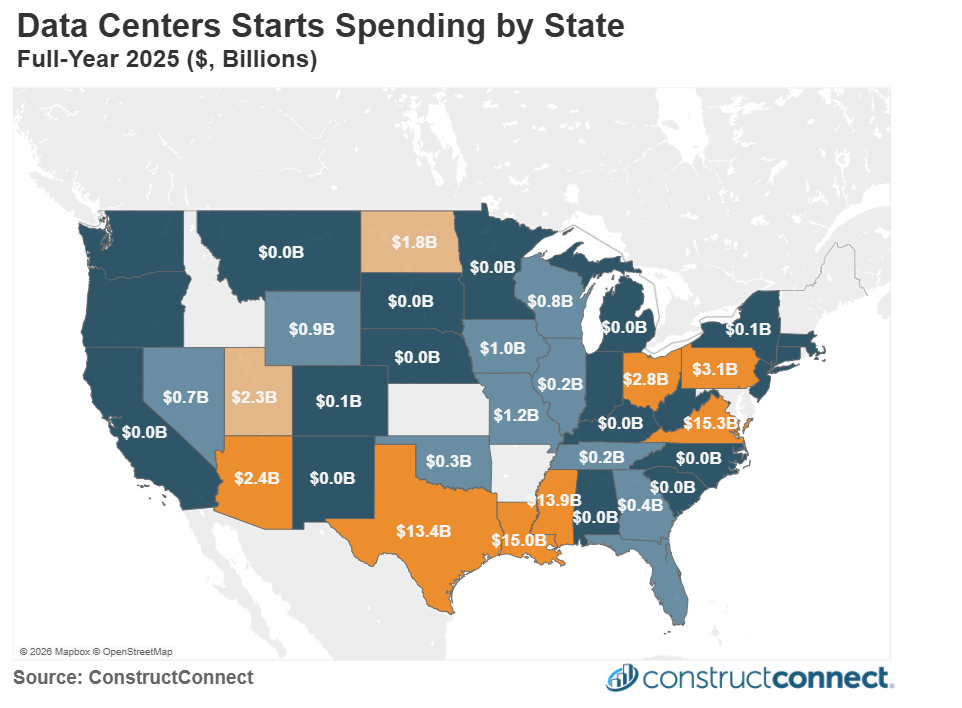
This map shows US Data Center construction starts spending in billions of dollars for the trailing 12-month period through December 2025. Image and data powered by ConstructConnect Project Intelligence
Data Center Costs Surge
Data center costs have surged massively over the past year, driven by spending that has exploded. In December, the average data center cost $633 million in 2025, up 70% over the prior year’s average.
Surging demand is not the only thing moving up and to the right on our charts — so are data center costs.
The most recent cost-per-square-foot data estimates the average square-foot cost at $1,033. For reference, in both 2024 and 2023, the per-square-foot cost hovered just above $530.
Near-Term Data Center Projects
The near-term potential project pipeline continues to grow as actual data center starts accelerate. ConstructConnect Project Intelligence (CCPI) is currently tracking 76 data center projects, totaling over $88 billion, in various stages of preconstruction, with start dates in the next six months.
Note: These projects remain in differing stages of preconstruction, with no guarantee of reaching groundbreaking.
This large project pipeline gives an early indication that 2026’s data center spending could potentially outpace 2025’s total.
In order for growth to continue, the regulatory environment must continue to remain friendly, and investment in power and water resources must expand to meet data center demand.
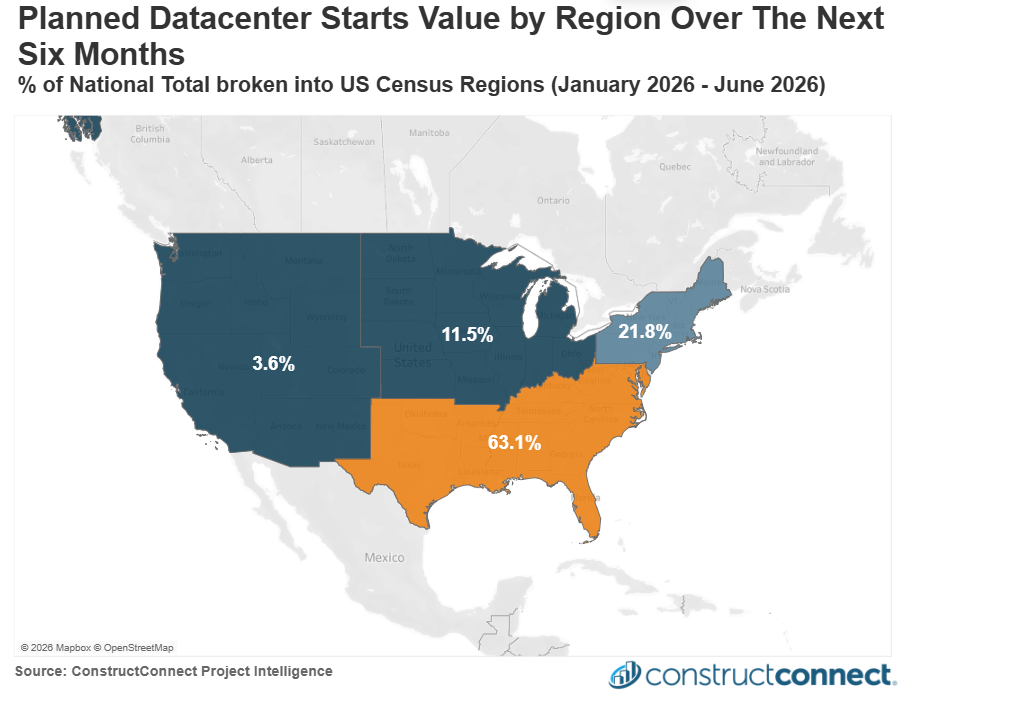
This map displays the regional distribution of total potential data center construction start values across the four US census regions over the next 6 months. Image and Data powered by ConstructConnect Project Intelligence
Power and Infrastructure Outlook
Investment in power infrastructure has become imperative to meet rapidly rising energy demand. ConstructConnect forecasts Power Infrastructure starts will reach $27.8 billion in 2026, a near-70% rebound from 2025’s lackluster total.
This level of investment is necessary, and power infrastructure spending is likely to remain elevated in the coming years.
Stay Connected
Stay connected with ConstructConnect News, your source for construction economy insights, market trends, and project news.
About ConstructConnect
At ConstructConnect, our software solutions provide the information that construction professionals need to start every project on a solid foundation. For more than 100 years, our keen insights and market intelligence have empowered commercial firms, building product manufacturers, trade contractors, and architects to make data-driven decisions, streamline preconstruction workflows, and maximize their productivity. Our newest offerings—including our comprehensive, AI-assisted software—help our clients find, bid on, and win more projects.
ConstructConnect operates as a business unit of Roper Technologies (Nasdaq: ROP), a constituent of the Nasdaq 100, S&P 500, and Fortune 1000.
For more information, visit constructconnect.com