KEY POINTS
-
General Motors’ headquarters move to Hudson’s Detroit supports adaptive urban renewal and anchors the city’s first major skyscraper in decades.
-
Developers delivered a structure with sustainable practices, blending modern amenities and design details inspired by GM’s 1956 Technical Center.
-
The move sparks a city-wide partnership to reimagine Detroit’s downtown, focusing on compact spaces and improved riverfront access that support modern urban development.
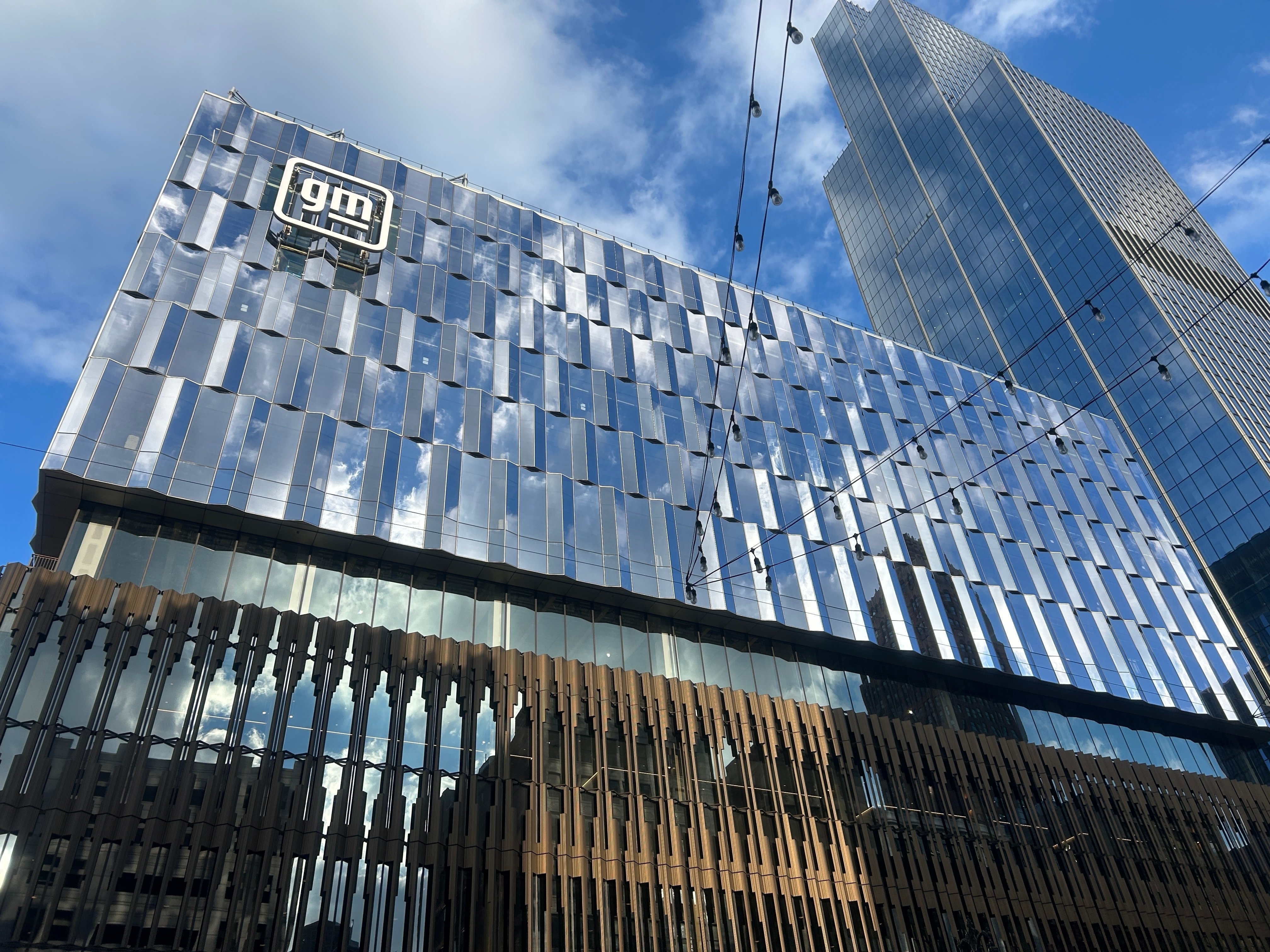
General Motors is making a landmark return to Woodward Avenue, opening its new global headquarters within the innovative Hudson’s Detroit development.
Announcing the new headquarters open for business on January 12, the company said, “Detroit is the beating heart of General Motors. It’s been that way since GM’s original Detroit home on Woodward Avenue opened in 1911. Today, we are returning to Woodward Avenue and launching a bold new era for the company.”
This location on Woodward Avenue brings the company full circle, returning to the area of its first headquarters (1911-1923) and serving as an anchor for Hudson’s Detroit, an initiative to revitalize downtown Detroit.
The company’s first Detroit headquarters, located on Woodward Avenue, was a small office at 127–129 Woodward Avenue, situated between Fort and Congress streets, and was used from 1911 to 1923.
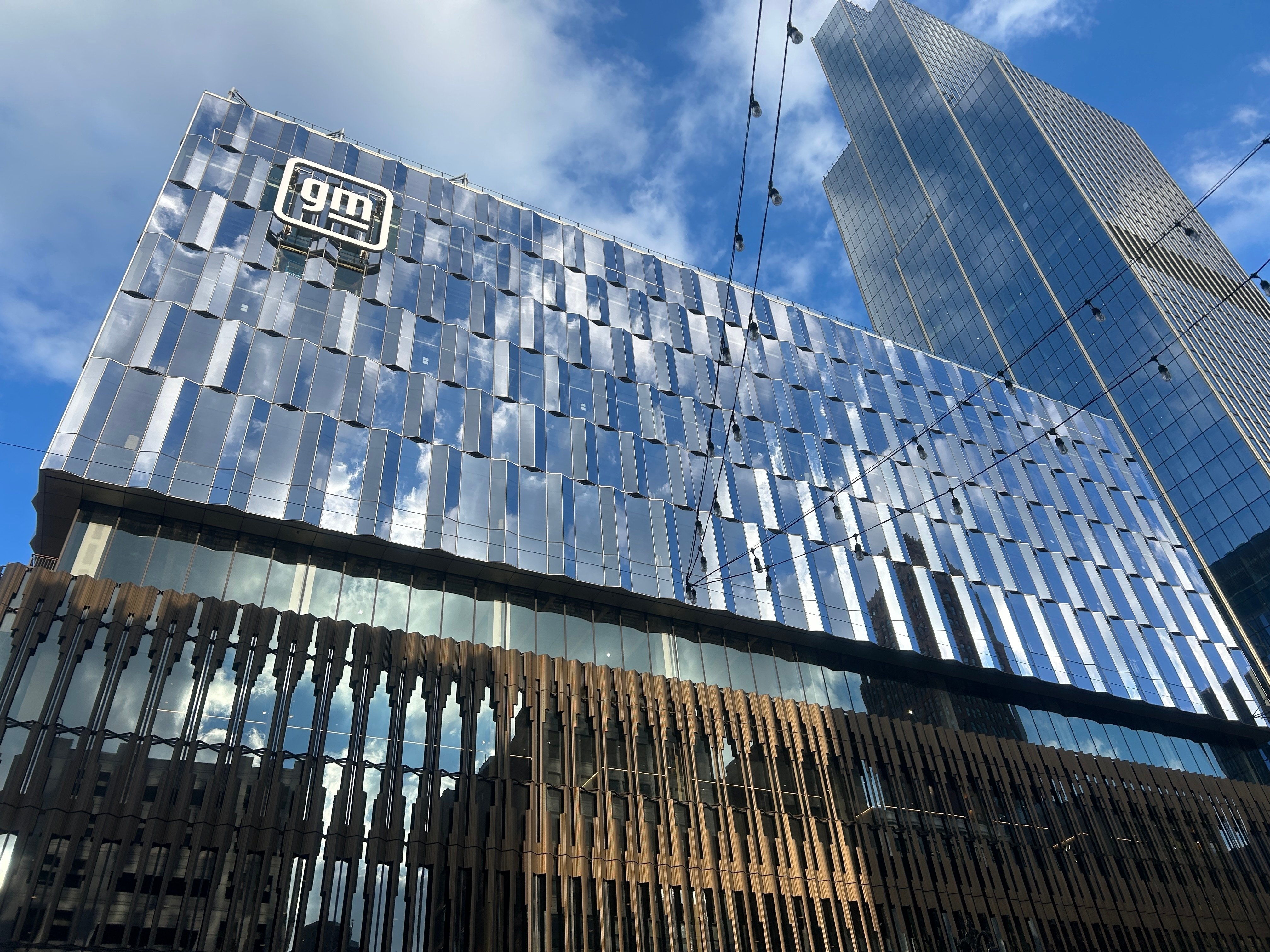
The new General Motors headquarters in Detroit, Michigan, marked its official opening on January 12, 2026. Image: Shutterstock
The relocation marks an important step in construction and design for GM, bringing together building methods, flexible workspaces, and sustainable features to support the company’s evolving needs.
For professionals in construction, development, and urban planning, this project serves as an example of adaptive reuse, complex engineering, and the revitalization of a historic city center.
The Scale of Hudson’s Detroit
The new GM headquarters occupies approximately 200,000 square feet across four floors of Hudson’s Detroit mixed-use development. Located on the historic site of the J.L. Hudson Department Store, this project marks a major milestone for the city, as it is the first significant skyscraper to be built in Detroit in decades.
Hudson’s Detroit, located at 1208 Woodward Avenue in the city’s Central Business District, spans over 1.5 million square feet. The project includes a 12-story low-rise and a 685-foot tower.
The mixed-use site will feature General Motors’ global headquarters, The Detroit EDITION hotel, luxury residences, retail spaces, restaurants, and public plazas designed to foster community engagement.
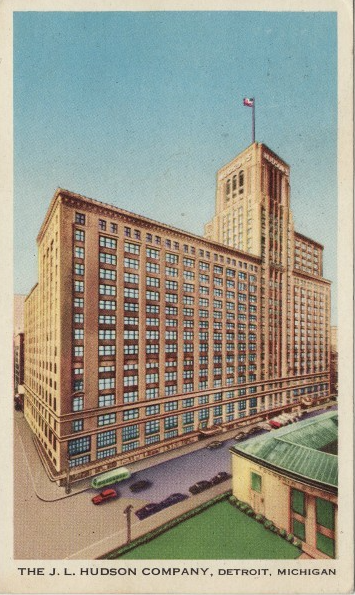
An undated postcard image shows the site of the former J.L. Hudson’s flagship department store on Woodward Avenue in downtown Detroit, Michigan. The Hudson’s building stood from 1923 until its demolition in 1998 and once anchored the city’s retail core. Today, the site is home to General Motors’ new global headquarters, a 200,000-square-foot office spanning four floors within Hudson’s Detroit mixed-use development. Image: Public domain
Developed by Bedrock and constructed by Barton Malow, it combines a 12-story office tower with ground-floor retail, event venues, a public plaza, and an adjacent 45-story tower for a hotel and residences.
Its development is a premier example of adaptive urban renewal designed to support the new era of hybrid work.
Site Development and Structural Details
Bringing the vision to life required an immense engineering effort. The project team transformed the historic space into a dynamic center that includes 650,000 square feet of office space.
At street level, retail spaces and a three-floor event venue called The Department are already activating the downtown core, having hosted events since late 2025.
Structural details:
-
Foundation: A total of 177 caissons were installed to provide a solid foundation for the structure.
-
Steel Framework: The office tower required 6,500 tons of steel (topped out in April 2022), with the total for the entire complex reaching 10,500 tons (topped out in April 2024).
-
Integrated Design: The construction allowed for a street-level rebuild that preserves downtown’s energy while integrating parking, rooftop bars, and sweeping city views.
The office space is already substantially leased to other major tenants, including the Rocket Community Fund, the Gilbert Family Foundation, Ven Johnson Law, and Accenture, creating a mixed business community.
Blending Modern Construction with Thoughtful Design
Barton Malow managed the project with a phased construction approach, starting with demolition and moving methodically through the installation of concrete cores and decks. The final stage involved sophisticated interior buildouts intended to provide a clear contrast to the famously complex layout of GM’s former home, the Renaissance Center.
The new workspace prioritizes intuitive navigation and employee well-being. A central glass atrium serves as the primary navigational point, while modern amenities, including pickleball courts and sports simulators, are incorporated to foster community and engagement.
Sustainability was a core principle of the design. The steel framing pays homage to the mid-century modern style of Eero Saarinen’s GM Technical Center, and large windows are used to maximize natural light.
The new facility also features efficient hybrid designs to accommodate the post-pandemic reality where around 80% of offices have embraced flexible work models, GM officials noted.
Honoring History in a Modern Space
GM’s new headquarters celebrates its rich legacy. The interior design draws significant inspiration from the company’s 1956 Technical Center. Both employees and visitors may recognize design elements, such as fluted wood, geometric lighting, and custom features, that reflect the brand’s past.
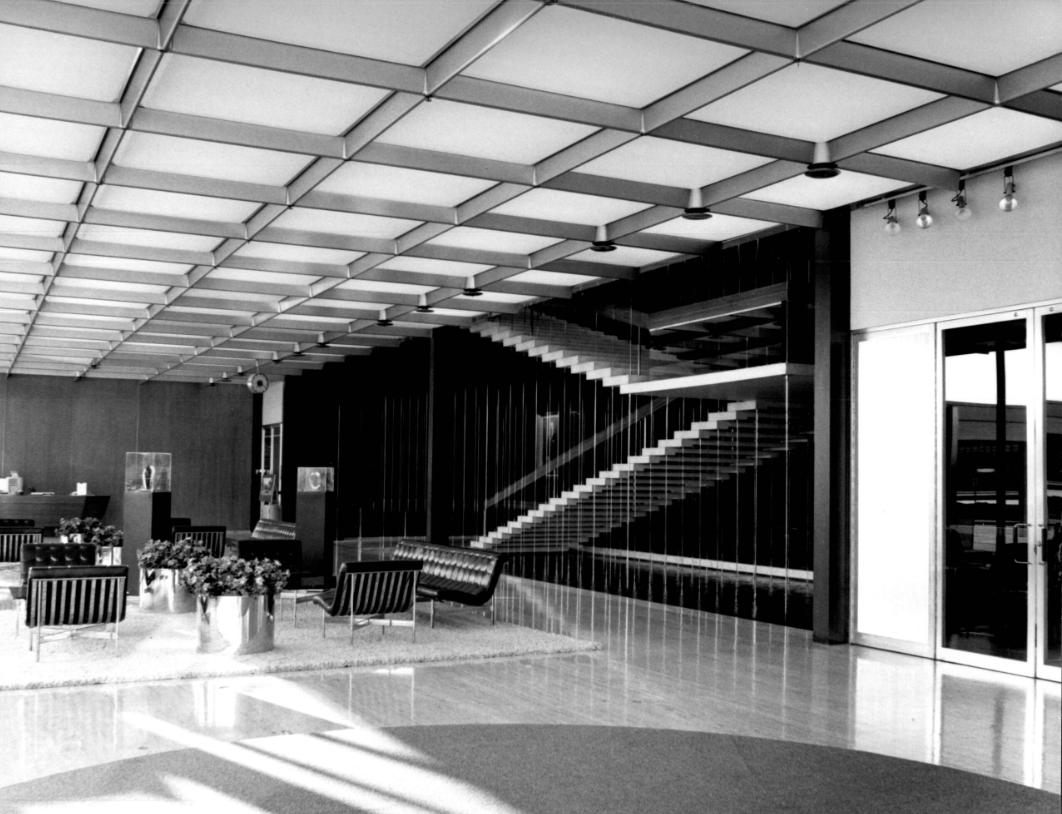
An undated interior image of General Motors Technical Center, which opened in stages from the 1950s to the 1970s, in Warren, Michigan, USA. It was designed by Eero Saarinen and Argonaut Realty, with landscaping by Thomas Church. GM’s new headquarters celebrates its rich legacy. The interior design draws significant inspiration from the company’s Technical Center. Image: Michigan Modern

Future of the Renaissance Center
The move also signals a new future for GM’s former headquarters, the Renaissance Center. GM’s departure from the 5.6-million-square-foot complex, where it had invested more than $1 billion since 1996, has catalyzed a collaborative partnership between GM, Bedrock, and the City of Detroit.
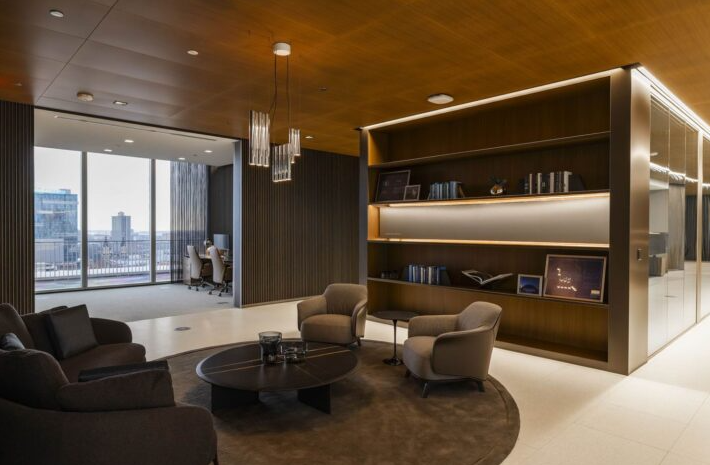
An interior image of the new General Motors headquarters. Image: General Motors
The transition marks the automaker’s strategic pivot away from vast, self-contained corporate campuses toward more compact, integrated footprints that promote collaboration. The partnership is now exploring a $1.6 billion redevelopment plan for the Renaissance Center site.
Early concepts suggest the potential demolition of some towers to create public green space and improve access to the celebrated Detroit RiverWalk.
A Build for GM and Detroit
The opening of the new headquarters at Hudson’s Detroit is also a defining moment for both General Motors and the city it calls home.
By choosing a smaller, more efficient, and deeply integrated workspace, GM is not only modernizing its own operations but also investing in the revitalization of the city’s streetscape.
For the construction and design industries, it demonstrates the increasing value placed on workspaces that are flexible, sustainable, and rich with historical character.
Stay Connected
Stay connected with ConstructConnect News, your source for construction economy insights, market trends, and project news.
About ConstructConnect
At ConstructConnect, our software solutions provide the information that construction professionals need to start every project on a solid foundation. For more than 100 years, our keen insights and market intelligence have empowered commercial firms, building product manufacturers, trade contractors, and architects to make data-driven decisions, streamline preconstruction workflows, and maximize their productivity. Our newest offerings—including our comprehensive, AI-assisted software—help our clients find, bid on, and win more projects.
ConstructConnect operates as a business unit of Roper Technologies (Nasdaq: ROP), a constituent of the Nasdaq 100, S&P 500, and Fortune 1000.
For more information, visit constructconnect.com