KEY POINTS
-
A wave of large manufacturing and data center projects, layered on top of steady population growth in Arizona, is translating into demand for Civil infrastructure.
-
State transportation plans, utility forecasts, and water and sewage treatment needs underscore a forecasted extended upswing in road, power, and water and sewage treatment construction as agencies look to match rising demand.
-
Arizona is emerging as a clear example of how industrial and data center megaprojects can reshape a region’s civil construction pipeline.
Arizona recorded a massive surge in manufacturing and data center construction starts in 2025. Manufacturing construction starts increased 84% year over year, driven largely by Taiwan Semiconductor Manufacturing Company breaking ground on a $25 billion fabrication plant in Phoenix.
Concurrently, the office category—which includes data centers—jumped 111% compared with the previous year.
The significant rise in commercial and industrial construction, together with ongoing population growth, is creating increased demand for infrastructure throughout Arizona. This demand is reflected in the state's Civil construction forecast for 2026, with anticipated growth in roads, power infrastructure, and water and sewage treatment.
Population Influx and Industrial Capital Drive a New Phase of Infrastructure Need
Demographic and industrial expansion drives Arizona's current infrastructure demand. According to state estimates, the state's population grew 13.6% over the past decade. This influx of residents, combined with massive capital investments in energy-intensive manufacturing and data centers, requires immediate expansion of the state's power grids, water systems, and road networks.
Ongoing support from the Infrastructure Investment and Jobs Act (IIJA) remains central to meeting Arizona’s infrastructure needs. The IIJA directs federal funding to power, water, road, and other essential infrastructure projects across the state, helping address pressures from rapid population and industrial growth.
Notably, the IIJA is scheduled to expire at the end of November 2026, although it is possible that a successor program could be established to sustain federal investment beyond that date.
Road Construction Forecasts Rise as State Commits to Long-Term Funding
Arizona currently faces significant road infrastructure challenges. According to an April 2026 report from TRIP, 53% of the state's major roads remain in poor or mediocre condition.
To address these deteriorating conditions and support the demands of rapid regional growth, the State Board of Transportation approved the Five-Year Transportation Facilities Construction Act. This initiative allocates $11 billion in targeted funding to upgrade roads, bridges, and airports between 2026 and 2030.
Driven by this new capital, road construction starts in Arizona are projected to reach $6.5 billion in 2026. Forecasts indicate these starts will continue to climb, remaining above $7 billion annually beyond 2027.
This represents a massive increase in investment, as Arizona road construction starts averaged just over $1.5 billion per year from 2021 through 2025.
Large-Load Customers Reshape Arizona’s Grid and Power Construction Outlook
Surging energy requirements from population growth and large-load commercial customers are fundamentally shifting Arizona's electrical grid needs. The recently formed Arizona Energy Promise Taskforce projects that the state’s utilities could face up to a 40% increase in peak demand over the next 15 years.
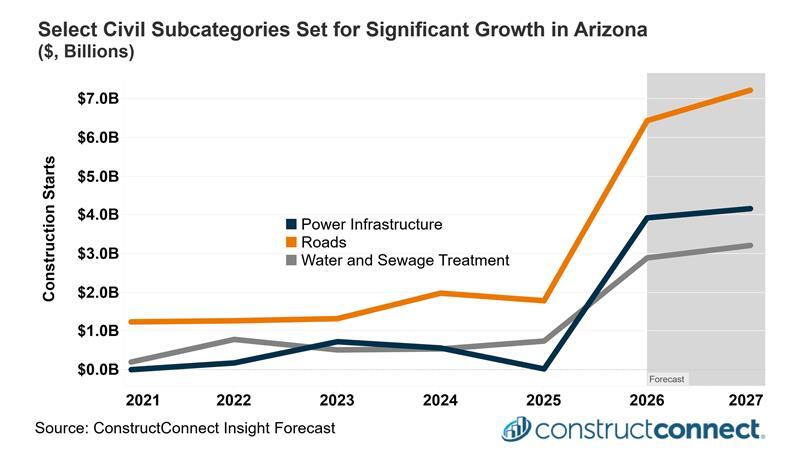
A chart is shown with select Civil construction subcategories forecast for significant growth in Arizona through 2027. Data powered by ConstructConnect Insight Forecast
Data centers and advanced manufacturing are major drivers of this growth. Arizona Public Service forecasts that between 2023 and 2038, data centers will add around 1,550 megawatts (MW) of peak demand. Over the same period, large industrial customers are projected to add another 690 MW of peak demand.
As a direct result of this sustained growth in large load customers and population, Arizona's power infrastructure starts are projected to reach $3.9 billion in 2026. Looking ahead, annual power construction starts are forecast to continue rising, reflecting the ongoing need to expand and upgrade the grid to accommodate increased demand.
Water and Sewage Work Projected to Accelerate to Match Arizona’s Rapid Expansion
Water and Sewage Treatment is the final major component of Arizona's 2026infrastructure expansion. Construction starts in this category are expected to nearly triple from 2025 levels, reaching a projected $2.9 billion in 2026.

This massive increase in spending stems from the same pressures driving the state's road and power grid expansions. A rapidly growing residential population, combined with water-intensive commercial operations like advanced manufacturing plants and data centers, requires a significantly larger utility footprint.
Momentum in this sector is expected to continue well past 2026. Forecasts indicate water and sewage treatment construction starts will grow an additional 11% in 2027 to keep pace with the state's expanding industrial and demographic needs.
What Arizona’s Civil Surge Means for Firms in Infrastructure Work
Record levels of manufacturing and data center construction, combined with strong population growth, have triggered substantial demand for civil infrastructure across Arizona.
This urgency translates directly to projected 2026 increases in road, power, and water and sewage treatment construction starts.
Arizona’s rising infrastructure demand, combined with new funding, is creating real opportunities for construction firms. The state’s experience also illustrates how megaprojects—such as large manufacturing plants and data centers—can quickly drive the need for new public infrastructure in a region.
Stay Connected
Stay connected with ConstructConnect News for construction industry news and construction market analysis to stay ahead of what’s building next.
About ConstructConnect
At ConstructConnect, our software solutions provide the information that construction professionals need to start every project on a solid foundation. For more than 100 years, our keen insights and market intelligence have empowered commercial firms, building product manufacturers, trade contractors, and architects to make data-driven decisions, streamline preconstruction workflows, and maximize their productivity. Our newest offerings—including our comprehensive, AI-assisted software—help our clients find, bid on, and win more projects.
ConstructConnect operates as a business unit of Roper Technologies (Nasdaq: ROP), a constituent of the Nasdaq 100, S&P 500, and Fortune 1000.
For more information, visit constructconnect.com