KEY POINTS
-
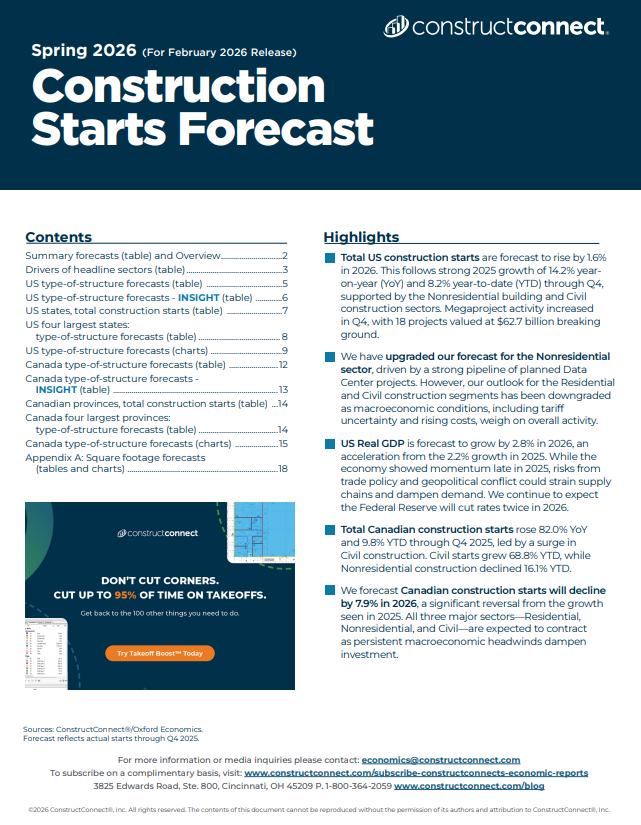
Total US construction starts are forecast to rise by 1.6% in 2026. This follows strong 2025 growth of 14.2% year-on-year (YoY) and 8.2% year-to-date (YTD) through Q4, supported by the Nonresidential building and Civil construction sectors.
-
Megaproject activity increased in Q4, with 18 projects valued at $62.7 billion breaking ground. We have upgraded our forecast for the Nonresidential sector, driven by a strong pipeline of planned Data Center projects.
-
Our outlook for the Residential and Civil construction segments has been downgraded as macroeconomic conditions, including tariff uncertainty and rising costs, weigh on overall activity.
As the macro environment continues to ebb and flow, we have downgraded our 2026 outlook for total US construction starts to a 1.6% increase. The Spring 2026 ConstructConnect Construction Starts Forecast, released today, is driven largely by a stabilizing investment outlook, which is weaker than what we expected at the beginning of 2025.
This middling outlook is largely due to higher costs and continued tariff uncertainty, which has delayed planned investment for all but the largest projects as businesses wait out the period of economic uncertainty. This impact will be felt across all three of the major sectors.
Residential construction is likely to be held back by continuing tight credit conditions, while Nonresidential building sectors will be harmed by depressed business demand for new structures. Civil construction is likely to be slightly more shielded but starts will still take a hit as groundbreakings are delayed.
What has become clear is that long-planned, very large investments have been relatively robust, highlighted by the continued performance of megaproject starts, while shorter-term and smaller investments have been delayed.
We anticipate Residential building starts will return to growth in 2026, now expected to expand 0.9%. Household headwinds seen earlier this year are likely to intensify, with inflation pressures persisting and mortgage rates offering little relief.
We expect Single-family housing starts to rise by 1.3%, while Multi-family starts are projected to stay mostly flat, increasing by 0.1%, as elevated financing costs continue to challenge builders and rising apartment vacancy rates raise concerns about excess capacity.
Nonresidential and Institutional Sectors: Driven by Megaprojects
Total Nonresidential Building activity is forecast to grow by 1.5% in 2026, an upgrade from our previous view. A fundamental driver of this growth is expected robustness in high-value megaprojects with long planning lead times, rendering them more likely to weather changing macroeconomic conditions.
Private Offices are an example where we predict strong growth in 2026 of 48.1%, due largely to exceptionally large megaprojects, mainly Data Centers. However, we think that such high levels of construction cannot and will not be sustained indefinitely; for this reason, we expect peak data center spending around 2029 and a modest decline thereafter.
Institutional construction is projected to decline by 3.9% in 2026, following the 5.4% contraction seen in 2025. Educational facilities (-10.6%), Religious buildings (-7.3%), and Police/Fire Stations (-4.2%) are set for the largest contractions. The biggest gains will be in the Hospitals/Clinics (11.8%), Prisons (8.6%), and Courthouses (8.4%) subsectors.
Commercial Construction: Large-Scale Developments Offset Constraints
Commercial construction is projected to grow by 18.1% in 2026, a slowdown from its performance in 2025. Persistently high interest rates and ongoing concerns about overcapacity in commercial real estate remain key constraints on new development. Nonetheless, several large-scale projects are expected to keep the sector in positive territory.
Strong growth is anticipated in Private Offices (48.1%) and Transportation Terminals (40.9%). The 48.1% growth in Private Offices is almost entirely due to a wave of Data Center developments. On the downside, notable declines are expected in governmental offices (-30.7%), Laboratories (-28.5%), and Amusement facilities (-11.6%).
Civil Construction: Continued Growth and Policy Priorities
Civil construction is expected to grow in 2026, continuing a period of strong performance but at a more moderate pace. In 2026, we anticipate contractions only in the airports and Dams/Canal/Marine subsectors.
Although Power investment faces political uncertainty, the sector remains a policy priority. Miscellaneous civil is projected to grow by 12.4%, while Power Infrastructure is expected to grow by 31.6%. The only other subcategory expected to grow at double-digit rates in 2026 is Bridges at 11.0%.
Read the latest quarterly Construction Starts Forecast Report to get a five-year forecast of construction starts by type of structure and by state, as well as drivers influencing each building sector.
About ConstructConnect
At ConstructConnect, our software solutions provide the information construction professionals need to start every project on a solid foundation. For more than 100 years, our insights and market intelligence have empowered commercial firms, manufacturers, trade contractors, and architects to make data-driven decisions and maximize productivity.
ConstructConnect is a business unit of Roper Technologies (Nasdaq: ROP), part of the Nasdaq 100, S&P 500, and Fortune 1000.
For more information, visit constructconnect.com