KEY POINTS
-
Brent Crude and West Texas Intermediate (WTI) are major oil benchmarks, differing in source, quality, and geographic exposure, with Brent serving as the global price reference.
-
Operation Epic Fury has disrupted oil markets, driving Brent and WTI prices higher due to concerns over Middle East supply stability.
-
Rising oil prices are likely to raise fuel prices and, with it, construction costs. Civil projects may be the most sensitive to rising diesel costs.
Around the world, different types of oil are pumped from the ground. As a result, there are several oil markets, and their prices reflect varying geographic exposure to different world events.
Brent vs. WTI: Key Differences in Oil Benchmarks
Two of the biggest oil markets trade in Brent Crude Oil and West Texas Intermediate or “WTI”. Both are classified as light, sweet crude oils suitable for refining into gasoline and diesel, yet they differ in source, quality, and location.
Brent crude is extracted from the North Sea, making it the benchmark for international, waterborne oil exports, while West Texas Intermediate (WTI) is produced in U.S. landlocked fields and serves as the primary US benchmark.
For these reasons, Brent’s price is often considered the global reference price. However, Brent’s greater global exposure to world events makes it more price-sensitive to the impacts of global conflict relative to WTI.
Operation Epic Fury and Its Ripple Effects on Fuel Prices
Operation Epic Fury, a large-scale U.S.-led military campaign launched in February 2026 against Iran, has generated significant concern around the stability of the Middle East’s oil supplies.
The potential destruction of production and or key supply chain infrastructure, including pipelines, hubs, and tanker ports, has driven the prices for both Brent and WTI crude significantly higher since last week.
The latest trading data point to both WTI and US national average diesel prices rising to multi-year highs.

A chart shows U.S. Diesel Retail sales prices and the Producer Price Index (Net inputs to construction industries, goods). Rising oil prices are likely to raise fuel prices and, with it, construction costs. Civil projects may be the most sensitive to rising diesel costs. Image: ConstructConnect
Diesel Fuel Prices
Diesel fuel prices are released by the Energy Information Administration each Tuesday. The last weekly reading was released on March 2nd, 2026, and reported diesel fuel’s price at $3.89 per gallon. AAA’s daily report for March 5th cited diesel at $4.17 per gallon.
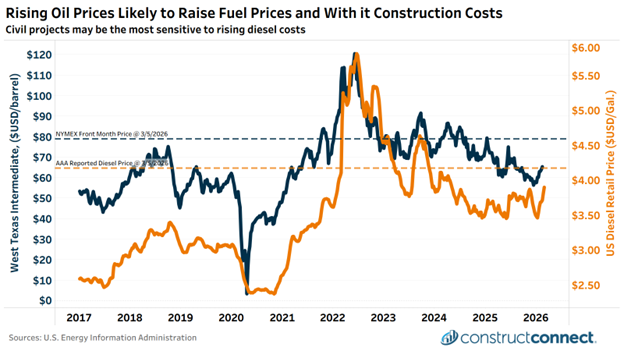
A chart shows West Texas Intermediate oil prices and US Diesel Retail prices. The last weekly reading was released on March 2nd, 2026, by the Energy Information Administration, and reported diesel fuel’s price at $3.89 per gallon. AAA’s daily report for March 5th cited diesel at $4.17 per gallon. Image: ConstructConnect
Historically, large swings in diesel prices have been correlated with similar, though smaller, moves in construction goods prices. Looking more broadly, rising fuel prices will directly affect transportation costs, which will spill over to all goods that require transportation.
Heavy, bulk goods in particular will be more impacted by higher fuel costs. Civil projects that involve significant amounts of heavy, high-volume materials, such as aggregate or concrete, will be disproportionately affected.
Stay Connected
Stay connected with ConstructConnect News for construction industry news and construction market analysis to stay ahead of what’s building next.
About ConstructConnect
At ConstructConnect, our software solutions provide the information that construction professionals need to start every project on a solid foundation. For more than 100 years, our keen insights and market intelligence have empowered commercial firms, building product manufacturers, trade contractors, and architects to make data-driven decisions, streamline preconstruction workflows, and maximize their productivity. Our newest offerings—including our comprehensive, AI-assisted software—help our clients find, bid on, and win more projects.
ConstructConnect operates as a business unit of Roper Technologies (Nasdaq: ROP), a constituent of the Nasdaq 100, S&P 500, and Fortune 1000.
For more information, visit constructconnect.com