KEY POINTS
-
Google is developing a second Georgia data center in LaGrange on a 270‑acre, utility‑ready site off I‑85, expanding beyond its existing Douglas County campus and reinforcing the state’s role as a Southeast hub for hyperscale cloud infrastructure.
-
The LaGrange facility is expected to provide an infrastructure catalyst, with Google funding 100% of site power and related upgrades.
-
The LaGrange project highlights the continued expansion of hyperscale data center infrastructure in the Southeast, particularly along major corridors with access to power and water resources.
Google plans to build a new data center at 411 Pegasus Parkway in LaGrange, creating a second major cloud facility in Georgia, and adding to its existing presence in the state in Douglas County’s Lithia Springs, according to Atlanta News First.
The company announced the project Tuesday in coordination with the City of LaGrange and local development officials. The Troup County facility, located just off Interstate 85, is already under construction and will support core Google services including Search, Maps, YouTube, and other digital platforms.
Key Construction Takeaways
The LaGrange project underscores the continued expansion of hyperscale data center infrastructure in the Southeast, particularly along major interstate corridors with access to high‑voltage power and water resources.
ConstructConnect Chief Economist Michael Guckes wrote recently, that, "The general perception is that AI will fundamentally change how companies and people work and live in the years to come.
"Enabling this transition will require a global network of data centers, whose investment value through 2030 is presently estimated at trillions of dollars. The U.S. is expected to capture around 40% of this spending."
The Google announcement, part of the global data center investment surge, may provide opportunities for construction firms in multiple areas, including:
Site Scale and Readiness
The 270‑acre Pegasus Parkway property with an existing large shell building and substation capacity suggests a multi‑phase buildout, opening the door for bid opportunities in civil, structural, MEP, and fit‑out scopes as Google scales capacity.
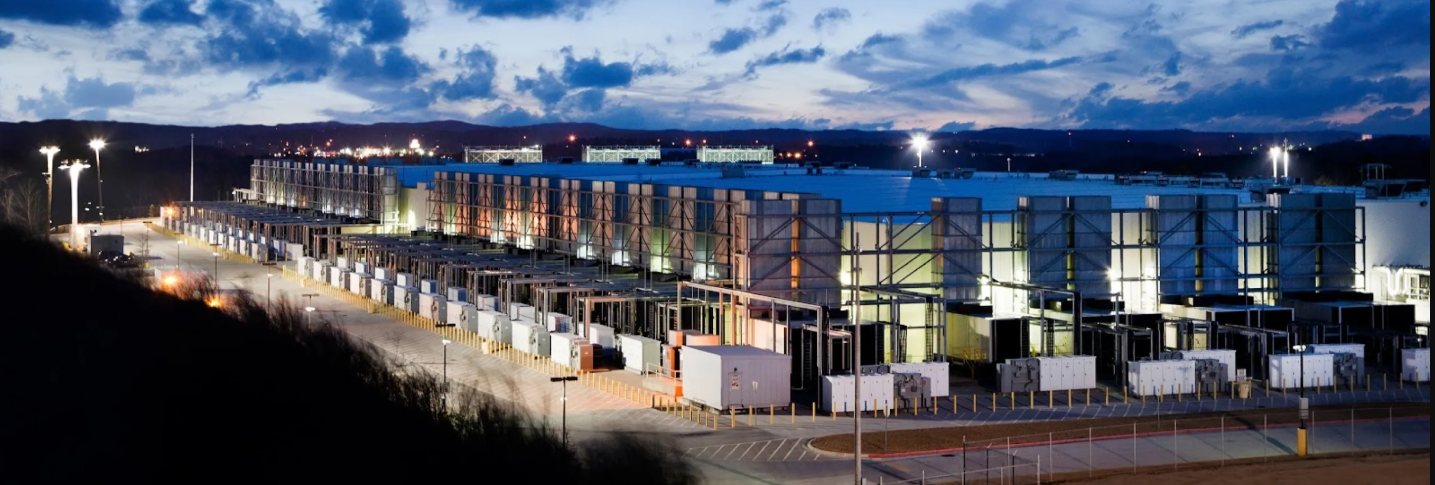
A Google data center image. The company announced it would build a second Georgia data center to support core Google services including Search, Maps, YouTube, and other digital platforms. Image: Google
Utility and Infrastructure Work
Google’s commitment to fully fund power and related infrastructure, plus city‑level goals to reduce pressure on electric rates, suggests significant investment in substations, transmission upgrades, and on‑site distribution systems, along with associated roadway and site‑work packages.
Sustainability and Water Systems
With corporate focus on energy efficiency, water reuse, and watershed resilience, contractors should expect specifications emphasizing high‑efficiency cooling, water treatment, and stormwater management, drawing on lessons from Douglas County’s facility.
Data Centers Reshaping Infrastructure and Construction
The LaGrange data center now joins a growing list of large‑scale data infrastructure projects reshaping utility loads and construction pipelines across the country, as ConstructConnect and building industry trade publications reported.
ConstructConnect economists Michael Guckes and Devin Bell said in the April 2026 Data Center Report, that U.S. data center construction starts in the, "South Central states, spanning from Texas to Alabama, collectively received $43.3 billion in new starts over the past 12 months."
"The Midwest, encompassing Illinois through Pennsylvania, followed with $31.2 billion, while the Southeast Seaboard states, from Virginia to Florida, accounted for $28.0 billion."
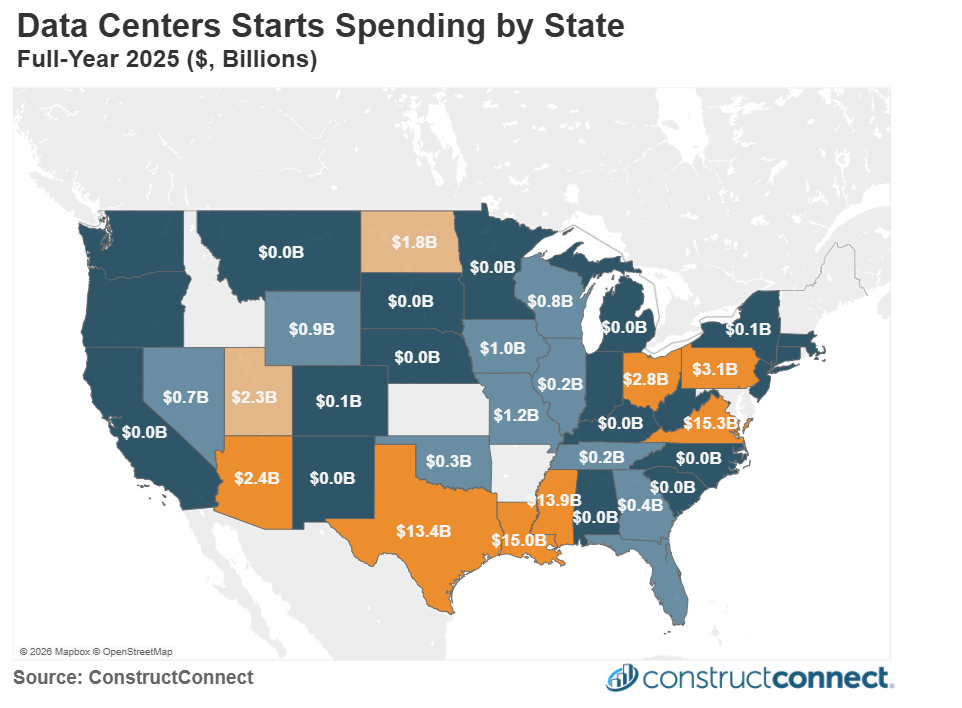
The April 2026 Data Center Report noted that in February 2026, $11.5 billion in data center starts spending was less than half of January’s record-breaking figure. Yet, it still ranks as the sixth-highest monthly total since recordkeeping began in January 2020. Shown in a US map above, the 12-month moving average for datacenter starts spending in $, billions. Image and Data: ConstructConnect
Filling a Power and Infrastructure Gap
City leaders are positioning the data center as a replacement power load and infrastructure anchor following the 2024 closure of Jindal Films Americas LLC, formerly LaGrange’s largest electric customer.
“Google’s decision to locate here fills a vital void in our utility system left by the closing of our largest electric customer,” LaGrange City Manager Patrick Bowie said in a statement. “We are working with their team to invest in infrastructure improvements that will benefit all utility customers while exerting downward pressure on rates.”
Google says that when it builds data centers, it covers 100% of the cost of power at the site and any infrastructure needs driven by its operations, rather than passing those costs on to local ratepayers.
The LaGrange site itself has been positioned for data center use for several years. Industry reporting notes that 411 Pegasus Parkway comprises roughly 270 acres with an existing 500,000-plus square‑foot facility and a dedicated substation capable of significant power delivery, making it suitable for rapid deployment as a large‑scale data campus.
Economic Impact and Georgia Footprint
Google has been operating in Georgia for nearly two decades, with its Douglas County data center forming the centerpiece of its in‑state infrastructure.
The company estimates that its Georgia data center represent $1.2 billion in cumulative capital investment, contributing roughly $1.5 billion annually to Georgia’s GDP and generating about $941 million in yearly labor income.
“Our newest investment in LaGrange represents another chapter in our deep partnership with Georgia — a state that continues to lead with innovation and vision,” said Jen Ryan, Google’s regional head of data center public affairs.
“More than just building a data center, our goal is to be a good neighbor, and that starts on day one by investing in local priorities, creating opportunities, and working with residents to build a strong future together.”
T. Scott Malone, president of the Development Authority of LaGrange, framed the project in terms of digital and AI‑driven growth. “Google’s investment in LaGrange is a testament to our community’s leadership and commitment to the AI economy,” Malone said.
“Building the infrastructure necessary to thrive in the AI economy will be critical to our future success, and we are thrilled to have a partner like Google to help lead the way.”
Energy‑Efficiency and Water Commitments
As part of the announcement, the company reiterated its corporate commitment to “replenish more freshwater than it consumes” in its operations.
In Georgia, that includes a partnership with the Trust for Public Land to remove invasive plants along the Chattahoochee River, a move intended to protect local ecosystems and improve water availability.
Google already operates its Douglas County data center using a recycled municipal wastewater cooling system, a precedent the company points to as it expands capacity in LaGrange.
Local Energy Affordability Program
Google is providing $1 million to support Groundswell’s SOUL® (Save On Utilities Long‑term) program, a nonprofit initiative focused on utility affordability to address energy usage from the project.
Groundswell CEO Michelle Moore said the funding will underwrite critical home repairs and energy‑efficiency upgrades for at least 50 LaGrange families, helping lower long‑term utility bills and preserve homeownership in the community.
Stay Connected
Stay connected with ConstructConnect News for construction industry news and construction market analysis to stay ahead of what’s building next.
About ConstructConnect
At ConstructConnect, our software solutions provide the information that construction professionals need to start every project on a solid foundation. For more than 100 years, our keen insights and market intelligence have empowered commercial firms, building product manufacturers, trade contractors, and architects to make data-driven decisions, streamline preconstruction workflows, and maximize their productivity. Our newest offerings—including our comprehensive, AI-assisted software—help our clients find, bid on, and win more projects.
ConstructConnect operates as a business unit of Roper Technologies (Nasdaq: ROP), a constituent of the Nasdaq 100, S&P 500, and Fortune 1000.
For more information, visit constructconnect.com