KEY POINTS
-
ConstructConnect's Quarterly U.S. Put-in-Place Construction Forecast Report for Spring 2026 holds its total spending outlook at $2.27 trillion, with 5.1% year-on-year growth projected for 2026.
-
An AI-fueled "investment supercycle" in data center construction reshapes the Private Office forecast, with spending expected to surge 25.2% in 2026, reaching a cumulative $659.3 billion through 2030.
-
The modest changes observed in the total construction outlook mask a substantially improved outlook for nonresidential building growth, offset by a weaker near-term residential outlook.
ConstructConnect released its Quarterly U.S. Put-in-Place Construction Forecast Report for Spring 2026 that reveals a construction industry navigating a complex cross-current, including a once-in-a-generation data center investment boom lifting nonresidential building.
Meanwhile, higher costs, tighter labor markets, and shifting interest rate expectations temper the near-term residential outlook.
The total spending forecast holds steady at $2.27 trillion, but the composition of that growth has shifted significantly since our last report.
Economic Outlook
At the start of the year, we projected real GDP growth of 2.8% in 2026 and 2.4% in 2027, up from a prior forecast of 2.1% for 2026. However, since the Iran War we have lowered our forecast to 1.9% growth in 2026.
The full inclusion of the One Big Beautiful Bill (OBBB) will act as a tailwind as fiscal spending and tax cuts propel further near-term national economic growth. Conversely, higher oil and material prices will encumber our forecast, making construction more expensive.
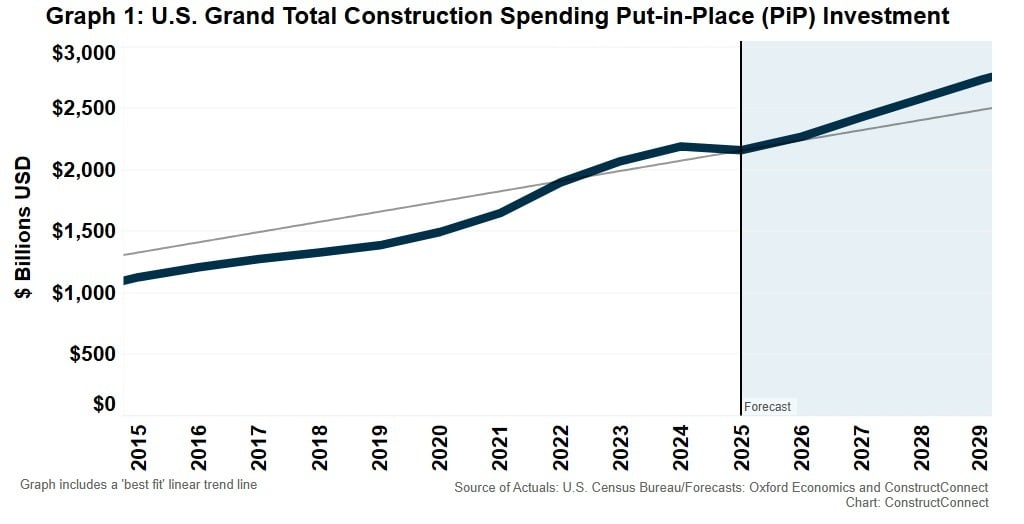 Shown in the image above is ConstructConnect's Quarterly U.S. Put-in-Place Construction Forecast Report for Spring 2026. The chart shows the total Put-in-Place construction spending outlook at $2.27 trillion, with 5.1% year-on-year growth projected for 2026. Image: ConstructConnect
However, the widening dispersion between US and European energy prices as a result of the Iran War will give US manufacturers a new cost competitiveness against some of their foreign competitors.
Additionally, the Congressional Budget Office has reduced its latest population growth projections, implying that the nation's ingrained labor challenges will only become more difficult. All of these factors will accelerate construction cost inflation.
The overall impact of the booming demand for AI products is likened by many industry experts to the dot-com boom of the late 1990s and early 2000s. The general perception is that AI will fundamentally change how companies and people work and live in the years to come.
Enabling this transition will require a global network of data centers, whose investment value through 2030 is presently estimated at trillions of dollars. The U.S. is expected to capture around 40% of this spending.
Beginning with the 1Q2026 starts and put-in-place forecasts, ConstructConnect's construction outlooks now reflect what we believe this "investment supercycle" means for the U.S. and Canadian construction industries.
Construction Spending Projections
Our outlook for total put-in-place construction spending for 2026 remains unchanged at $2.27 trillion. The new outlook projects year-on-year growth of 5.1% in 2026, rising to a peak of 7.0% in 2027. Growth rates in 2028 and 2029 have been revised upward by approximately 1% annually from our last forecast.
The modest changes observed in the total construction outlook mask a substantially improved outlook for nonresidential building growth, offset by a weaker near-term residential outlook.
Nonresidential Building
The outlook for Nonresidential Building (NRB) has been upgraded considerably since our last report. NRB 2026 construction is anticipated to grow by 6.5%, up from 5.7%. Powering much of this growth is Private Offices, which includes the majority of data center activity.
The impact of the investment boom is most evident in our Private Office subcategory forecast, which captures data center construction as well as traditional offices.
The magnitude of this expected future spending will not only drastically reshape our Office spending outlook but also notably raise our Total Commercial and Total Nonresidential Building outlooks.
Within Private Offices, our new forecast calls for 25.2% growth in 2026, 14.8% in 2027, and 7.4% in 2028.
Total put-in-place spending will rise from just under $90 billion in 2025 to a peak of $144 billion in 2029. In the five-year period ending 2030, private office cumulative spending is forecasted to total $659.3 billion. When compared to our prior forecast, which ended in 2029, we now expect 50% greater spending in the overlapping period.
Power Infrastructure will also benefit from the tailwinds of strong data center construction. Our new forecast expects growth of 13.3% and 13.9% in 2026 and 2027, respectively. Annual spending over the next five years will increase by 60%, or by 9.8% on an annually compounded basis.

Civil Construction
Civil construction in 2025 rose by 2.7%, beating our prior expectation of a 2.0% decline. In 2026, civil spending is expected to increase by 8.1% and thereafter moderate to a rate of 4.4% in 2030.
Our latest five-year forecast predicts total spending in 2030 of $666 billion, an increase of 33%, or 5.9% compounded annually over the next five years.
Riding the wave of interest in data center construction, put-in-place power and communications activity is expected to grow by more than 8% annually between 2026 and 2029. Unfortunately, Sewage/Waste Disposal & Water Supply is expected to face a significant contraction in 2026 and 2027, sending its five-year CAGR to a negative 1.5%.
Residential Construction
Housing affordability is slowly improving, with wages and disposable income growing faster than the average national home price. Furthermore, 30-year mortgage rates have declined by almost 1% since the start of 2025. However, higher inflation rates driven by geopolitical events and legislative actions have recently pushed expected interest rates higher, including for mortgages.
These headwinds have contributed to a new 2026 total residential outlook that expects only 2.3% growth, a figure that is down substantially from our prior forecast of 9.7%. In the mid and far segments of our forecast, we continue to anticipate a strong turnaround in residential activity, with consecutive years of 8% growth through 2029.
Private vs. Public Sector
Our forecast continues to favor the private sector, with a five-year CAGR of 5.8% — an increase of more than 1% since our last outlook. Our comparable public-sector outlook of 1.3% is an improvement over the negative CAGR outlook in our prior forecast; however, much of this outlook is highly dependent upon solid activity growth in 2028 and 2029.
Stay Connected
Stay connected with ConstructConnect News for construction industry news and construction market analysis to stay ahead of what’s building next.
About ConstructConnect
At ConstructConnect, our software solutions provide the information that construction professionals need to start every project on a solid foundation. For more than 100 years, our keen insights and market intelligence have empowered commercial firms, building product manufacturers, trade contractors, and architects to make data-driven decisions, streamline preconstruction workflows, and maximize their productivity. Our newest offerings—including our comprehensive, AI-assisted software—help our clients find, bid on, and win more projects.
ConstructConnect operates as a business unit of Roper Technologies (Nasdaq: ROP), a constituent of the Nasdaq 100, S&P 500, and Fortune 1000.
For more information, visit constructconnect.com