KEY POINTS
-
Construction firms are facing headwinds from several directions, with labor, materials, energy and financing all putting pressure on budgets and margins.
-
Tightening macroeconomic conditions show little signs of easing, meaning challenges could extend for a period of time.
-
Headline growth is still strong, however much of this growth is supported by megaprojects while conditions remain more uneven across geographies and subcategories.
Construction has likely become more complex for owners, contractors, and suppliers across the industry.
Persistent inflation has reduced the likelihood of near-term rate cuts, keeping financing costs elevated. Material and energy prices have risen, and labor has become more expensive and harder to find.
Construction spending has been up since last year, but large-value projects are consuming a growing share of construction starts, concentrating activity at the top end of the market.
In this environment, firms that manage labor and material costs closely while targeting the categories and geographies where starts are growing will be best positioned to protect margins and find opportunities.
Macroeconomic Factors Compound Pressure
Macroeconomic factors have played a significant role in tightening conditions in the construction industry. Tariffs on key trading partners have pushed material prices higher, tighter immigration enforcement has squeezed the labor supply, and conflict in the Middle East has driven energy prices up as shipping through the region remains disrupted.
Compounding those factors, rate relief has not materialized to ease those pressures. At the start of 2026, many expected the Federal Open Market Committee (FOMC) to cut the Federal Funds Rate multiple times over the course of the year.
However, persistent inflation has since narrowed those expectations. The CME Group's FedWatch tool now puts a 34.6% chance on a rate hike at the September meeting, with no expectation for a cut. That leaves firms facing elevated financing costs with the possibility of rates moving even higher before they fall.
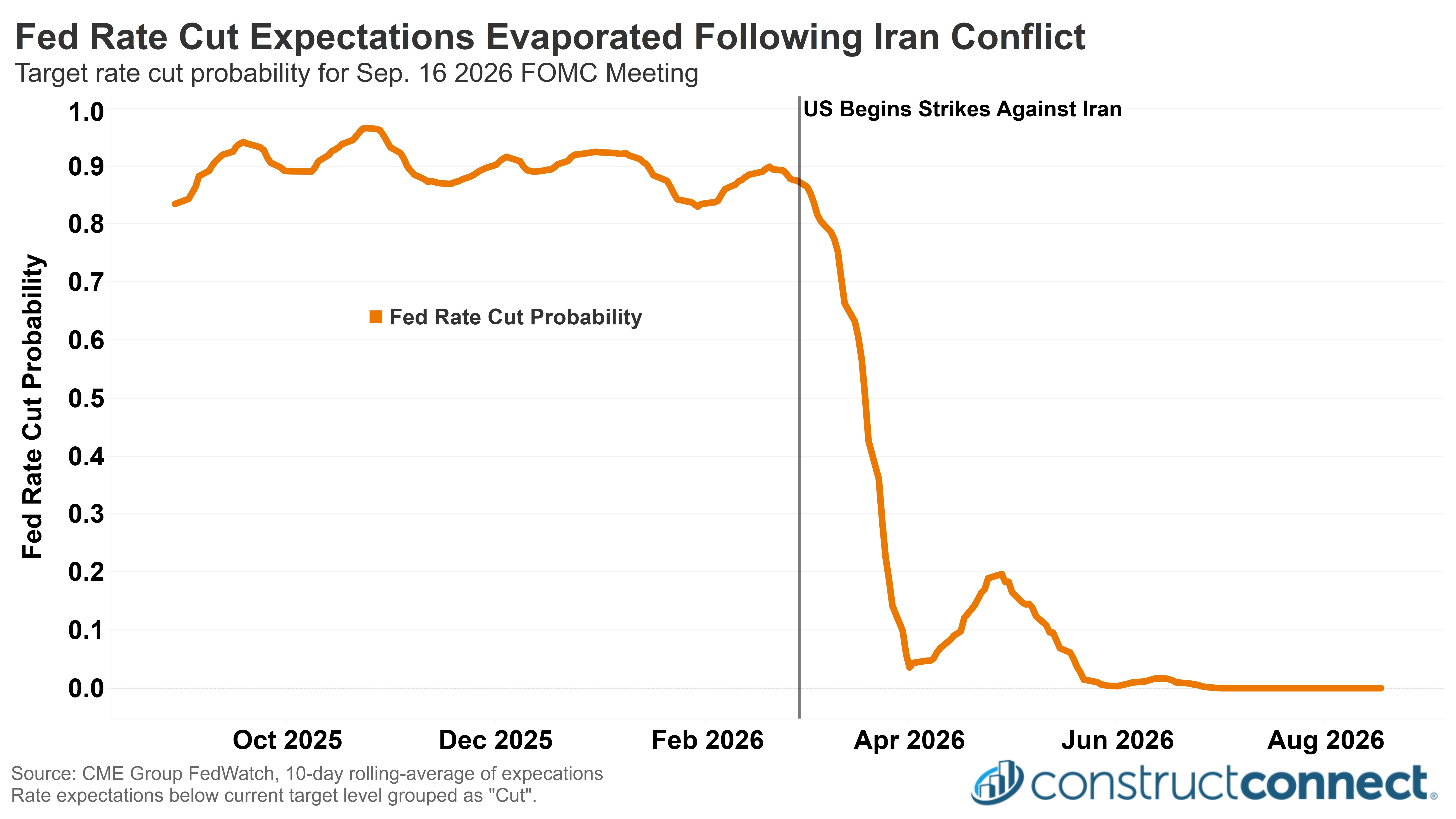
At the start of 2026, many expected the Federal Open Market Committee (FOMC) to cut the Federal Funds Rate multiple times over the course of the year. The CME Group's FedWatch tool now puts a 34.6% chance on a rate hike at the September meeting, with no expectation for a cut. Image: ConstructConnect
Construction Material Prices Jump
Not only have those external factors weakened the chances of interest rate relief, they have also helped drive a 9% increase in construction material prices in June 2026, the fastest year-over-year (YoY) growth rate since late 2022. The increase has been sharper for some materials, with steel up 22.5% YoY, copper up 26.2%, and aluminum up 40.5%.
Inflation can squeeze some in the industry, especially those with fixed-price contracts. In this case firms must honor their commitments while absorbing costs that have climbed sharply, squeezing margins. Firms like these should be looking to negotiate escalation clauses into contracts or lock in material pricing early to protect against further increases.
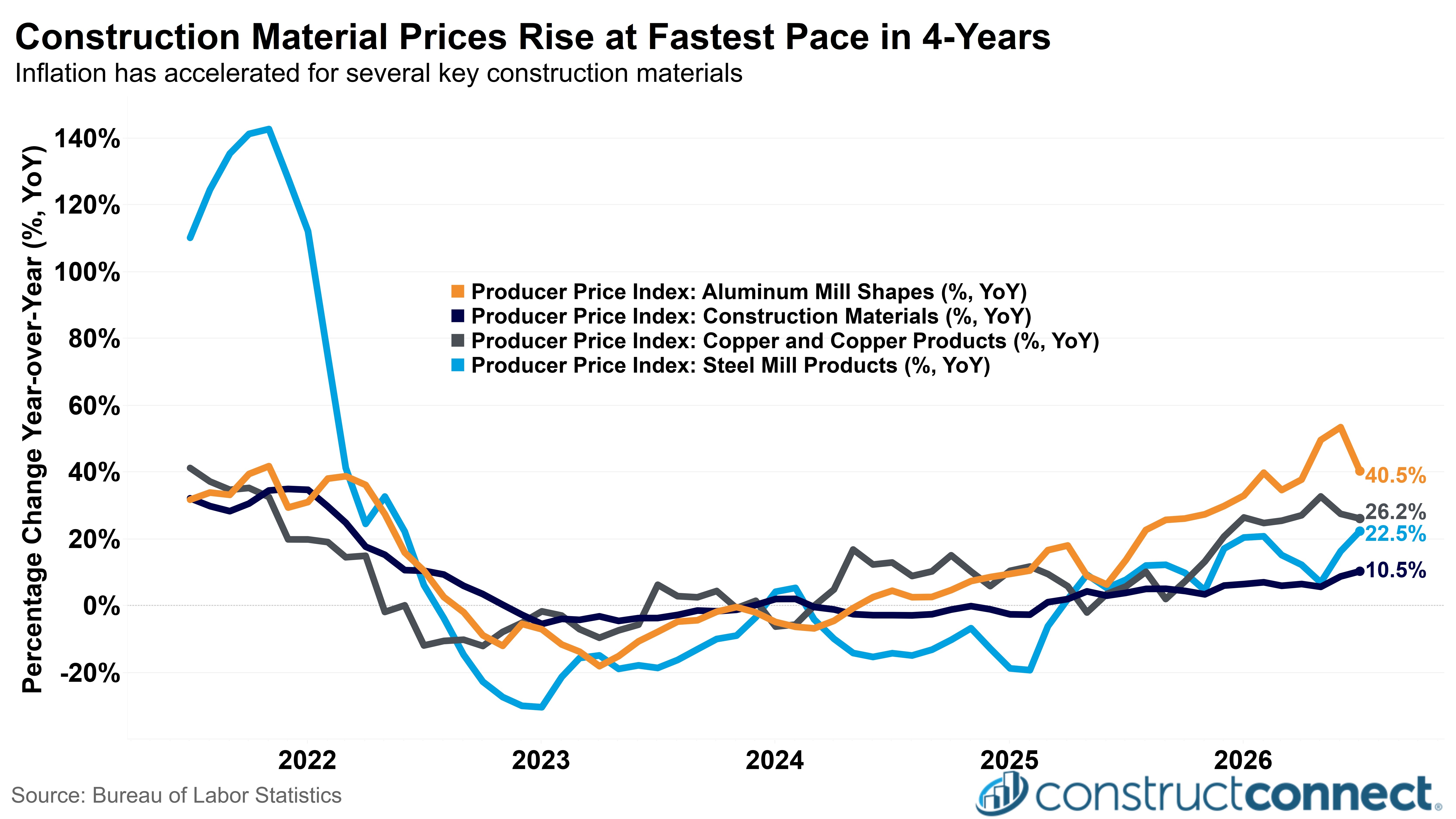
A chart shows that price inflation has accelerated for a number of key construction materials. Image: ConstructConnect
Labor Picture Compounds Cost Pressure
Labor costs and availability add to the pressure facing the industry. Immigration enforcement, which intensified under the Trump administration in early 2025, has tightened the construction labor pool. This has acutely affected construction, as roughly 30% of the industry's workforce is foreign-born. Even though many of those workers may be authorized, the enforcement climate will likely continue to slow growth in the construction labor supply.
Decreased availability of labor has coincided with steadily rising labor costs as well. Hourly construction wages have risen 4.4% since July 2025, outpacing the broader private sector's 3.2% increase. The rising average hourly earnings, paired with higher available hours, creates a noticeable gap in weekly pay. Weekly average construction wages sit at $1,625, a $334 premium, or 25.9%, above the $1,291 average across the broader private sector.
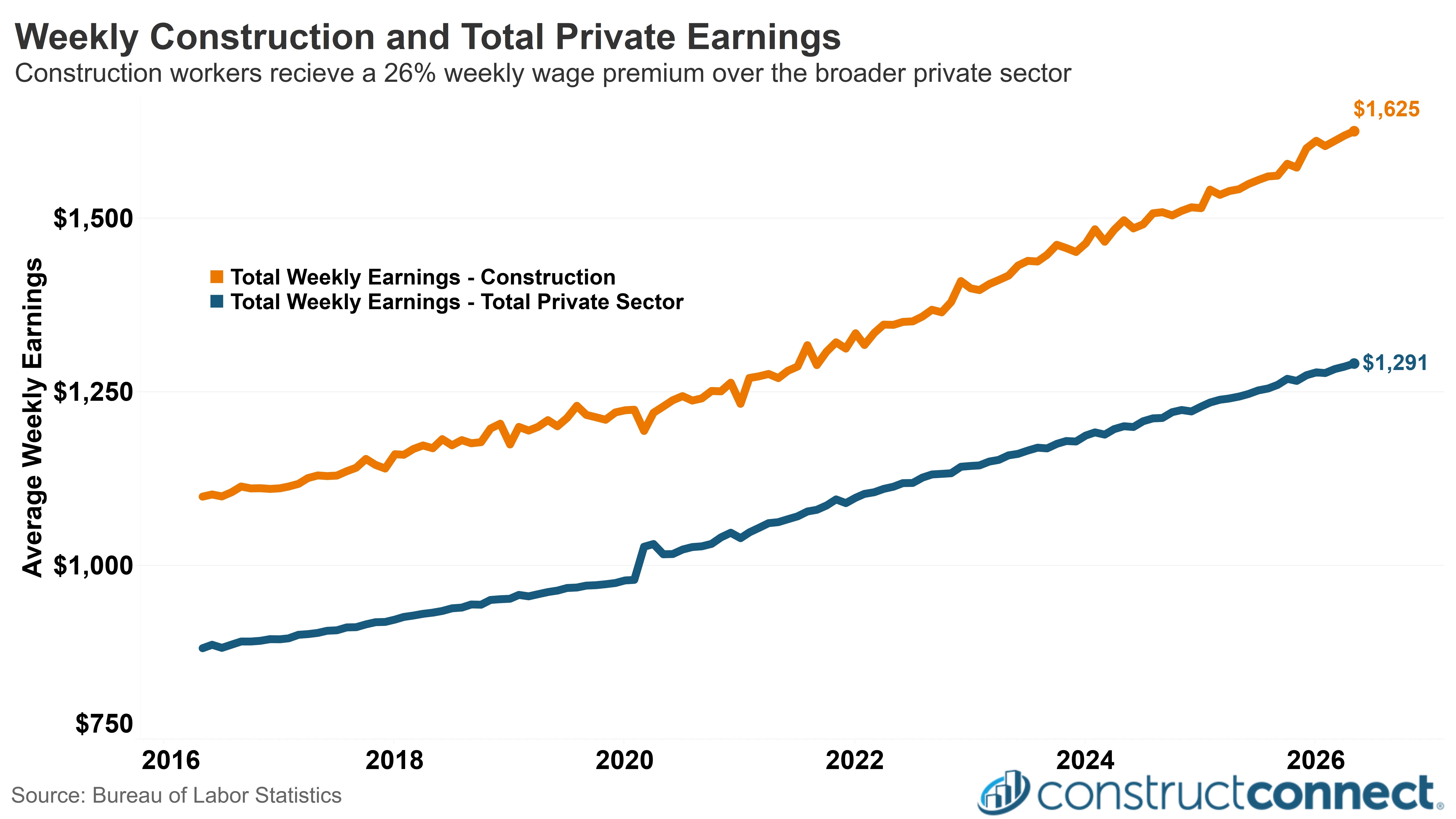
A chart of weekly average construction wages through June 2026 shows they reached $1,625, a $334 premium, or 25.9%, above the $1,291 average across the broader private sector. Image: ConstructConnect
In this environment where labor supply is tight and construction wages already outpace the broader private sector, the cost of losing workers compounds quickly. That means firms that develop and retain their workforce will be better positioned than those that are forced to recruit and train in a constrained and expensive labor market.
Growth Is Real, But Not Even
Despite tough macroeconomic conditions, Total Nonresidential U.S. construction starts are up 16.6% year-to-date through the end of June 2026.
However, megaprojects, defined as developments with start values exceeding $1 billion, account for much of that growth. They now make up roughly 25% of all Nonresidential spending, up from around 15% at the same point in 2024.
This means the headline gain is concentrated in a small number of very large projects rather than spread broadly across the market. Large-scale projects typically go to firms with the capacity to manage them, leaving the rest of the market competing for a smaller share of the work.
Careful Planning is a Complexity Antidote
Construction is facing pressure from multiple directions that add complexity to doing business. Financing costs remain high with little sign of relief, material and energy prices have climbed, construction labor carries a significant wage premium, and growth is narrower than the headline figure suggests.
These conditions suggest construction firms plan carefully to counteract complexity. Firms should consider escalation clauses or locked-in pricing to guard against further material cost increases, invest in training and developing their workforce to avoid steep hiring and retraining costs, and target the categories and geographies where growth is most active.
Stay Connected
Stay connected with ConstructConnect News for construction industry news and construction market analysis to stay ahead of what’s building next.
About ConstructConnect
At ConstructConnect, our software solutions provide the information that construction professionals need to start every project on a solid foundation. For more than 100 years, our keen insights and market intelligence have empowered commercial firms, building product manufacturers, trade contractors, and architects to make data-driven decisions, streamline preconstruction workflows, and maximize their productivity. Our newest offerings—including our comprehensive, AI-assisted software—help our clients find, bid on, and win more projects.
ConstructConnect operates as a business unit of Roper Technologies (Nasdaq: ROP), a constituent of the Nasdaq 100, S&P 500, and Fortune 1000.
For more information, visit constructconnect.com