KEY POINTS
-
Texas Gov. Greg Abbott directed regulators to audit all data center projects moving through ERCOT’s interconnection queue, and no project can move forward until that review is complete.
-
State officials say ERCOT is weighing about 474 gigawatts of proposed grid connections and about 90 percent of the new power requests are tied to data centers.
-
Developers will have to document power plans, water use, cooling systems, public incentives, community protections and ownership details or risk being denied grid access.
Texas is putting a new gate in front of one of the state’s fastest-growing construction markets.
Gov. Greg Abbott ordered a comprehensive verification and audit of all data center projects advancing through the interconnection process in an Aug. 3 press release and an accompanying directive letter to the Public Utility Commission of Texas (PUCT) and grid manager Electric Reliability Council of Texas (ERCOT).
The order says the review must be completed before any data center project moves forward and that projects failing to comply with PUCT, ERCOT and state-law requirements must be denied connection to the Texas grid.
Grid manager ERCOT oversees the flow of electric power to more than 27 million Texas customers, which is about 90 percent of the state’s electric load.
Grid Reliability and Community Protection Measure
Abbott framed the move as a grid-reliability and community-protection measure. In the letter, he said ERCOT is currently considering about 474 gigawatts of proposed grid connections, more than five times the system’s record peak electricity demand, and that about 90 percent of the new power requests are from data centers.
A data center is typically measured by its continuous power capacity, that is the amount of electricity it can safely draw and distribute around the clock, rather than by the size of the building. One megawatt (MW) equals 1 million watts and can generally power about 800 to 1,000 homes, while one gigawatt (GW) equals 1 billion watts, or roughly enough electricity to supply 800,000 to 1 million homes.
The statement from the Texas Governor indicated that the "audit must be completed before any data center project moves forward," effectively creating a halt to the projects advancing.
Texas has become one of the country’s most active data center development regions. Large campuses can bring major site work, utility packages, concrete, steel, mechanical systems, and transmission-related construction.
ConstructConnect economists Michael Guckes and Devin Bell reported in the August Data Center Report that, "Data center project starts remain concentrated in a handful of states." Texas, they noted, was among those states.
The ConstructConnect economists added, "Near-term planned spending is geographically consistent with the broader shift toward regions with available power and water resources. Texas, North Carolina, Virginia, Arkansas, and Utah lead the pipeline."
The governor’s directive makes clear that in Texas, future project momentum will hinge not just on financing and land control, but on whether developers can prove their projects will not overburden the grid or local infrastructure.
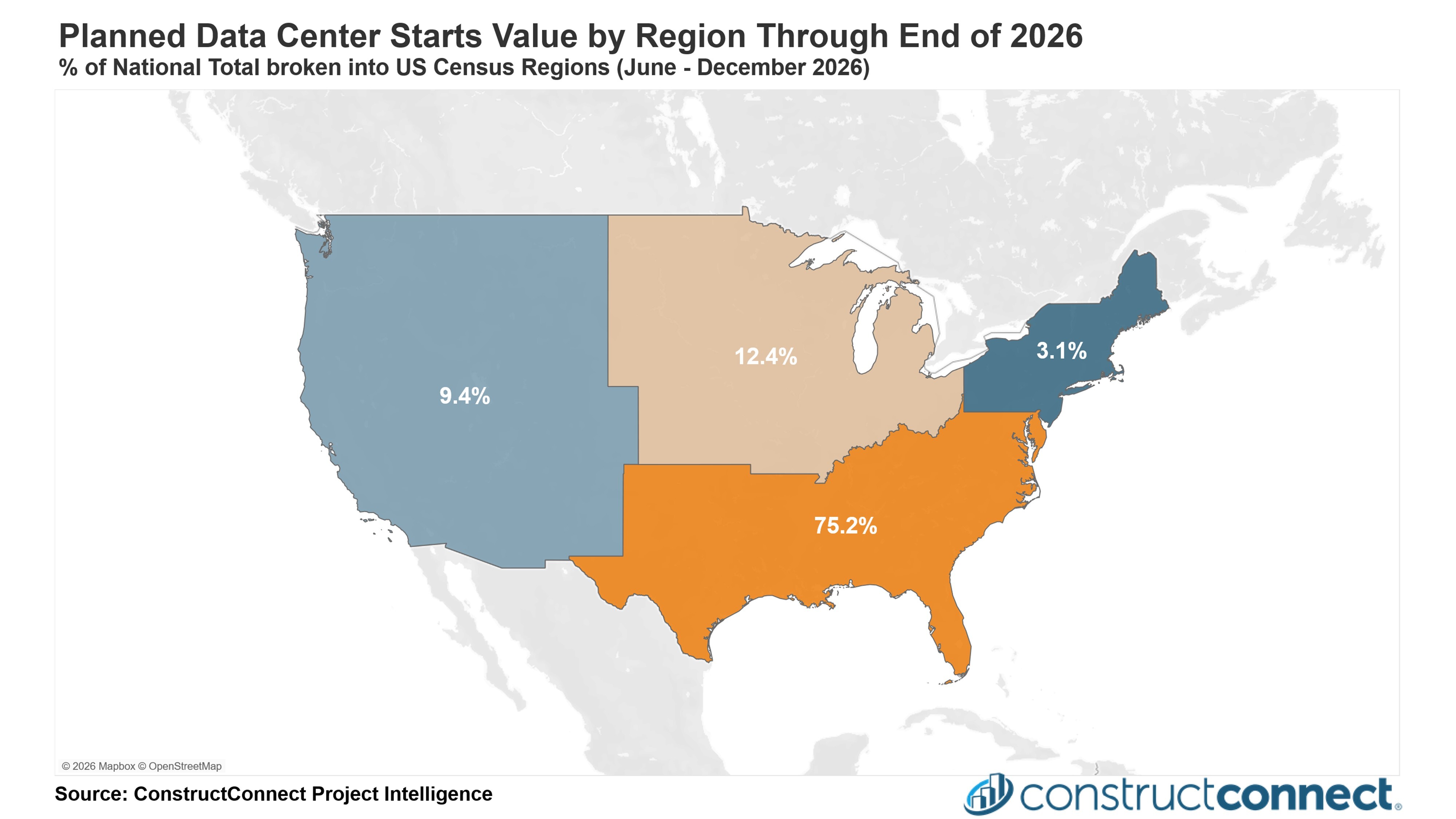
ConstructConnect economists Michael Guckes and Devin Bell reported in the August Data Center Report that, "Data center project starts remain concentrated in a handful of states." And Texas, they noted, was among those states. A map image shows the planned US Data Center construction starts value by US Census Region from July to December 2026. These projects are still in the preconstruction phase and are not guaranteed to break ground. Image and Data: ConstructConnect
New Checkpoint for Texas Data Center Development
The state is requiring a project-by-project review before additional facilities are approved to move ahead in ERCOT’s queue.
The order follows growing concern in Texas over the speed and scale of data center demand. Abbott said the volume of proposed load could endanger the reliability and stability of the electric grid, and he pointed to incomplete compliance by some data centers with a PUCT survey on water and power usage as one reason the broader audit is now necessary.
That adds a new layer of due diligence for owners and development teams. A project may still have strong land, capital backing, and local political support, but if it cannot satisfy the state’s information requests and audit standards, it could stall before it reaches a buildable power solution.
What Texas Wants from Data Center Developers
The directive lays out five major areas the Texas regulator and its grid operator must examine for each data center project.
-
First, the state wants a clearer picture of who is paying for what. Developers must disclose the extent to which a project is funding itself versus relying on tax incentives, grants, abatements or other public financial assistance.
-
Second, Texas wants to know how much each facility will lean on the grid. That includes projected annual and peak electricity consumption, along with any effort to build or procure on-site generation and other steps to reduce ERCOT demand.
-
Third, water is now a front-and-center siting issue. Projects must provide projected annual and peak water use, anticipated water sources and details on cooling technology, including whether the facility will use air-cooled, closed-loop or other water-efficient systems.
-
Fourth, the state is asking how each project will reduce impacts on neighboring property owners and communities. The governor’s letter specifically cites noise mitigation, light controls, setbacks, traffic improvements and emergency response coordination.
-
Finally, regulators must collect information on project ownership and controlling interests, signaling a push for more transparency around who is behind major grid-connected facilities.

An aerial view of the construction of a massive AI data center campus with 400 million square feet hosting and 600MW capacity in Hutto, Texas, with a power substation in the background from June 2026. Image: Shutterstock
Construction Implications Could Reach Beyond the Data Center
The directive does not eliminate opportunity, but it could reshape which projects advance first.
Developments that can show credible on-site generation plans, water-efficient cooling strategies, and stronger community-mitigation measures may be better positioned in the review process.
Projects that depend heavily on public incentives, large water withdrawals, or full reliance on ERCOT without a demand-reduction strategy could face tougher scrutiny. The Texas decision comes as data center projects face increased opposition from states and communities, driving some states to put restrictions on the projects.
In New York state, for instance, the Governor paused state environmental permits last month. Its action made New York the first state to pause hyperscale data center projects, which include those of 50 megawatts or more for up to one year while agencies build a new regulatory framework.

How Will Construction Be Impacted by the Texas Data Center Halt?
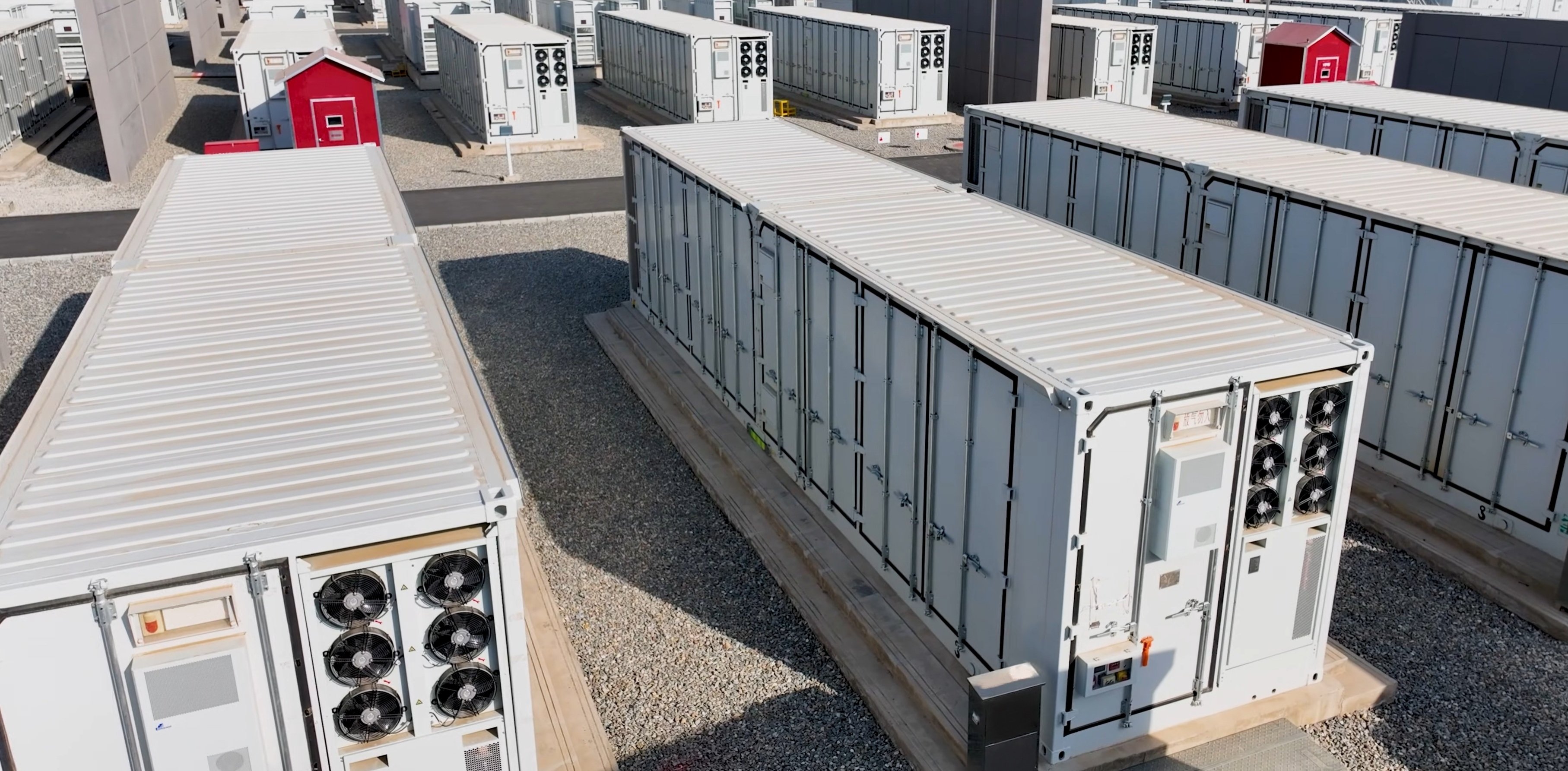
The Texas Governor's action has implications well beyond the server building itself. The order could impact demand for power-generation packages, substations, battery energy storage systems, water-reuse systems, dry or hybrid cooling approaches, sound attenuation measures, road improvements, and other enabling infrastructure that makes a project easier for regulators and host communities to accept.
The policy also raises the possibility of slower timelines for some proposed campuses as teams compile utility, environmental, and ownership documentation.
Abbott said the move builds on a June 10 directive aimed at shielding Texans from data center infrastructure costs.
With the new audit order now in place, Texas is signaling that future data center construction will be judged not only by the size of the investment, but by how well each project can support itself without shifting grid, water or community costs onto the public.
Stay Connected
Stay connected with ConstructConnect News for construction industry news and construction market analysis to stay ahead of what’s building next.
About ConstructConnect
At ConstructConnect, our software solutions provide the information that construction professionals need to start every project on a solid foundation. For more than 100 years, our keen insights and market intelligence have empowered commercial firms, building product manufacturers, trade contractors, and architects to make data-driven decisions, streamline preconstruction workflows, and maximize their productivity. Our newest offerings—including our comprehensive, AI-assisted software—help our clients find, bid on, and win more projects.
ConstructConnect operates as a business unit of Roper Technologies (Nasdaq: ROP), a constituent of the Nasdaq 100, S&P 500, and Fortune 1000.
For more information, visit constructconnect.com