KEY POINTS
-
Meta says its Richland Parish data center will expand to 5 gigawatts, with total regional investment topping $50 billion and peak construction employment expected to exceed 7,500 jobs.
-
The company says the campus will support 1,000 operational roles, add more than $1 billion in local infrastructure work, and fund workforce training through a $5 million gift to Louisiana Delta Community College.
-
The expansion also deepens scrutiny of how hyperscale AI projects affect power systems, as Meta and Entergy back a package of new generation, batteries, and grid upgrades tied to the site.
In a July 13, 2026, statement, Meta said it is expanding the Richland Parish campus as part of its global infrastructure buildout and will provide 5 gigawatts of capacity for Hyperion, the company’s largest AI computing campus.
Monday’s announcement pushes the investment total above $50 billion and formally ties that spend up from a 2GW to a 5GW capacity buildout.
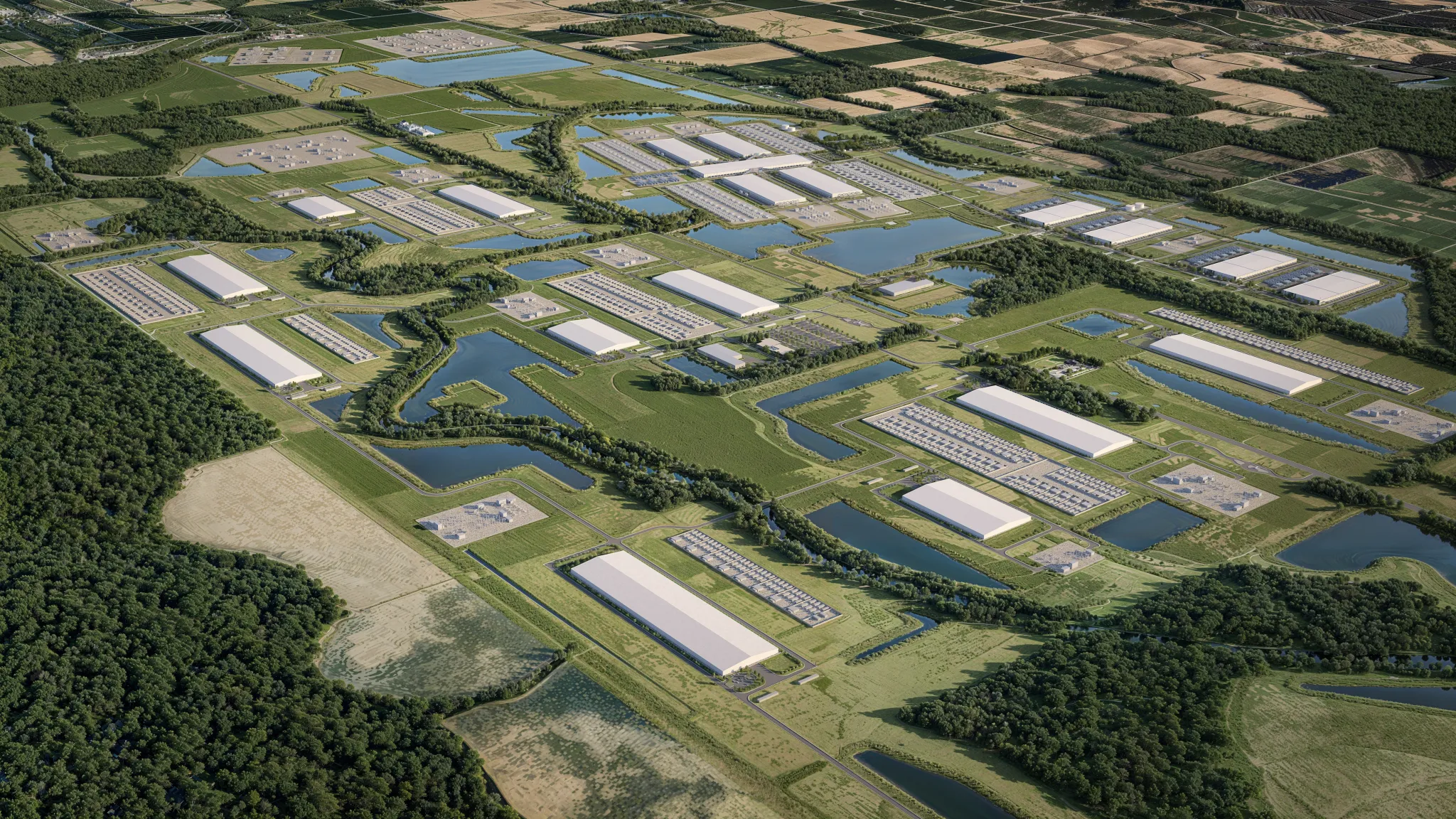
Meta is expanding its Richland Parish, Louisiana, data center campus, shown in a rendering above, from a 2GW to a 5GW complex for Hyperion, its largest AI training cluster, pushing total investment past $50 billion. Image: Meta
Meta originally unveiled the campus, now spanning nearly 4,000-acres or 6.25 square miles, in late 2024 as a $10 billion development planned for more than 2GW of power capacity. By October 2025, a joint venture tied to the site had put the project’s buildings and infrastructure value at about $27 billion.
A data center is typically measured by its continuous power capacity, that is the amount of electricity it can safely draw and distribute around the clock, rather than by the size of the building. One megawatt (MW) equals 1 million watts and can generally power about 800 to 1,000 homes, while one gigawatt (GW) equals 1 billion watts, or roughly enough electricity to supply 800,000 to 1 million homes.
AI Infrastructure Driving Nonresidential Construction
The multi-billion-dollar Meta announcement is another sign that AI infrastructure remains one of the strongest demand drivers in nonresidential building, especially for heavy civil, power, water and specialized mission-critical trades.
Late last month, ConstructConnect economists Michael Guckes and Devin Bell reported that U.S. Data Center construction spending now stands at $58.1 billion, year-to-date through May 2026. That level, the economists reported, is more than four times the record level set over the same period in 2025.
[Read the July 2026 ConstructConnect Data Center Report]
Meta said the Richland Parish project will support more than 7,500 jobs at peak construction and 1,000 permanent roles once operational. Those positions include electricians, HVAC workers, engineers, server and network technicians, culinary staff, safety workers, and security personnel.
The company also said it has contracted more than $1.6 billion with Louisiana businesses to date and is working with DPR Construction, Turner Construction Co. and Mortenson Construction on local hiring and workforce development.
Local Workforce Push Gains More Attention
A large share of Meta’s July 13 announcement focused on labor pipelines and local participation.
The company said it is making Source Louisiana the default portal for subcontracting opportunities tied to the site. It also announced $5 million in support for Louisiana Delta Community College, which Meta described as the largest gift in the school’s history.
The funding will create scholarships for residents training for data center-related trades and technical work. Meta said all Richland Parish high school graduates beginning with the class of 2026 will be eligible for full scholarships for data center-related trade certificates or courses.
Meta also pointed to workforce programs developed with Louisiana Delta Community College and said it is expanding partnerships with the University of Louisiana at Monroe (ULM) and other local institutions.
According to the company, enrollment at ULM’s construction management school is up 37% from a year earlier, with dozens of graduates already hired by its general contractors.
Those details matter because hyperscale data center projects are increasingly constrained not only by power availability but by access to skilled labor, specialty subcontractors and regional training capacity.
Civil And Community Spending Grow with the Site
The data center expansion includes more than $1 billion in local infrastructure improvements, including roads, water and wastewater systems, the company said.
It also said the project has boosted tax revenues, citing teacher bonus checks in Richland Parish that were 400% higher this year than last year. The company said it has also supported public schools, youth programs and local nonprofits through direct giving and community grants.
Among the projects and groups Meta highlighted were Richland Parish schools, the Richland Revitalization Board, the Northeast Louisiana Veterans Cemetery, the Northeast Louisiana Children’s Museum, local chambers of commerce, and other regional organizations.
Those claims underscore the pitch states and local governments continue to make around AI campuses, even as opposition grows. Data center projects do not typically stop at the building site, but spill into education, utilities, roads, and local business formation.
Energy Deal Remains Part of the Story
The buildout’s energy footprint will likely draw as much attention as its job count.
Meta said its recent agreement with Entergy Louisiana will fund seven new natural gas-fired generating plants, three grid-scale batteries, nuclear uprates and additional purchased power. The company said the package is expected to save Entergy Louisiana customers about $2.65 billion over 20 years, including $650 million previously announced.
Meta also said it is contributing $215 million to Entergy affordability and residential energy-efficiency programs, while helping fund generation of up to 2.5GW of clean and renewable energy.
The company said it will match 100% of the Richland Parish site’s energy use with clean and renewable energy and target LEED Gold certification for the campus once operational.
At the same time, the project lands amid broader debate over whether large AI campuses can strain utility systems and shift risk onto ratepayers. Environmental and consumer groups have increasingly pushed back on the energy-intensive AI buildout, even as Meta says it will cover the full cost of the energy, water and related infrastructure the campus uses.
A Meta spokesperson told CNBC the Louisiana project is expected to reach 2GW by 2030, though the company has not given a full timeline for when the entire 5GW buildout will be complete.
What It Means for Construction
The Meta Richland Parish data center project expansion highlights two observations from the US nonresidential construction market.
First, AI data centers are getting larger, costlier and more infrastructure-heavy, with project scopes reaching far beyond the building shell into substations, generation, water systems, roads and long-term workforce programs.
.jpg?width=4000&height=2250&name=DataCtr%20as%20PCT%20of%20NRB%20Spend%2012MMA%20(PPTX%20VIZ).jpg)
Data Center construction starts have accounted for over one-fifth of all Nonresidential building (NRB) starts over the last 12 months, ConstructConnect economists Michael Guckes and Devin Bell reported in the July 2026 Data Center Report. Image and Data: ConstructConnect
Second, the value proposition for communities is being framed less around a single campus and more around a full development package, in this case a regional one, that includes contractor spending, utility upgrades, training pipelines, and public investment.
That framing may become more common as states compete for hyperscale projects and as developers, utilities, and public officials try to show that the economic upside can outweigh increasing concerns over power demand, land and water use, and long-term public cost.
Stay Connected
Stay connected with ConstructConnect News for construction industry news and construction market analysis to stay ahead of what’s building next.
About ConstructConnect
At ConstructConnect, our software solutions provide the information that construction professionals need to start every project on a solid foundation. For more than 100 years, our keen insights and market intelligence have empowered commercial firms, building product manufacturers, trade contractors, and architects to make data-driven decisions, streamline preconstruction workflows, and maximize their productivity. Our newest offerings—including our comprehensive, AI-assisted software—help our clients find, bid on, and win more projects.
ConstructConnect operates as a business unit of Roper Technologies (Nasdaq: ROP), a constituent of the Nasdaq 100, S&P 500, and Fortune 1000.
For more information, visit constructconnect.com