KEY POINTS
-
China Daily reported that China started operating what it described as the world’s first undersea data center directly powered by offshore wind, combining renewable power generation with AI-focused digital infrastructure.
-
The Shanghai Lin-gang demonstration project is designed to send offshore wind power straight to submerged data modules and use seawater cooling to cut energy demand, eliminate freshwater use, and sharply reduce land needs.
-
The Shanghai area project blurs the boundaries between power supply, cooling, and computing capacity as one integrated construction and engineering problem rather than three separate systems.
China started operating what China Daily reported June 2 is the world’s first undersea data center directly powered by offshore wind. The project marks a new attempt to pair renewable energy with the fast-growing infrastructure demands of artificial intelligence.
The Shanghai Lin-gang undersea data center demonstration project entered operation in May off Shanghai’s eastern coast, according to China Daily.
The report said the development was built by a subsidiary of state-owned China Communications Construction and is being positioned as a model for next-generation computing infrastructure.
Offshore Power Meets AI Infrastructure
According to China Daily, the project is located about 6 miles offshore in Shanghai’s Lin-gang area and has a planned capacity of 24 megawatts (MW), the equivalent capacity to power around 24,000 homes. The data center is currently operating at 2.3 MW.
Data centers are typically sized in megawatts (MW), which measure power capacity or load. One megawatt equals 1 million watts and is generally considered enough power to supply about 800 to 1,000 homes.
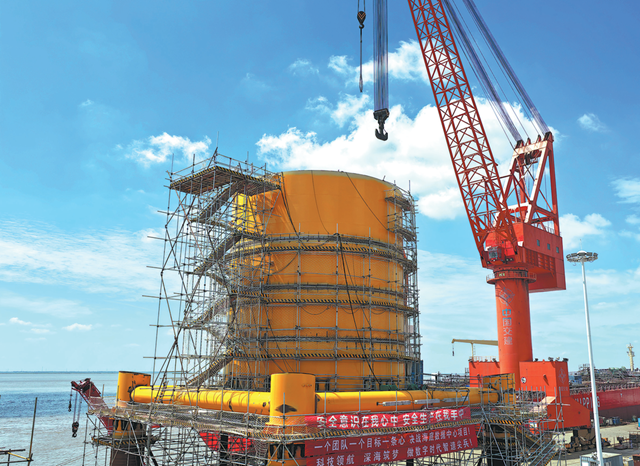
An image of the data cabin of the Shanghai Lin-gang undersea data center demonstration project. Image: Xu Congjun, for China Daily
The Shanghai Lin-gang undersea data center feature what developers described as a direct offshore wind connection. In that setup, electricity generated by offshore wind farms is transmitted straight to submerged data modules through subsea photoelectric composite cables instead of being routed through conventional grid systems first.
Photoelectric composite cables combine power and fiber lines in one cable to support simultaneous electricity and data transmission while simplifying wiring and lowering infrastructure costs.
That design matters as the AI infrastructure buildout surges.
The Summer 2026 U.S. Nonresidential construction forecast, reported by ConstructConnect, "continues to be shaped by the rapid buildout of AI-related infrastructure, especially data centers, which is pushing nonresidential activity higher even as other parts of the market remain more measured," according to Chief Economist Michael Guckes.
Guckes emphasized the impact of data centers, "The biggest revision in the latest US forecast is in Nonresidential construction. That sector was upgraded to reflect a stronger data center profile, reinforcing how concentrated large-project activity has become in the current cycle."
The Shanghai project blurs the boundaries between power supply, cooling and computing capacity, treating them as one integrated construction and engineering problem rather than three separate systems.
How Seawater Cooling Could Change the Equation
China Daily reported the undersea system uses seawater as a natural cooling source through a circulating copper-pipe heat exchange design. Developers said that approach cuts electricity consumption by 22.8 percent, eliminates freshwater use entirely, and reduces land use by more than 90 percent.
Tsinghua University professor Li Zhen told China Daily that conventional data centers typically use about one-third of their electricity on cooling systems. For an undersea data center of similar scale, Li said, cooling would account for only about one-tenth of total power use.
Li also told the newspaper that China’s data centers consume about 250 billion kilowatt-hours (KWh) of electricity annually, with about 80 billion kilowatt-hours used for environmental cooling. If similarly scaled facilities were placed underwater, he said, cooling demand could fall to about 30 billion kilowatt-hours, saving about 50 billion kilowatt-hours per year.
What It Means for Construction
For the construction industry, the project stands out because it combines offshore engineering, subsea cable systems, renewable generation, and digital infrastructure in one delivery model.
It also places a data center and co-located power undersea. As computing demand rises, developers and public officials are looking for ways to build data capacity without intensifying pressure on urban land, freshwater supplies, and strained power systems. Whether or not the project increases in scale and leads to development elsewhere remain unknown.
Stay Connected
Stay connected with ConstructConnect News for construction industry news and construction market analysis to stay ahead of what’s building next.
About ConstructConnect
At ConstructConnect, our software solutions provide the information that construction professionals need to start every project on a solid foundation. For more than 100 years, our keen insights and market intelligence have empowered commercial firms, building product manufacturers, trade contractors, and architects to make data-driven decisions, streamline preconstruction workflows, and maximize their productivity. Our newest offerings—including our comprehensive, AI-assisted software—help our clients find, bid on, and win more projects.
ConstructConnect operates as a business unit of Roper Technologies (Nasdaq: ROP), a constituent of the Nasdaq 100, S&P 500, and Fortune 1000.
For more information, visit constructconnect.com