KEY POINTS
-
Construction material inflation reached 9% year over year in June, its highest level since late 2022, while bid prices rose just 3.5%, deepening margin pressure for firms with fixed-price commitments.
-
Tariffs and geopolitical disruption are fueling the surge, with U.S. - Iran tensions raising oil prices and complicating shipping through the Strait of Hormuz, while aluminum, copper, and steel posted especially sharp increases.
-
The pressure extends beyond materials, as construction wages climbed 4.9% year over year, leaving roughly 70% of project costs rising faster than bid prices.
Construction Material Prices Rise at Fastest Pace in Over 3 Years
Construction material inflation in June climbed to its highest level since the second half of 2022, outpacing bid prices. Tariffs on key construction materials and disruptions from U.S.-Iran tensions, which have pushed up oil prices and complicated shipping through the Strait of Hormuz, are driving the increase.
Historically, when material price growth has outpaced bid prices, firms with fixed commitments have faced shrinking margins with little room to adjust. The current environment is shaping up to be no different.
We've Seen a Surge in Construction Prices Before
Steel and aluminum tariffs drove a surge in construction material price inflation in 2018, with costs peaking at nearly 8% year-over-year by mid-year, more than double the pace of bid prices.
Firms locked into fixed contracts bore the brunt, facing rapidly eroding margins as input costs climbed faster than the prices they had committed to deliver work for.
The next margin squeeze came in 2021 and 2022, as pandemic-era stimulus pushed construction demand higher while supply chains struggled to keep pace. Material inflation held above bid price growth for more than a year, eroding firms' margins in the process.
The Current Inflationary Environment
Existing tariffs on key construction materials, compounded by U.S.-Iran tensions that have pushed up oil prices and disrupted shipping through the Strait of Hormuz, have once again created conditions where material price growth is outpacing bid prices.
Construction material prices rose 9% year-over-year in June, while bid prices grew only 3.5% over the same period. Material inflation has held above bid price growth every month since April 2025, with June 2026 marking the starkest divergence yet.
The increase has not hit all materials equally. Aluminum prices rose 52.4% year-over-year, while copper and steel climbed 29.7% and 16.9%, respectively.
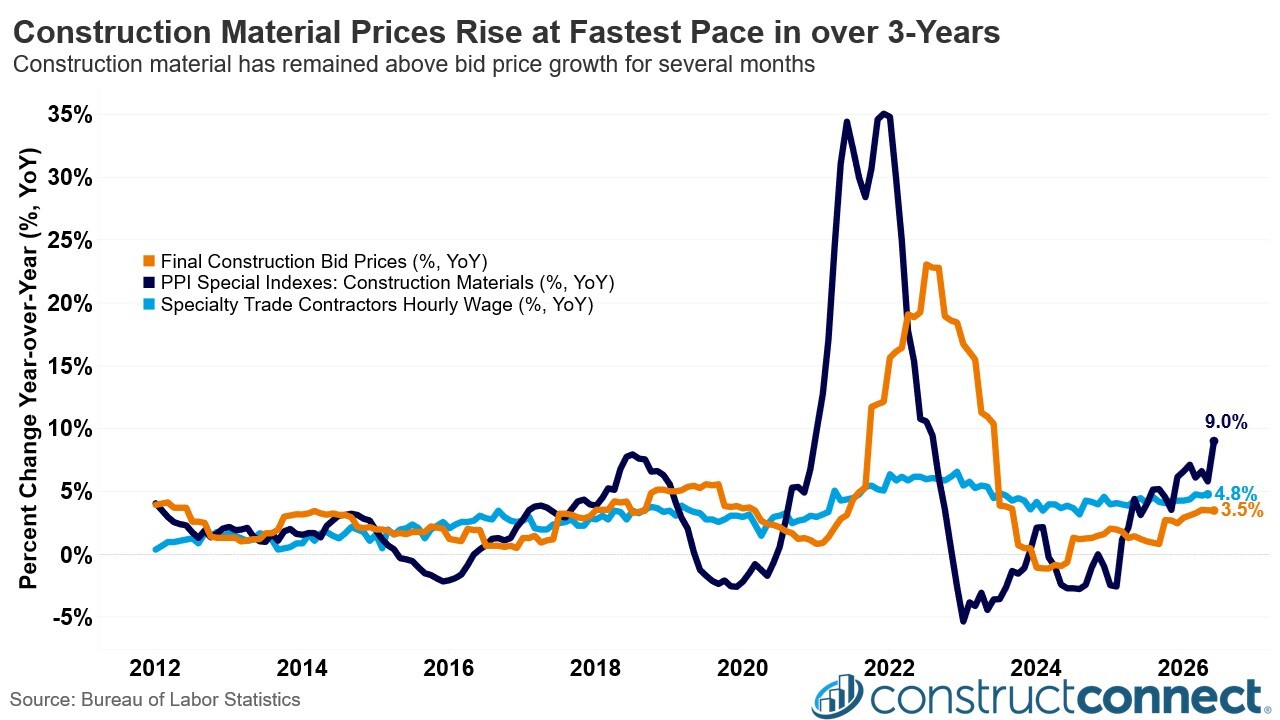
Construction material inflation in June 2026, shown in the chart above on the darkest line, climbed to its highest level since the second half of 2022, outpacing bid prices. The chart includes wages of specialty trade contractors, construction materials, and final bid prices from the Bureau of Labor Statistics, 2012 through June 2026. Image: ConstructConnect
Labor and Material Costs are Squeezing Margins, Too
Escalating prices are compounded as margin pressure extends beyond materials.
Average hourly construction wages grew 4.9% year-over-year, meaning roughly 70% of a typical project's total costs are now rising faster than bid prices, a pattern that mirrors the conditions behind both the 2018 and 2021-22 squeezes.

A question now is how long firms in the industry stomach eroding profit margins, as material and labor inflation outpaces final bid prices.
Until material prices ease or bid prices catch up, contractors and developers face a similar environment that squeezed firms in 2018, and again in 2021-22.
Stay Connected
Stay connected with ConstructConnect News for construction industry news and construction market analysis to stay ahead of what’s building next.
About ConstructConnect
At ConstructConnect, our software solutions provide the information that construction professionals need to start every project on a solid foundation. For more than 100 years, our keen insights and market intelligence have empowered commercial firms, building product manufacturers, trade contractors, and architects to make data-driven decisions, streamline preconstruction workflows, and maximize their productivity. Our newest offerings—including our comprehensive, AI-assisted software—help our clients find, bid on, and win more projects.
ConstructConnect operates as a business unit of Roper Technologies (Nasdaq: ROP), a constituent of the Nasdaq 100, S&P 500, and Fortune 1000.
For more information, visit constructconnect.com