KEY POINTS
-
Summer project activity spans auto, solar, semiconductor and bridge work, with price tags ranging from $225 million to $4.05 billion.
-
Toyota, Bosch, and Cypress Creek are advancing major industrial and energy investments that could support steel demand, power infrastructure work, and regional supply-chain activity.
-
Ohio and Kentucky have launched the Brent Spence Bridge Corridor project, which will use more than 95 million pounds of U.S. steel (roughly 47,500 tons).
A summer wave of big-ticket projects is poised to lift steel demand while it shapes US nonresidential construction activity across auto manufacturing, utility-scale solar, semiconductors, data centers, and bridge infrastructure.
Auto and Chip Investments
Toyota Motor North America said it will invest $3.6 billion in its San Antonio assembly plant, including a second vehicle assembly line scheduled to begin operating in 2030. The company said the added line will raise annual production capacity by about 150,000 vehicles, while Tacoma pickup production shifts from Baja California, Mexico, to San Antonio over the next four years.
Large automotive investments typically support work tied to suppliers, logistics, site services and regional industrial infrastructure, creating a broader field of opportunity than a single factory expansion might suggest.
Separately, Bosch reached an agreement for up to $225 million in CHIPS funding to support an investment of up to $2 billion for silicon carbide semiconductor production in Roseville, California. That adds another signal that advanced manufacturing spending is still moving into the project pipeline.
[Read The Midwest Manufacturing Renaissance That No One is Talking About from ConstructConnect Chief Economist, Michael Guckes]
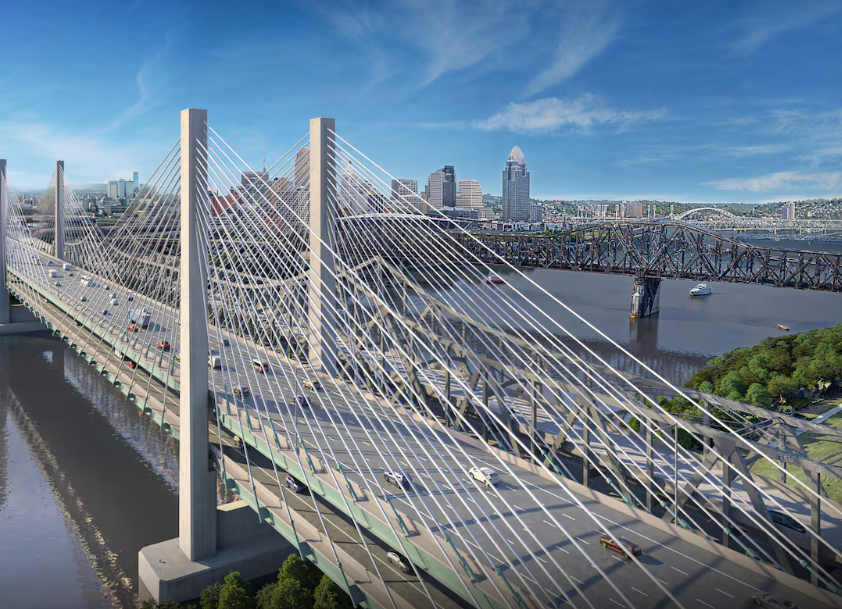
Ohio and Kentucky have launched the $4.05 billion Brent Spence Bridge Corridor project, as shown in a rendering. The Brent Spence Bridge Corridor organization said the project will use more than 95 million pounds of U.S. steel (roughly 47,500 tons), reinforcing the scale of materials demand that a single marquee transportation project can create. Image: Ohio Dept. of Transportation
Steel Demand from Energy and Infrastructure Projects
In Arkansas, Cypress Creek Energy and Google broke ground on the first two phases of the Steel River Energy Center, which developers describe as the largest American solar energy project to date.
ConstructConnect News reported that the first two phases will add 1.6 GWdc of solar generation and 1.9 GWh of battery storage to the local grid. The full project is slated to reach 2.5 GWdc of solar and 2.9 GWh of storage by 2029. GWdc refers to the direct current (DC) power output of a solar energy system as measured in gigawatts.
The project also carries a notable materials implication. Recycling Today reported that the first two phases will require more than 400,000 steel piles and more than 142,000 tons of steel from U.S. Steel’s Big River facility in Osceola, Ark.
U.S. Steel has described Big River as a high-recycled-content electric arc furnace mill, underscoring how new energy infrastructure is feeding demand into lower-carbon steel production channels.
Another Arkansas energy project reflects the same convergence of industrial production and power supply. Recycling Today reported that Green & Clean Power, a sister company to Hybar Steel, has built a behind-the-meter solar and battery storage facility in Osceola capable of supplying Hybar’s electric arc furnace mills with all of their energy needs at times.
Data Centers at the Intersection of Scale and Construction Materials Demand
Data Center construction starts have accounted for over one-fifth of all Nonresidential building (NRB) starts over the last 12 months, ConstructConnect economists Michael Guckes and Devin Bell reported in the July 2026 Data Center Report.
The scale of some of these data center projects is immense, as is the anticipated demand for the construction materials to build them.
One such example came from Meta, which said this week it is expanding the Richland Parish campus as part of its global infrastructure buildout. The Louisiana megaproject will provide 5 gigawatts of capacity for Hyperion, the company’s largest AI computing campus. Monday’s announcement pushes the investment total above $50 billion and formally ties that spend up from a 2GW to a 5GW capacity buildout.
Meta originally unveiled the campus, now spanning nearly 4,000-acres or 6.25 square miles, in late 2024 as a $10 billion development planned for more than 2GW of power capacity. By October 2025, a joint venture tied to the site had put the project’s buildings and infrastructure value at about $27 billion.
95-Million Pounds of US Steel
Heavy civil work is also adding to the summer outlook. Ohio and Kentucky have launched the $4.05 billion Brent Spence Bridge Corridor project, which will include a new cable-stayed companion bridge alongside the existing span between Cincinnati and Covington, Ky.
Project backers say the work is partially supported by $1.63 billion in federal grants, among the largest transportation grants in U.S. history, and is expected to generate about 6 million work hours while employing more than 700 tradespeople.
A LinkedIn post from the Brent Spence Bridge Corridor organization said the project will use more than 95 million pounds of U.S. steel (roughly 47,500 tons) reinforcing the scale of materials demand that a single marquee transportation project can create.
Stay Connected
Stay connected with ConstructConnect News for construction industry news and construction market analysis to stay ahead of what’s building next.
About ConstructConnect
At ConstructConnect, our software solutions provide the information that construction professionals need to start every project on a solid foundation. For more than 100 years, our keen insights and market intelligence have empowered commercial firms, building product manufacturers, trade contractors, and architects to make data-driven decisions, streamline preconstruction workflows, and maximize their productivity. Our newest offerings—including our comprehensive, AI-assisted software—help our clients find, bid on, and win more projects.
ConstructConnect operates as a business unit of Roper Technologies (Nasdaq: ROP), a constituent of the Nasdaq 100, S&P 500, and Fortune 1000.
For more information, visit constructconnect.com