KEY POINTS
-
Hyperscale data center developers have submitted more than 30 requests to connect to New York’s grid, Syracuse.com reported, with many proposals tied to former industrial properties across Upstate communities.
-
One proposed Genesee County project would cost $19.5 billion and use 500 megawatts of electricity. Syracuse.com reported the project also carries a proposed $1.4 billion sales-tax exemption package, sharpening political debate over public incentives.
-
Grid capacity is emerging as the decisive constraint. New York officials say large-load requests are rising fast enough to create reliability and cost-allocation concerns, pushing the state toward stricter rules for interconnection and ratepayer protection.
Upstate New York is becoming a new front in the U.S. data center buildout, but the contest is not just about land. It is about power.
Syracuse.com reported this month that hyperscale data center developers have submitted more than 30 requests to connect to New York’s electric grid, the first major step toward building large campuses. Many of the proposed sites are former industrial properties in communities that have spent decades trying to replace lost manufacturing jobs and tax base.
The projects are large even by recent data center standards. In Genesee County, Stream Data Centers is pursuing a 2.2 million-square-foot campus at the Science, Technology and Advanced Manufacturing Park, or STAMP, near Batavia, Syracuse.com reported. The project carries a reported cost of $19.5 billion and would use 500 megawatts of electricity, roughly enough to power more than half a million average Upstate homes.
Elsewhere, a developer in St. Lawrence County is seeking to site two data centers totaling 2,800 megawatts. Other locations cited by Syracuse.com include a former gun factory in the Mohawk Valley, a vacant aluminum plant in the North Country, and a former coal plant near Niagara Falls.
Why Legacy Industrial Sites are Drawing Hyperscale Interest
Old industrial sites often come with large tracts of land, existing transmission access, and local officials eager to land the next major investment story. For owners and developers, they can offer a faster path than starting from scratch on undeveloped or greenfield land.
For local governments, they provide the chance to turn outmoded industrial acreage into new tax revenue and construction activity.
But the same sites also expose a tension in the data center boom.
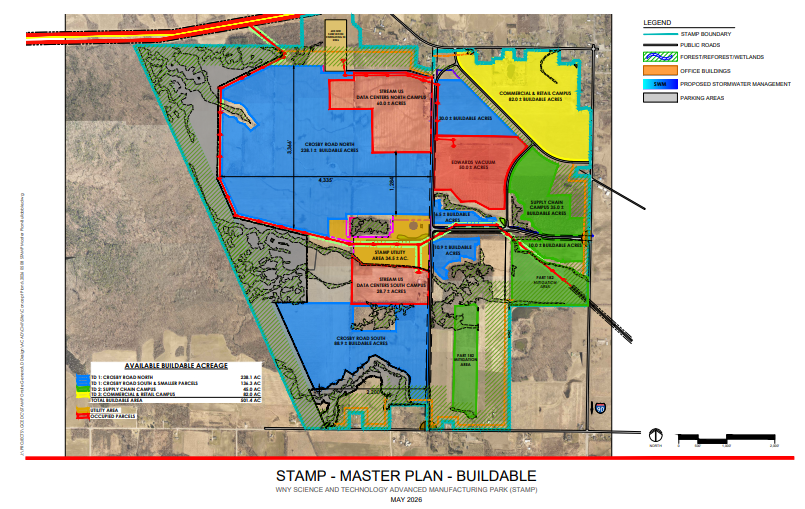
A map image of the Science, Technology and Advanced Manufacturing Park, or STAMP, in Genesee County, NY. The megasite, according to developers, has "$7 billion of announced investments and over 500 buildable acres." Image: Science, Technology and Advanced Manufacturing Park
Hyperscale projects can require city-scale power while producing fewer permanent jobs than traditional factories. That makes the public-benefit argument tougher, especially when large incentive packages are involved.
Opposition to Tax-Break Math
At STAMP, Syracuse.com reported that the Genesee County Economic Development Center has proposed a $1.4 billion exemption from sales taxes for the 500-megawatt project. The outlet said that works out to more than $11 million in tax breaks per job.
That is the kind of ratio that can quickly change the politics around a project. In a small town or county looking for investment, jobs may still matter. But the gap between capital cost, power demand, and long-term headcount is drawing scrutiny from state officials and ratepayers, particularly as electricity demand rises and grid upgrades become more expensive.
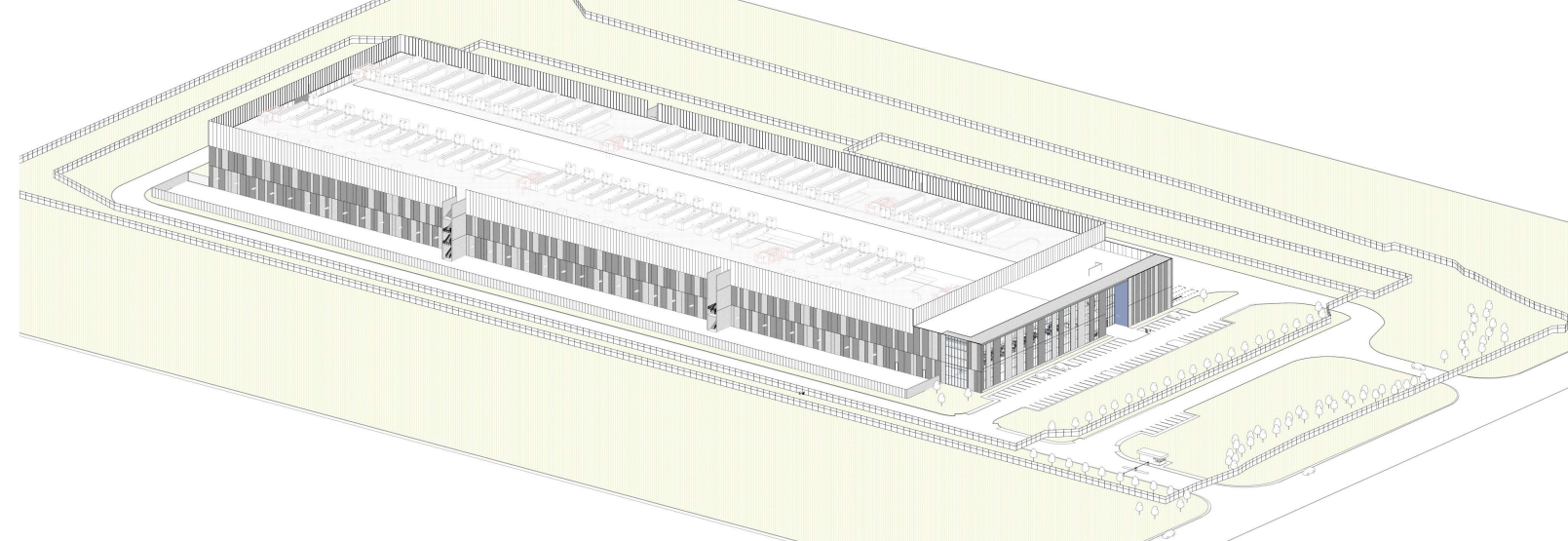
A data center building footprint shown in a Progress Set plan as captured from a Stream Data Centers project in South Carolina. Hyperscale projects like these can require city-scale power while producing fewer permanent jobs than traditional factories. That makes the public-benefit argument tougher, especially when large incentive packages are involved. Image: Stream Data Centers
Why Grid Capacity is a Bottleneck
That gap between capital cost, power demand, and long-term headcount is why grid capacity, not land, is a bottleneck.
The New York Independent System Operator (NYISO) is the nonprofit that operates the state’s bulk power grid and wholesale electricity market. NYISO studies a data center request to determine whether the load can be accommodated without throwing the system out of balance.

Large load projects of this size may require new substations or transmission lines. Utilities are generally required to have the data centers pay for direct interconnection upgrades, but the broader system effects are more complicated.
For contractors and suppliers, that matters because the viable projects will not simply be the ones with land and incentives. They will be the ones that can secure a workable path to electric power.
How New York State is Responding
Albany has already started to respond. In February, Gov. Kathy Hochul announced a Public Service Commission proceeding aimed at making sure data centers and other large-load projects pay their fair share for the costs they impose on the electric system.
The governor’s office said that, as of January 2026, the New York Independent System Operator interconnection queue included 48 projects representing more than 11 gigawatts of new large load, many tied to energy-intensive industries such as data centers.
The state’s concern is straightforward. Projects that require major system upgrades or tighten grid reliability margins should not have their costs borne by everyday ratepayers. Reliability margins are the grid’s ability to meet peak demand, handle sudden disruptions, and avoid outages.
Hochul’s administration has said projects driving exceptional demand without comparable public benefits should bear the costs they create or provide their own energy supply.
That position could reshape how future data center deals are structured in New York. It may also offer a preview of where the broader U.S. market is headed as large AI-related loads collide with aging grids and rising community and political pressure over utility bills.
Even amid the surge in data center construction starts and project announcements, these projects face a swarm of challenges, from labor and materials to energy infrastructure, real estate, natural resource usage, environmental regulations, political and local opposition. Still, there appears to be no slowdown in data center ambitions.
Stay Connected
Stay connected with ConstructConnect News for construction industry news and construction market analysis to stay ahead of what’s building next.
About ConstructConnect
At ConstructConnect, our software solutions provide the information that construction professionals need to start every project on a solid foundation. For more than 100 years, our keen insights and market intelligence have empowered commercial firms, building product manufacturers, trade contractors, and architects to make data-driven decisions, streamline preconstruction workflows, and maximize their productivity. Our newest offerings—including our comprehensive, AI-assisted software—help our clients find, bid on, and win more projects.
ConstructConnect operates as a business unit of Roper Technologies (Nasdaq: ROP), a constituent of the Nasdaq 100, S&P 500, and Fortune 1000.
For more information, visit constructconnect.com