KEY POINTS
-
Once home to the famed Packard car brand, the Detroit plant became a symbol of the city’s industrial decline after closing in the late 1950s.
-
Following failed redevelopment attempts, Packard Development Partners LLC now leads a $50 million project, Packard Park, featuring mixed-use spaces, an industrial building, and a Museum of Detroit Electronic Music.
-
The project will restore the historic Albert Kahn-designed building, revitalizing the neighborhood and celebrating Detroit’s industrial and architectural legacy.
From Automotive Glory to Industrial Ruin
It’s a famed one-time car brand – Packard – and of course, its headquarters used to be in Detroit.
But the car company closed in the late 1950s, and the mammoth 40-acre multi-building campus, straddling both sides of Detroit’s Grand Boulevard with an iconic overhead walkway, slid into what became known as the city’s most notorious industrial ruin.
In the decades since it has served as a facility for multiple smaller industrial and commercial users but over time decay set in.
By the early 2000s, the behemoth on Detroit’s near east side was essentially abandoned, one of countless ruins that epitomized the Motor City as the poster child of America’s Rust Belt.
In the years since, there have been some stirrings of revitalization, if only in part.
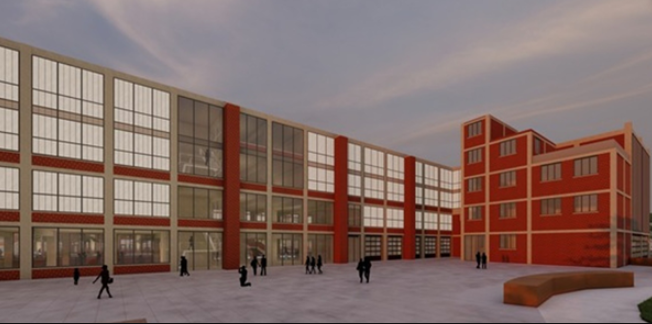
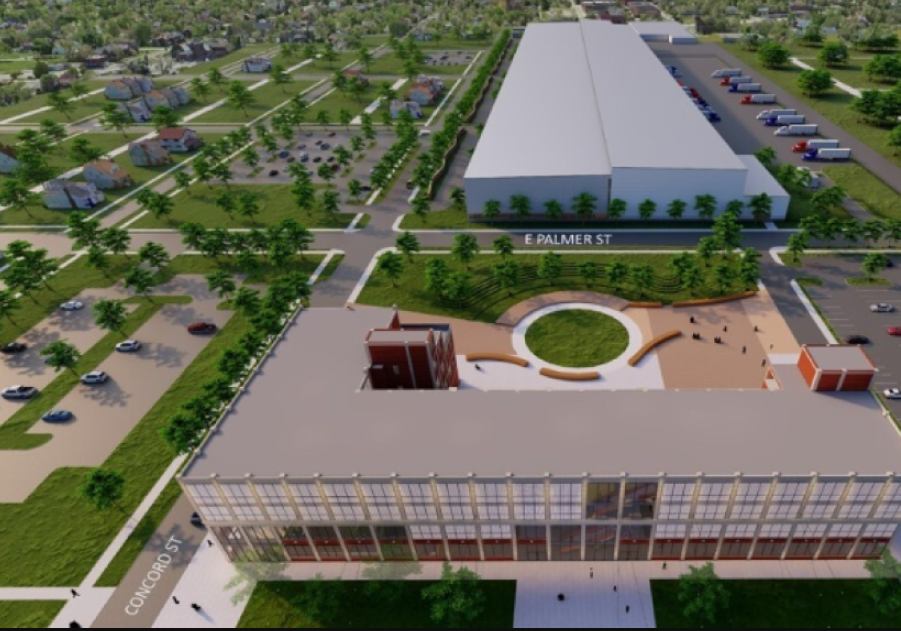 Shown in a rendering is the rehabbed original remaining Packard plant building with the new manufacturing building beyond. Image: Packard Development Partners LLC
Best known was a proposal 10 years ago by a flamboyant South American developer, Fernando Palazuelo, who had a grand vision including a hotel and massive techno music space helmed by a famed Berlin nightclub owner. But even he couldn’t make the numbers work, and plans were revised down to a more conventional development of new logistics spaces and warehousing.
And despite the headlines, Palazuelo eventually defaulted on taxes, and the property was seized by the city, which proceeded to carry out partial demolition.
The city then put up a request for proposals, and this time, as per a December announcement, it may finally have a development team that will make the revitalization work.
A New Vision for Packard Park
The developers are homegrown builders Mark Bennett and Oren Goldenberg of Packard Development Partners LLC. Both have proven track records in revitalizing old city eyesores and putting new life into neighborhoods.
Bennett has multiple residential and mixed-use projects. And Goldenberg, most famously with his Dreamtroit, a mixed-use conversion of another famed auto plant, the original Lincoln Motor Co. factory.
Now, a $50 million rebuild of the existing building, along with a new, almost 400,000-square-foot Class-A industrial building, is earmarked for completion in 2029 on a campus to be called Packard Park.
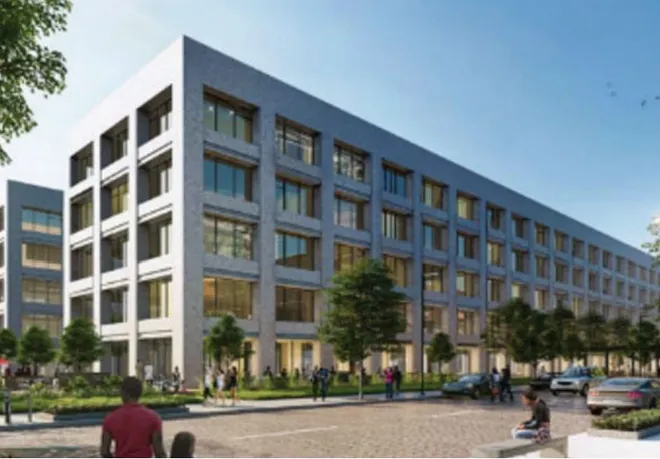
The renovated, almost 120,000-square-foot original building, designed by legendary Detroit architect Albert Kahn, will be converted into several eclectic uses. These include an indoor skate park, “creative programming,” housing, and a homage to the city as the birthplace of electronica, MODEM – the Museum of Detroit Electronic Music.
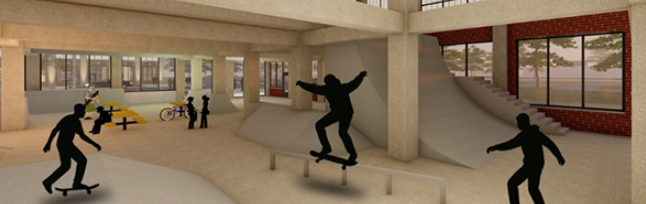
A rendering shows the interior of the rehabbed original Packard building, which could be used for one of several creative or recreational purposes. Image: Packard Development Partners LLC
Honoring History While Revitalizing the Neighborhood
Interestingly, the Albert Kahn building was the first industrial building in the world to be built using reinforced concrete. His brother Julius Kahn, a civil engineer, developed the process in 1902.
“And towards the end of the year, he filed for a patent for the first scientific and practical form of reinforced concrete,” Detroit architectural historian and author Michael G. Smith said.
Smith is optimistic that, after the earlier trials and tribulations of redeveloping Packard, the reborn plant’s time is now.
That money will come through layered capital or “stack,” including equity, debt, tax credits, philanthropy, and state and local incentives.
“They’ve both been successful in raising money in the past,” he said.
Smith noted Goldenberg’s Dreamtroit “is not that much different from this,” with the rehabbed space actually larger.
Smith, who has written two books on Detroit architecture and concrete buildings, says he feels “very good” about this development.
For one, it brings redevelopment in that otherwise bleak neighborhood to a new level. Previous rehabs have largely been “inside unwindowed walls” in warehouse-type structures, he said.
“This building will have the appearance of being occupied both in the daytime and the nighttime that I think will be a big positive for the city.”
And second, because of the Kahn building’s legacy.
“It harkens back to a very important era of the city’s and country’s history, and there are very new structures of that type that have remained intact.”
Stay Connected
Stay connected with ConstructConnect News, your source for construction economy insights, market trends, and project news.
About ConstructConnect
At ConstructConnect, our software solutions provide the information construction professionals need to start every project on a solid foundation. For more than 100 years, our keen insights and market intelligence have empowered commercial firms, building product manufacturers, trade contractors, and architects to make data-driven decisions, streamline preconstruction workflows, and maximize their productivity. Our newest offerings—including our comprehensive, AI-assisted software—help our clients find, bid on, and win more projects.
ConstructConnect operates as a business unit of Roper Technologies (Nasdaq: ROP), a constituent of the Nasdaq 100, S&P 500, and Fortune 1000.
For more information, visit constructconnect.com

.jpg?width=180&height=180&name=RON%20STANG%20(2).jpg)