KEY POINTS
-
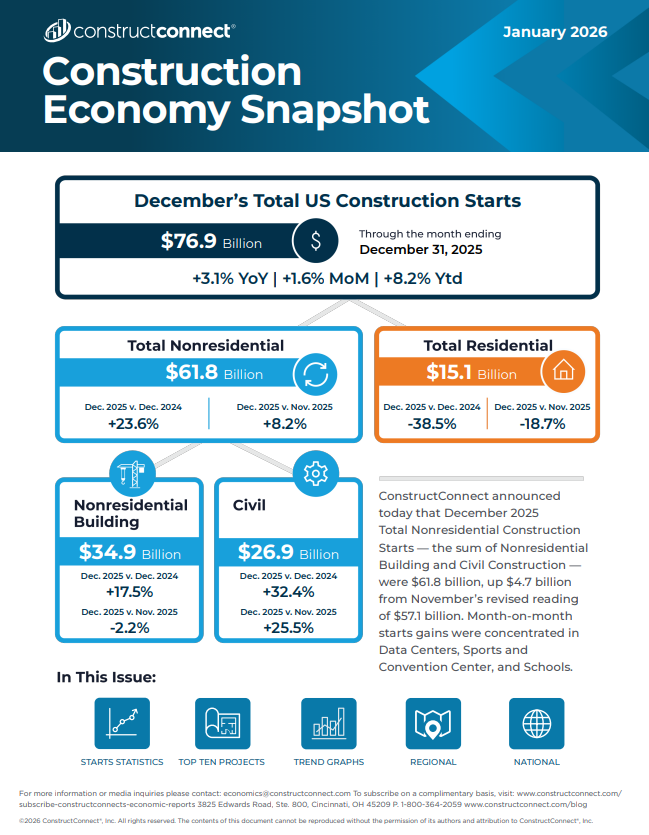
ConstructConnect announced that Total Nonresidential Construction Starts for December 2025 reached $61.8 billion, marking a $4.7 billion increase from November’s revised figure of $57.1 billion.
-
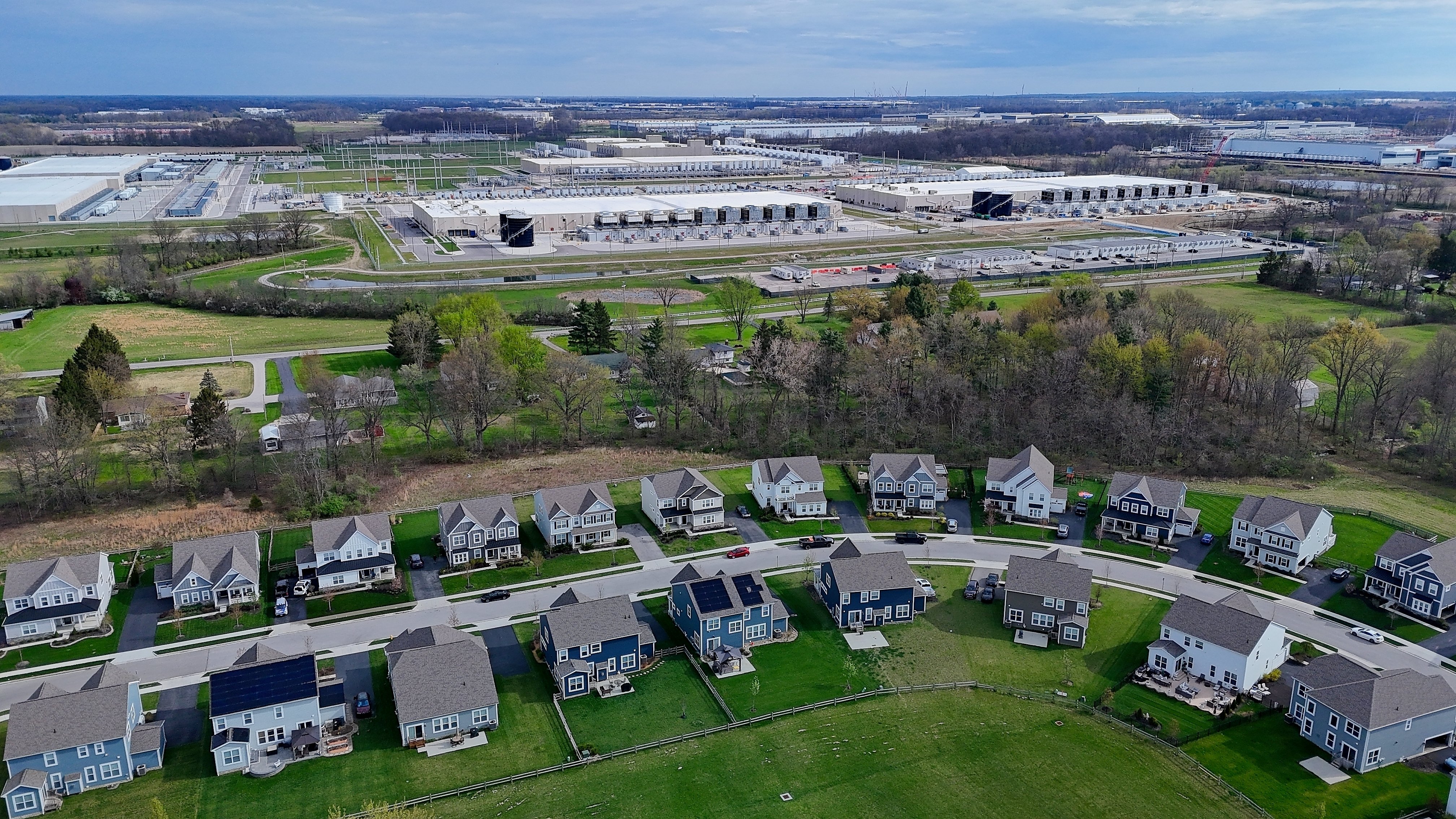
The month-on-month growth was driven by strong performance in key sectors, including Data Centers, Sports and Convention Centers, and Schools.
-
Despite seasonal fluctuations, December’s performance was robust, with starts up 24% year-on-year, highlighting the continued strength of the Nonresidential Construction sector.
ConstructConnect announced that December 2025 Total Nonresidential Construction Starts — the combined total of Nonresidential Building and Civil Construction — reached $61.8 billion.
This marks a $4.7 billion increase from November’s revised figure of $57.1 billion. The month-on-month gains were concentrated in Data Centers, Sports and Convention Centers, and Schools.
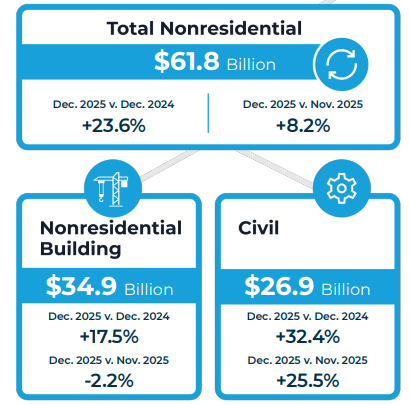
Image: ConstructConnect Construction Economy Snapshot
December Spending Data Reflects Seasonal Trends
Nonresidential starts closed out 2025 on a high note, with December’s total of $61.8 billion showcasing the sector’s resilience.
ConstructConnect Chief Economist, Michael Guckes, said, “While slightly lower than readings from earlier months, this dip aligns with the typical seasonal slowdown in construction spending rather than signaling a decline in demand.”
Guckes added, “Year-on-year (YoY) comparisons, which help account for seasonal fluctuations, reveal a strong performance, with December starts up 24% compared to the same period in 2024.”
For the entirety of 2025, Civil Construction demonstrated remarkable growth, closing the year up 13.9%, or $38.4 billion, over 2024. Key drivers of this growth included Airports, Power Infrastructure, All Other Civil, and Dams, Canals, and Marine Work.
Guckes said, “2025 marked the fourth consecutive year of double-digit growth in Civil Construction, with the sector achieving a compounded annual growth rate (CAGR) of over 19% between 2021 and 2025.”

Michael Guckes, Chief Economist, ConstructConnect
Nonresidential Building: A Year of Acceleration
Nonresidential Building (NRB) also posted impressive gains in 2025, with growth accelerating significantly in the second half of the year. July’s record-breaking $59.5 billion in starts highlighted the sector’s momentum, Guckes reported.
Office starts, including Data Centers, more than doubled during the year, followed by strong performances in Manufacturing, Nursing Homes and Assisted Living, and Military spending.
However, segments such as Prisons, Vocational Schools, and Hotels/Motels experienced weaker results, largely due to exceptionally strong comparisons from 2024.
Residential Construction
The Census Bureau’s late-year revisions to Residential starts, following the government’s historic shutdown, revealed a challenging year for single-family housing, Guckes noted.
Single-family starts ended 2025 down 14%, while multifamily housing fared better, declining by just 4%.
Over the past four years, the single-family market has faced consistent declines, the economist reported, with a four-year CAGR of negative 9.2%. In contrast, multifamily housing has remained relatively stable, with a four-year CAGR of 0.3%.
A Strong Finish to 2025
Despite seasonal fluctuations and challenges in the Residential sector, 2025 proved to be a robust year for Nonresidential Construction. Civil Construction’s sustained growth and Nonresidential Building’s late-year surge underscore the industry’s resilience and adaptability.
Stay Connected
Read the Construction Economy Snapshot for more details on construction labor, trends, and regional analysis.
About ConstructConnect
Construction Starts Here™ at ConstructConnect, where our mission is to help the construction industry start every project on a solid foundation. A leading provider of software solutions for the preconstruction industry, ConstructConnect empowers commercial construction firms to streamline their workflows and maximize productivity. ConstructConnect operates as a business unit of Roper Technologies (Nasdaq: ROP), a constituent of the Nasdaq 100, S&P 500, and Fortune 1000.