KEY POINTS
-
Built in the 1970s as a symbol of Detroit’s rebirth, the Renaissance Center was once the largest U.S. private development and home to the world’s tallest hotel, but faced decades of decline.
-
A $1.6 billion redevelopment led by GM and Bedrock will demolish two towers, convert others into housing and offices, and replace the concrete podium with a park connecting to Detroit’s Riverwalk.
-
The project seeks to fix past planning issues, better connect the RenCen to downtown Detroit, and transform it into a vibrant destination, supported by public and private funding.
The Renaissance Center’s Origins
Detroit’s iconic Renaissance Center was constructed in the 1970s as an answer to the destruction wrought and the social issues underlying the infamous 1967 Detroit Riot, with the “Renaissance” symbolic of the city’s rebirth.
A Landmark Facing Decline
But now the five-building structure on the Detroit riverfront is about to go under the wrecking ball, at least in part.
The towering “rosette”-style complex, a cylindrical central tower, the Marriott Hotel with 73 stories, and four 39-story surrounding office towers are to be massively renovated (plans are still in the concept stage), transforming their use and footprint functionality.
When it was first completed, almost 50 years ago, the “RenCen,” as it’s popularly known, was the largest private development in the U.S. and hosted the world’s tallest hotel.
But over the decades, the complex fell on hard times.
Challenges of RenCen
RenCen’s head offices moved to newer, competing office parks in the suburbs, and older downtown buildings underwent massive restorations, creating cool attractions for tech firms.
And the structure, though technically downtown, was seen as too “remote” from the rest of the CBD, separated by its brutalist architecture, a concrete berm (since removed), multilane boulevard, and river location.
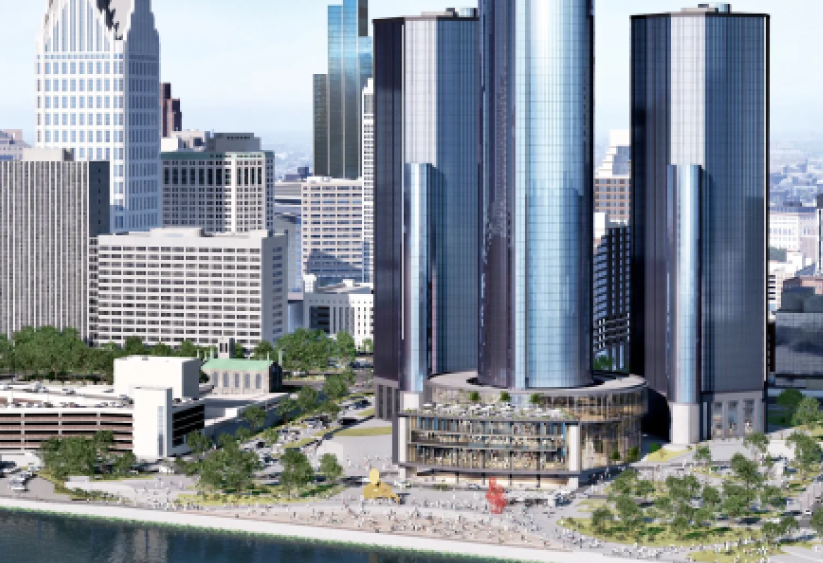
Shown is an artist’s rendering of the revamped Detroit Renaissance Center after two front towers and a podium are removed and replaced by a park. Image: Bedrock
The complex has also been home to General Motors’ world headquarters, and the auto company still owns the buildings.
But the final nail seems to have been GM’s decision last year to move to the new Hudson’s Detroit 49-story skyscraper, nearing completion, just a few blocks away.
Such has been its hollowing out that the RenCen now has only an astonishingly low 10 per cent office occupancy rate.
Criticism of Design and Market Realities
Jeff Horner, an urban studies professor at Detroit’s Wayne State University, called the RenCen “fortress-like” and “a great example of everything wrong with urban planning in the United States in the 1970s. That place is as divorced from reality as anything.”
The multi-level promenade configuration with its notorious byzantine walkways, which was “completely wrong-minded,” was a “completely wrong-minded building that even people who worked there could take or leave.”
The structure’s architecture aside, not to be disregarded has been the overall “softness of the commercial real estate market” in the Motor City, Horner said.
This has ironically even affected the new Hudson’s Detroit building, which was “scaled back from its original plans. It was supposed to be bigger, taller, and higher.”
A $1.6 Billion Transformation Plan
Regardless, GM and hometown developer Bedrock are partnering on a $1.6 billion revamp of RenCen.
The two towers closest to the river would be demolished, and the remaining office towers would be reconfigured for housing and offices. Meanwhile, the central cylindrical tower would be rearranged into both a smaller mid-market hotel and higher-floor apartments.
Finally, the massive concrete podium at the base would be removed. In their place would be a six-acre park connecting to Detroit’s expanding Riverwalk trail with better connections to the CBD.
A New Vision and Optimism
The project appears to be a go now that the quasi-public Detroit Downtown Development Authority kicked in $75 million for demolition and park construction. Developers are confident the state will soon approve brownfield redevelopment funds.
Eric Larson, CEO of the Downtown Detroit Partnership, a collaborative organization between public and private organizations to boost the city’s core, said he was “very excited” about the proposal.
“One thing that is really unique about the ability to renovate versus rebuild is you do have an existing shell and structure that reduces the amount of time,” he said.
“While it will be a number of years in development, I think the commitment from Bedrock, who would lead the project, is to move very, very efficiently, very quickly.”
Said urban planning professor Horner, “It’s going to be more of a destination now,” which ironically is what the original RenCen was meant to be but never quite fulfilled.
Stay Connected
Stay connected with ConstructConnect News, your source for construction economy insights, market trends, and project news.
About ConstructConnect
At ConstructConnect, our software solutions provide the information construction professionals need to start every project on a solid foundation. For more than 100 years, our keen insights and market intelligence have empowered commercial firms, building product manufacturers, trade contractors, and architects to make data-driven decisions, streamline preconstruction workflows, and maximize their productivity. Our newest offerings—including our comprehensive, AI-assisted software—help our clients find, bid on, and win more projects.
ConstructConnect operates as a business unit of Roper Technologies (Nasdaq: ROP), a constituent of the Nasdaq 100, S&P 500, and Fortune 1000.
For more information, visit constructconnect.com

.jpg?width=180&height=180&name=RON%20STANG%20(2).jpg)