KEY POINTS
-
The six-month overnight modernization of the Vancouver International Airport’s north runway was completed without disrupting daily flight schedules.
-
Canada’s first-ever 20-meter echelon asphalt milling and paving operation ensured precision and efficiency within tight overnight windows.
-
Locally produced asphalt enhanced durability and resistance to extreme conditions, ensuring long-term performance.
Clear communication, meticulous planning, and disciplined execution were essential to completing a six-month overnight modernization of the north runway at Vancouver International Airport (YVR), according to the team at Amrize, which delivered the project in partnership with general contractor Kiewit.
Precision Planning for Nighttime Construction
“Night-time construction required precise coordination among crews, equipment operators, material suppliers, and airport authorities to ensure safety and schedule certainty,” the project team said in a statement prepared for ConstructConnect’s Canadian media publication, the Journal of Commerce.
“The primary challenges were the compressed overnight work windows, the scale of the runway, and the need to maintain zero disruption to flight schedules. These were addressed through detailed sequencing, advanced technology, and close collaboration between all project partners.”
Starting at 10 p.m. each night, crews worked on the massive runway, adding layers of asphalt over a six-month period. By 7 a.m. the next morning, crews returned the runway to service, with its surface, line painting, and lights ready to safely accommodate the day’s flights.
The project was delivered on schedule and in full compliance with stringent performance requirements. It is now being hailed as a new benchmark for runway rehabilitation in Canada.
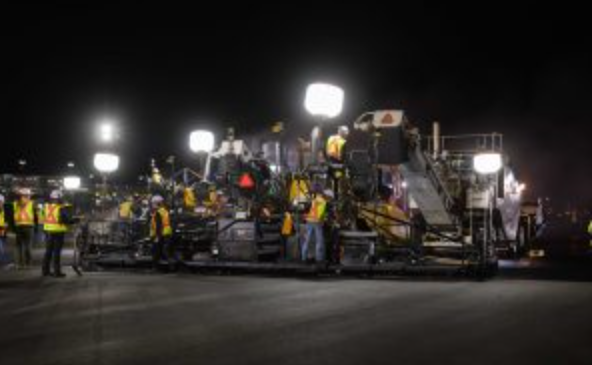
Starting at 10 p.m. each night, crews worked on the massive runway, adding layers of asphalt over a six-month period. Image: Vancouver International Airport
Innovative Paving Technology and Collaboration Overcome Challenges
According to the Amrize team, all parties shared a clear understanding of the project objectives and worked collaboratively to address challenges as they arose.
The project rehabilitated the nearly three-kilometer (1.86 miles) runway, originally constructed in the 1990s, without disrupting daily flight operations at one of the country’s busiest airports.
Crews completed milling, paving, compaction, inspection, and cleanup each night so the runway could reopen safely for daily flight operations the following morning. This approach was repeated consistently over the six-month duration.
More than 154,000 metric tonnes (170,000 US tons) of advanced, high-performance asphalt were installed across existing concrete panels of the full length of the runway and 11 connecting taxiways to re-establish the required profile and enhance long-term performance.
At the heart of the project was Canada’s first-ever 20-meter echelon asphalt milling and paving operation, achieved using two synchronized 10-metre screeds.
“This approach allowed large sections of runway to be rehabilitated efficiently within extremely short overnight construction windows, while maintaining the precision and quality standards required for active airport operations,” the Amrize project team said in its statement.
Sustainable Materials for Long-Term Performance
For Amrize, the work underscored how advanced materials and planning can support complex infrastructure projects under demanding conditions.
The company supplied an asphalt mix engineered and produced locally at its Mitchell Island plant in Vancouver. The mix is [Canada] Environmental Product Declaration (EPD)-certified and designed with enhanced resistance to fatigue-cracking, enabling it to withstand heavy aircraft loads and Canada’s extreme temperature swings.
“Transforming YVR’s north runway was a once-in-a-generation project,” said Lincoln Kyne, regional president, aggregates and construction materials at Amrize. “By combining high-performance asphalt with advanced paving technology, we’ve ensured the longevity, resilience, and safety of this critical piece of airport infrastructure.”
Paving the runway at night posed significant logistical challenges. They had to work to a schedule so the runway could be reopened just hours later.
Precise Planning and Coordination
The operation relied on more than 100 pieces of equipment that were mobilized each shift. They included synchronized pavers, milling machines, compactors, haul trucks, GPS-enabled control systems, and thermal imaging technology that ensured temperature uniformity and accuracy down to the millimeter.
Each phase of work was guided by detailed plans that provided a minute-by-minute breakdown of work sequencing, equipment mobilization, haul routes, and visitor viewing areas.
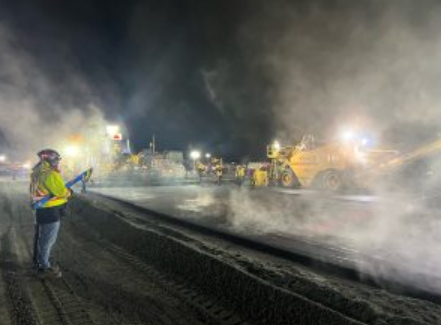
More than 154,000 metric tonnes (170,000 US tons) of advanced, high-performance asphalt were installed across existing concrete panels of the full length of the runway and 11 connecting taxiways to re-establish the required profile and enhance long-term performance. Image: Vancouver International Airport
During project work, plans were submitted that described the activities of all the trades and expected production targets. Planning efforts also incorporated contingency scenarios and mock trials for mobilization and equipment failure response.
“To ensure long-term runway performance and surface consistency, Amrize used advanced paving technologies combining GPS-guided grade control and real-time thermal imaging,” the company noted. “Digital surface models and fixed reference points allowed the paving screed to be automatically adjusted in real time, achieving millimetre-level accuracy.”
Thermal imaging was used immediately behind the screed to monitor temperature uniformity and identify potential thermal segregation – a known cause of premature pavement cracking and reduced pavement life.
By detecting temperature variations as paving progressed, crews were able to make real-time adjustments between passes and shifts, ensuring consistent compaction and creating smoother joints and a more durable runway surface.
Exemplifies What’s Possible
The Amrize project team says the venture exemplifies what’s possible when advanced materials meet precision engineering, sound planning, and execution.
“The project highlighted how high-performance, innovative building solutions, combined with an unparalleled footprint and a highly efficient distribution network, can support complex infrastructure work under demanding constraints.
“The success of the project demonstrates the potential to apply this paving approach, technology, and material design to future airport and critical infrastructure projects where durability and minimal operational disruption are required.”
Stay Connected
Stay connected with ConstructConnect News, your source for construction economy insights, market trends, and project news.
About ConstructConnect
At ConstructConnect, our software solutions provide the information that construction professionals need to start every project on a solid foundation. For more than 100 years, our keen insights and market intelligence have empowered commercial firms, building product manufacturers, trade contractors, and architects to make data-driven decisions, streamline preconstruction workflows, and maximize their productivity. Our newest offerings—including our comprehensive, AI-assisted software—help our clients find, bid on, and win more projects.
ConstructConnect operates as a business unit of Roper Technologies (Nasdaq: ROP), a constituent of the Nasdaq 100, S&P 500, and Fortune 1000.
For more information, visit constructconnect.com

.jpg?width=180&height=180&name=Grant%20Cameron%20(1).jpg)