KEY POINTS
-
Crews are raising the Gross Dam by 131 feet using Roller Compacted Concrete, making it the tallest dam in Colorado and the largest dam raise in the U.S.
-
The $565 million project will triple the reservoir’s capacity, storing an additional 77,000 acre-feet of water to secure the water future for Colorado’s Front Range residents.
-
Construction, led by Kiewit Corp. and Barnard Construction Co., involves building 118 concrete steps and is expected to be completed by 2027, 20 years after permitting began.
Several large crawler cranes are spread across the sprawling construction site in Boulder County, Colo., northwest of Denver, where crews are raising the height of the massive Gross Dam.
Hundreds of feet below, a batch plant is making concrete that is being delivered via an extensive conveyor system to the top of the dam, where it is loaded onto trucks for placement.
The site is a beehive of activity. Hundreds of workers are raising the height of the dam by 131 feet. Once completed, the towering structure will be 471 feet tall and around 2,000 feet wide.
Expansion of the dam will allow Denver Water to triple the capacity of the reservoir and store an additional 77,000 acre-feet of water, drawn mostly from the Fraser and Williams Fork Rivers.
Total budget for the project is $565 million.
Raising the Height of a Dam
Crews are hiking the height of the dam by building 118 concrete steps from the bottom of the existing structure to the new dam crest. Each step is four feet tall with a two-foot-long setback from the step below.
Roller Compacted Concrete is being used to raise the dam. The process gets its name from the way it’s applied in the construction process. Workers place the concrete for the steps with mini-dump trucks, spread it with a small bulldozer, and then roll and compact it into place.
When complete, the structure will be the largest dam raise in the U.S. and the tallest dam in Colorado.
. 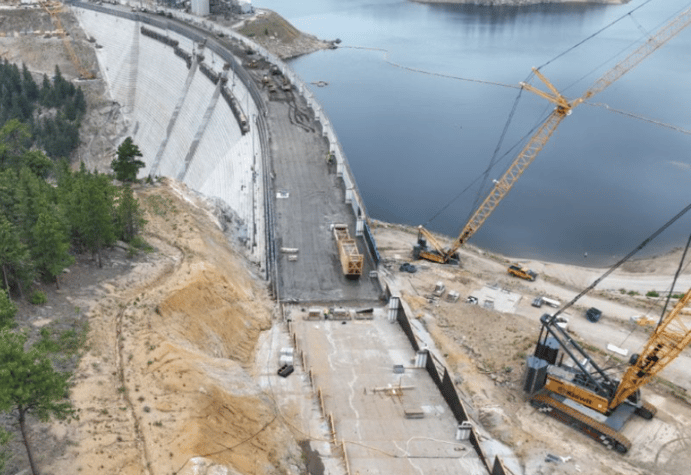
Construction is literally moving up in Boulder County, Colo., where crews are raising the height of the massive Gross Dam by 131 feet. Once completed, the towering structure will be 471 feet tall and around 2,000 feet wide. The work is being done by a joint venture of Kiewit Corp. and Barnard Construction Co. Image: Denver Water
Casey Dick, deputy program manager for the project at Denver Water, explains the task is tricky due to the step design of the dam and the fact the structure gets narrower as it gets taller.
“That means our workspace get smaller and smaller and the same operations have to happen in a much smaller space as we get taller.”
A Complex Construction Process
The finished dam will be steeper than the original structure. It will be 300 feet thick at the base and 25 feet thick at the top.
The work is being done by a joint venture of Kiewit Corp. and Barnard Construction Co. A critical part of the new construction has been building the formwork that holds concrete for the steps in place until it cures. The concrete work reached the original crest of the dam in the summer.
On the downstream side of the dam, the new section is a series of concrete steps that resemble stairs. During construction, the trucks deposited layers of concrete that make up the steps.
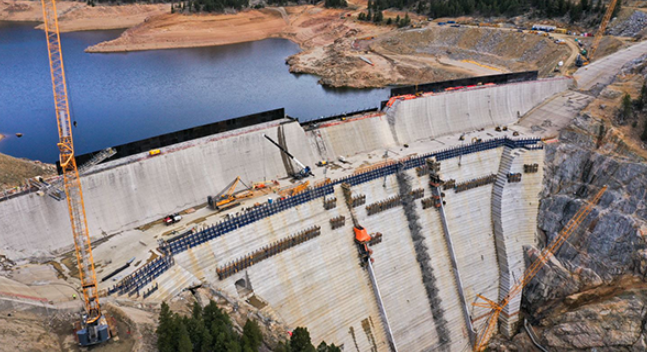
The $565 million project is hiking the height of the dam by building 118 concrete steps from the bottom of the existing structure to the new dam crest. Image: Denver Water
Construction of the new steps is expected to wrap up this year, and in 2026, workers will complete the top of the dam. A control building, electronics, concrete railing, and a bridge over the spillway will be added.
The project will be completed, and the reservoir will be filled in 2027, which will mark 20 years since permitting for the project was first sought.
Crews have been working around the clock, seven days a week, to raise the dam and intend to continue until the weather makes it too cold to do concrete work.
Project Timeline and Challenges
The shape of the dam has been altered slightly.
“The original structure was built as a curved gravity dam,” notes Dick. “Now we’re taking advantage of that curved geometry to create what is called a thick arch dam in the centre of the canyon. This arch style means the force of the water in the reservoir pushes up against the dam and into the canyon walls to give it its strength.”
Thrust blocks have been built into the sides of the original dam to give the structure additional support.
Construction for the project started April 1, 2022, but was temporarily halted last spring while court cases ran their course.
Work had been stopped because of concerns the U.S. Army Corps of Engineers did not fully consider climate change impacts when it approved the expansion. A number of environmental groups sued on the grounds the permit for the work violated several legislative acts.
The main concern was that diverting water would affect ecosystems and downstream communities. However, last May, a federal judge ruled the work could continue, but a separate injunction remains in place against filling the expanded reservoir and removing more than 200,000 trees. Denver Water is in the process of appealing that portion of the court’s decision.
Cost of the project has risen steadily over the years. Originally, a $531-million contract was approved by the Denver Board of Water Commissions in 2021 but in 2023 the figure was increased by another $31 million.
Denver Water says the project is an investment on many levels, as it provides a secure water future for residents who live on Colorado’s Front Range, and the project is creating jobs beyond the engineering and construction industries for the local and regional economy.
Stay Connected
Stay connected with ConstructConnect News, your source for construction economy insights, market trends, and project news.
About ConstructConnect
At ConstructConnect, our software solutions provide the information that construction professionals need to start every project on a solid foundation. For more than 100 years, our keen insights and market intelligence have empowered commercial firms, building product manufacturers, trade contractors, and architects to make data-driven decisions, streamline preconstruction workflows, and maximize their productivity. Our newest offerings—including our comprehensive, AI-assisted software—help our clients find, bid on, and win more projects.
ConstructConnect operates as a business unit of Roper Technologies (Nasdaq: ROP), a constituent of the Nasdaq 100, S&P 500, and Fortune 1000.
For more information, visit constructconnect.com

.jpg?width=180&height=180&name=Grant%20Cameron%20(1).jpg)