KEY POINTS
-
Stanford’s AI Index 2026 finds the United States hosts 5,427 AI data centers, more than ten times any other country, with most leading AI chips fabricated by a single Taiwanese foundry, TSMC.
-
AI’s environmental footprint is accelerating, as training xAI’s Grok 4 emitted an estimated 72,816 tons of CO₂e, while GPT‑4o’s annual inference water use alone may exceed the drinking water needs of 12 million people.
-
The challenges facing project owners and constraints on AI-related nonresidential construction projects has evolved into a multi-dimensional headwind that includes construction labor, power, water, and supply-chain exposure.
Nearly every leading AI processor installed in those US facilities is fabricated by a single Taiwanese foundry, TSMC, leaving the global AI hardware supply chain heavily dependent on one company and one geography, even as a TSMC–U.S. expansion began in 2025.
The AI Index also provides an estimate of the scale of AI’s resource demands. AI data center power capacity has climbed to 29.6 gigawatts, roughly comparable, the Stanford report indicated, to New York State at peak electricity demand.
Training xAI’s Grok 4 alone is estimated to have produced more than 72,000 metric tons of CO₂ equivalent, while the annual inferred water usage of GPT‑4o may exceed the drinking water needs of 12 million people, according to the Standford report.
Those figures frame the kind of energy and water systems today’s nonresidential projects must accommodate.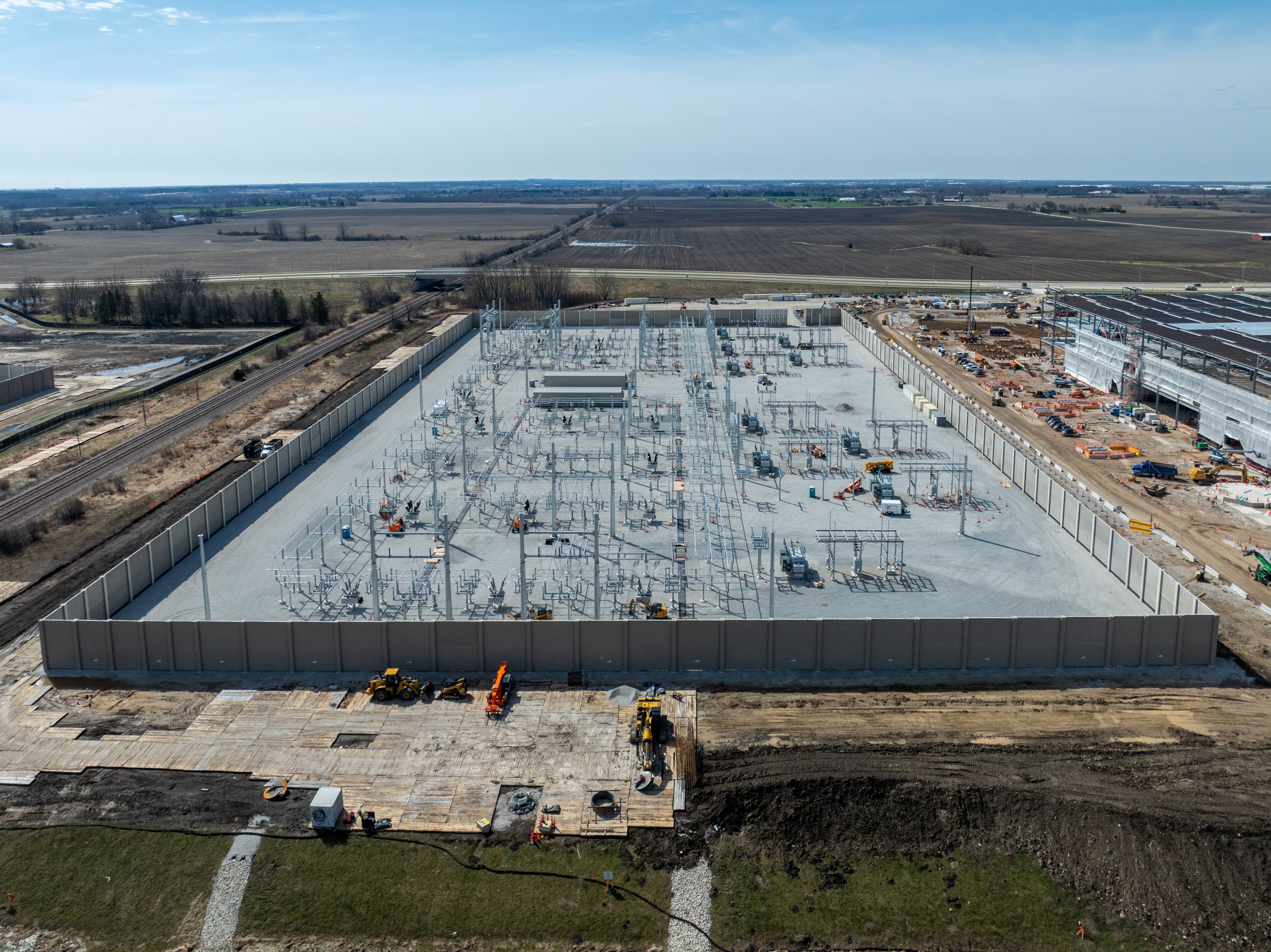
A 2026 image of a Microsoft data center construction site with electrical substation infrastructure and ongoing development in Mount Pleasant, Wisconsin. Image: Shutterstock
AI Buildout is Already Reshaping the U.S. Nonresidential Landscape
According to the April 2026 ConstructConnect Data Center Report, the AI buildout is already reshaping the U.S. nonresidential landscape.
ConstructConnect data show that in February 2026, U.S. data center construction starts totaled $11.5 billion, pushing year‑to‑date spending to $36.9 billion, compared with just $1.4 billion over the same period in 2025.
January’s unprecedented $25.4 billion in starts remains the single largest monthly total on record and has lifted the 12‑month moving average for data center starts to $9.7 billion per month, ConstructConnect economists Michael Guckes and Devin Bell reported.
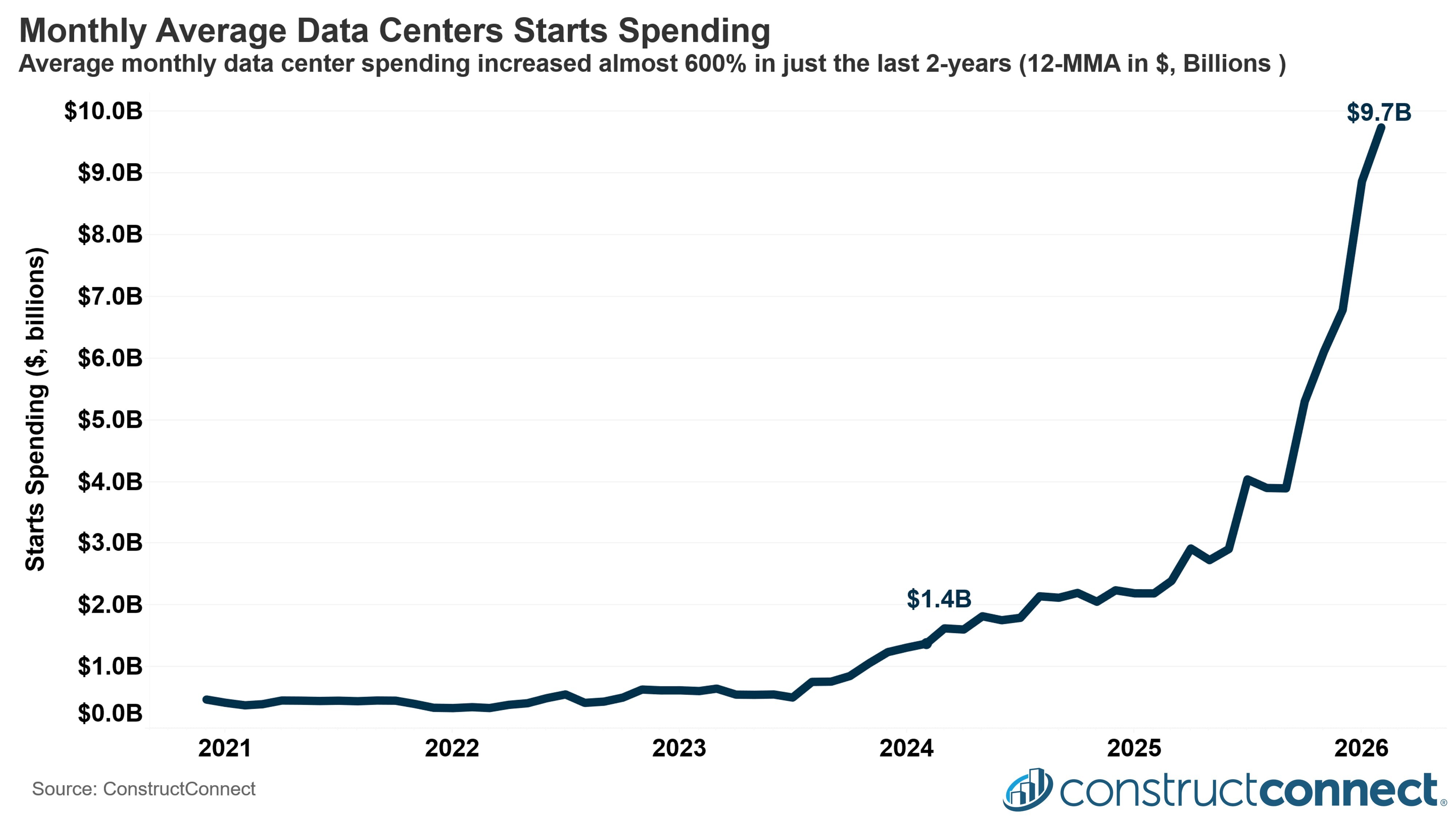
The combined January and February 2026 results have elevated the 12-month moving average for datacenter starts spending to $9.7 billion, as shown in the chart above. If this pace holds steady, full-year spending for 2026 would reach $116.4 billion. Image and Data: ConstructConnect
Looking ahead, ConstructConnect is tracking $70.8 billion in additional data center projects scheduled to start within the next six months. These projects are concentrated in the South Central and Southeast, with additional hotspots in Pennsylvania, Indiana, Ohio, and Oregon, ConstructConnect economists stated.
However, it is important to note that these projects are in various stages of preconstruction and are not guaranteed to break ground as currently scheduled. While not every project will advance, the pipeline underscores how AI‑related demand is embedded in the outlook.
AI Buildout Faces Multi-Dimensional Headwinds
In 2025, Power Infrastructure construction starts in the United States, surpassed $36 billion for the first time on record according to ConstructConnect data.
Power Infrastructure starts are forecast in 2026 to grow by 31.6% year‑over‑year, specifically to keep up with the energy demands of new data center developments, according to ConstructConnect forecast data.
For owners, utilities, suppliers and contractors, an implication is that the growth will be defined as much by substations, high‑voltage connections, and water‑efficient cooling systems as by chips and algorithms.
With U.S. data center counts, construction volumes, and power infrastructure accelerating, a challenge for the industry is no longer whether AI will drive work, but how well it can deliver the power, water, and grid resilience needed to support it.
And there's the construction labor issue.
The Stanford report does not directly address who builds that infrastructure, but recent coverage from ConstructConnect News pointed to data around labor constraints. A Randstad USA analysis of more than 150 million U.S. job postings between 2022 and 2026 found that demand for robotics technicians rose 113%, HVAC engineers 78%, and industrial automation roles 51%.
General trade demand for electricians, welders, and construction specialists rose roughly 30% as data centers, power systems, and automated facilities expand.
The Randstad report noted it now takes 56 days on average to hire a skilled trades worker (slightly longer than the 54‑day average for desk‑based professionals). There is also the problem of attrition. For every 100 young workers entering the trades, 102 are exiting, equal to an annual decline of 1.72% in the pipeline.
Taken together, the AI Index 2026 data and the Randstad findings of skilled-trades demand suggest the same conclusion. The challenges facing project owners and constraints on AI-related nonresidential construction projects has evolved into a multi-dimensional headwind that includes construction labor, power, water, and supply-chain exposure.
Stay Connected
Stay connected with ConstructConnect News for construction industry news and construction market analysis to stay ahead of what’s building next.
About ConstructConnect
At ConstructConnect, our software solutions provide the information that construction professionals need to start every project on a solid foundation. For more than 100 years, our keen insights and market intelligence have empowered commercial firms, building product manufacturers, trade contractors, and architects to make data-driven decisions, streamline preconstruction workflows, and maximize their productivity. Our newest offerings—including our comprehensive, AI-assisted software—help our clients find, bid on, and win more projects.
ConstructConnect operates as a business unit of Roper Technologies (Nasdaq: ROP), a constituent of the Nasdaq 100, S&P 500, and Fortune 1000.
For more information, visit constructconnect.com