KEY POINTS
-
Chicago's Foundry Park amends the previous $6B Lincoln Yards plan with a scaled-down, phased mixed-use development on the 30-acre former Finkl Steel site along the north branch of the Chicago River.
-
Developer JDL Corp expects construction to begin in October, with Phase 1 costing $800 million and the full neighborhood completed in seven years.
-
The project calls for around 3,300 residences, ground-floor retail, a boutique hotel, and two modern high-rise riverfront glass towers.
What was old is new again. And what was old has also been changed.
In the first case, a new major mixed-use development along the north branch of the Chicago River harks back to the city’s industrial past and an old steel plant. In the second, in a post-COVID-19-era characterized by financial constraints and a demographic rethink, a scaled down community will replace one that was primed for massive towers.
The first proposal for the site was known as Lincoln Yards. The second – expected to be under construction this October – is Foundry Park.
“Foundry” is a reference to the one-time Finkl Steel plant on a 30-acre triangular piece of land five miles northwest of the city’s downtown Loop.
Local developer Jim Letchinger of JDL Development (his partner is Kayne Anderson Real Estate) told Chicago’s Plan Commission his plan amends a previous $6 billion one by Chicago’s Sterling Bay that had “much more substantial density and much larger buildings…There are a couple of large buildings but for the most part we brought the density way down.”
He said the plan has already been well vetted by the community.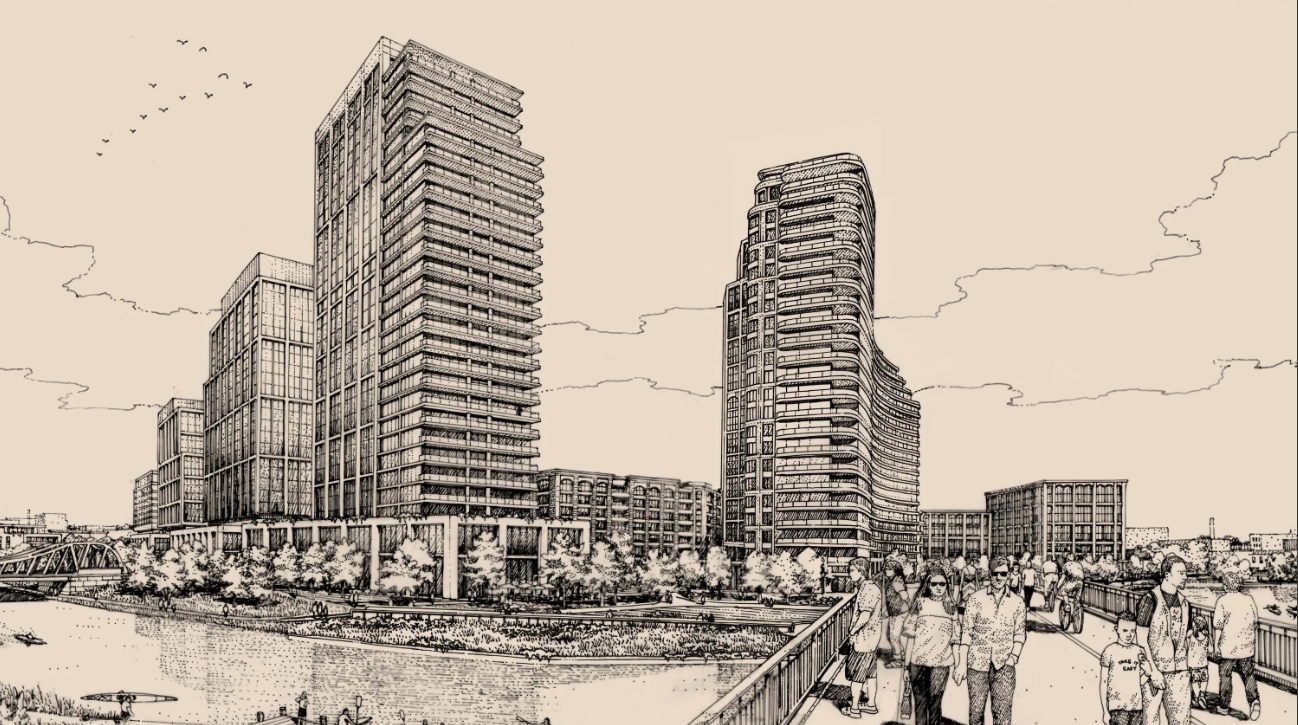
A close-up view of the planned Riverwalk along the North Branch of the Chicago River. Image: JDL Development
Contextual with Design of Adjacent Neighborhood
The fallow site had long been a tough nut to crack because of its “industrial legacy” and “fragmented ownership” as well as dated infrastructure, Kheir Al-Kodmany, professor or urban planning and policy at University of Illinois Chicago, told the Daily Commercial News.
The new plan calls for two modern high-rises along the river, but beyond the river buildings “very much contextual with the design of the existing (adjacent) neighborhoods” such as Bucktown and Lincoln Park, Letchinger told the plan commission in February.
The riverfront glass towers – some 40 stories – though, are “very representative” of the “great architecture” already existing along the river, he said. As well, a half mile Riverwalk and hoped for extension of the city’s Bloomingdale Trail walking and cycling path will extend west to east through the project.
The scaled down interior features low to midrise buildings in close proximity to parks with river access and two acres of public space.
Some 3,300 residences – 20 per cent affordable – would be built along with ground floor retail. A boutique hotel is also in the works. Phase one would cost $800 million with the overall neighborhood completed in seven years. Letchinger said 600 to 800 construction jobs would be created and 2,500 permanent ones.
The scaled down development by Hartshorne Plunkard Architecture make sense, Al-Kodmany said.
Phased Approach Based on Economic Shifts
“Broader economic shifts — particularly the restructuring ofoffice demand after COVID-19, rising construction costs, and tighter financing — have reinforced the need for more cautious, phased approaches,” he said. “Together, the site’s industrial history and current economic realities have contributed to a slower but more deliberate trajectory.”
The plan also will connect existing neighborhoods like Bucktown and Lincoln Park.
“By reintroducing a finer-grained street network, improving pedestrian and bicycle infrastructure, and activating the riverfront, it can help ‘stitch’ together previously disconnected areas,” Al-Kodmany agreed.
The project has the backing of local city alderman Scott Waguespack who called it “much needed.”
He told the commission the developer will improve immediate streets and pedestrian access.
“I think this is a plan that I am confident will really transform this area.”
Alderman Brian Hopkins called it a “superior plan.”

But he voted against it because of lack of public street infrastructure funding – previously estimated at $800 million – connecting the development to surrounding districts. He blamed the city.
“You cannot expect the developer to pay for all of that,” he said. The fact the city hasn’t stepped up is “inexcusable.”
Al-Kodmany said there may be a silver lining.
“Phased infrastructure reduces financial risk, avoids overbuilding and promotes more efficient use of resources. While it may slow early momentum, it can ultimately support a more stable and resilient development process.”
Stay Connected
Stay connected with ConstructConnect News, your source for construction economy insights, market trends, and project news.
About ConstructConnect
At ConstructConnect, our software solutions provide the information construction professionals need to start every project on a solid foundation. For more than 100 years, our keen insights and market intelligence have empowered commercial firms, building product manufacturers, trade contractors, and architects to make data-driven decisions, streamline preconstruction workflows, and maximize their productivity. Our newest offerings—including our comprehensive, AI-assisted software—help our clients find, bid on, and win more projects.
ConstructConnect operates as a business unit of Roper Technologies (Nasdaq: ROP), a constituent of the Nasdaq 100, S&P 500, and Fortune 1000.
For more information, visit constructconnect.com

.jpg?width=180&height=180&name=RON%20STANG%20(2).jpg)