KEY POINTS
-
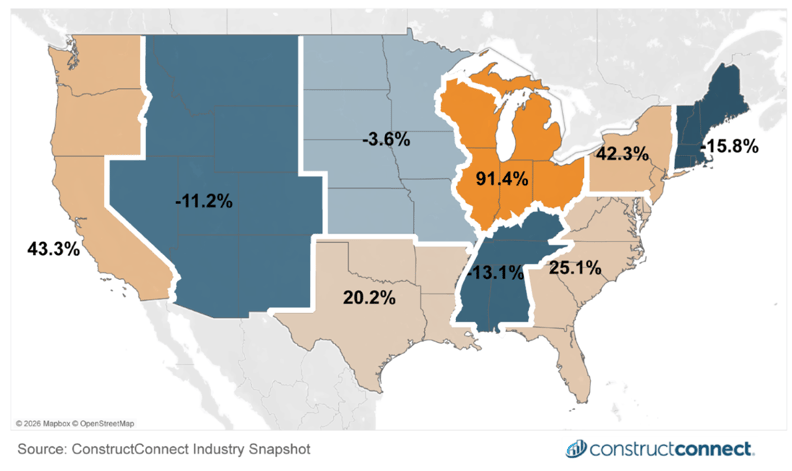
Through April, five of nine Census divisions are ahead, led by East North Central up 91.4%, Pacific up 43.3%, and Middle Atlantic up 42.3%, while New England, East South Central, and Mountain are each down more than 11%.
-
Nonresidential Building is the most uneven category. East North Central is up 180.7%, driven by Indiana up 422.7% and Illinois up 352.5%, while Mountain, New England, and East South Central are each down more than 18%.
-
Civil work is favoring coastal markets. Middle Atlantic is up 98.7% and Pacific up 72.7%, while much of the Central U.S. is flat or declining, underscoring an uneven infrastructure pipeline.
Year-to-date construction activity through April is sharply divided by geography. Five of nine Census Bureau divisions are ahead of last year’s pace, but the gap between the strongest and weakest markets is wide.
East North Central is up 91.4%, the Pacific is up 43.3%, and the Middle Atlantic is up 42.3%. South Atlantic and West South Central are also positive, up 25.1% and 20.2%, respectively. New England, East South Central, and Mountain are each down more than 11%.
West North Central is essentially unchanged.
The divergence is sharpest in Nonresidential Building (NRB). East North Central posted a 180.7% NRB gain year-to-date — a figure driven almost entirely by Indiana which was up 422.7%, and Illinois, which rose 352.5%, as a concentration of large projects lifted the entire division.
Outside of those two states, the division’s result would look far more typical. South Atlantic and West South Central are solidly positive at 47.1% and 33.9%. Mountain, New England, and East South Central are each down more than 18%, meaning contractors in those markets are competing for a meaningfully smaller pool of work than a year ago.
Civil construction is following a different pattern. The Middle Atlantic is up 98.7% and the Pacific is up 72.7%, reflecting significant infrastructure commitments in those divisions. Following behind are the Mountain and South Atlantic divisions which are up 18.3% and 25.1% respectively.
In contrast, the four Central regions are facing stalling activity if not outright declines this year. The Civil picture reinforces that infrastructure dollars are flowing to a limited set of coastal geographic markets and leaving much of the nation’s interior lagging behind.
Stay Connected
Stay connected with ConstructConnect News for construction industry news and construction market analysis to stay ahead of what’s building next.
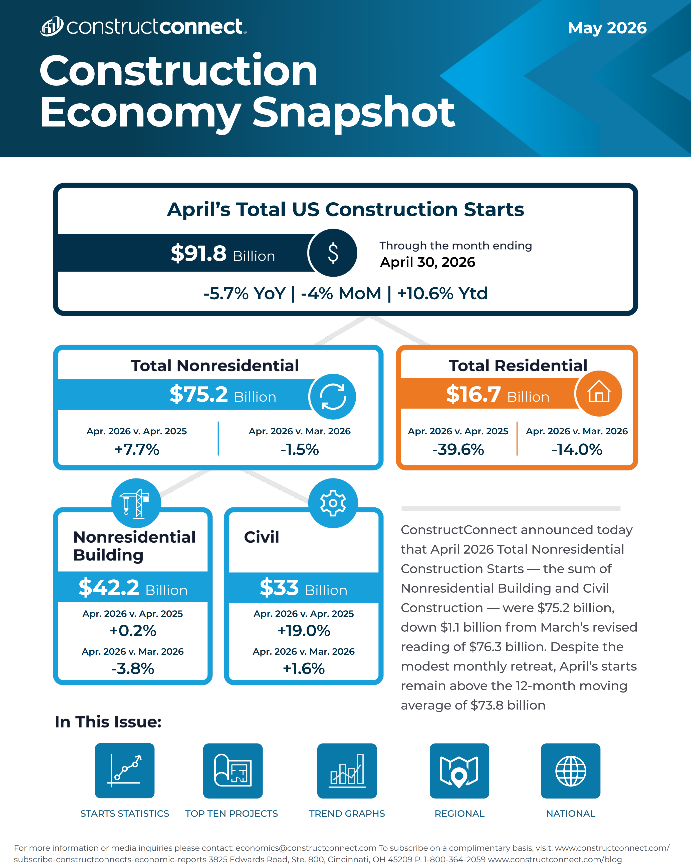
Read the Construction Economy Snapshot for more details on construction starts, trends, and regional analysis.
About ConstructConnect
At ConstructConnect, our software solutions provide the information construction professionals need to start every project on a solid foundation. For more than 100 years, our insights and market intelligence have empowered commercial firms, manufacturers, trade contractors, and architects to make data-driven decisions and maximize productivity.
ConstructConnect is a business unit of Roper Technologies (Nasdaq: ROP), part of the Nasdaq 100, S&P 500, and Fortune 1000.
For more information, visit constructconnect.com