KEY POINTS
-
April’s construction employment totaled 8.3 million workers, a gain of 9,000 jobs from the prior month.
-
The gains were led by nonresidential specialty trades, which added 13,000 positions during the month.
-
Nonresidential building followed with a gain of 6,000 jobs, continuing a run of positive monthly results that has been one of the more consistent trends in the construction labor market.
April’s construction employment totaled 8.3 million workers, a gain of 9,000 jobs from the prior month. The gains were led by nonresidential specialty trades, which added 13,000 positions during the month.
Nonresidential building followed with a gain of 6,000 jobs, continuing a run of positive monthly results that has been one of the more consistent trends in the construction labor market. Civil construction contributed a modest 1,000 jobs.
These nonresidential gains were partially offset by losses in the residential segment, where specialty trades shed 9,000 positions and residential building contracted by 2,000 jobs — a pattern consistent with the ongoing contraction in new home construction activity.
The average construction wage in April rose to $40.97 per hour while total private sector wages also increased, ending the month at $37.41 per hour. The difference in average weekly hours worked remains historically elevated: construction workers averaged 39.3 hours per week, a premium of 5.0 hours above the total private sector average of 34.3 hours. Image: ConstructConnect
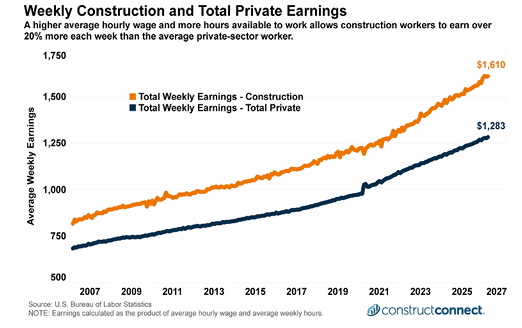
Together, the higher hourly rate and additional weekly hours bring total weekly construction compensation to $1,610, a premium of $327 — or approximately 26% — above the average total private sector worker’s weekly earnings of $1,283. This durable earnings advantage continues to make construction one of the most attractive employment options for hourly wage earners.
Stay Connected
Stay connected with ConstructConnect News for construction industry news and construction market analysis to stay ahead of what’s building next.
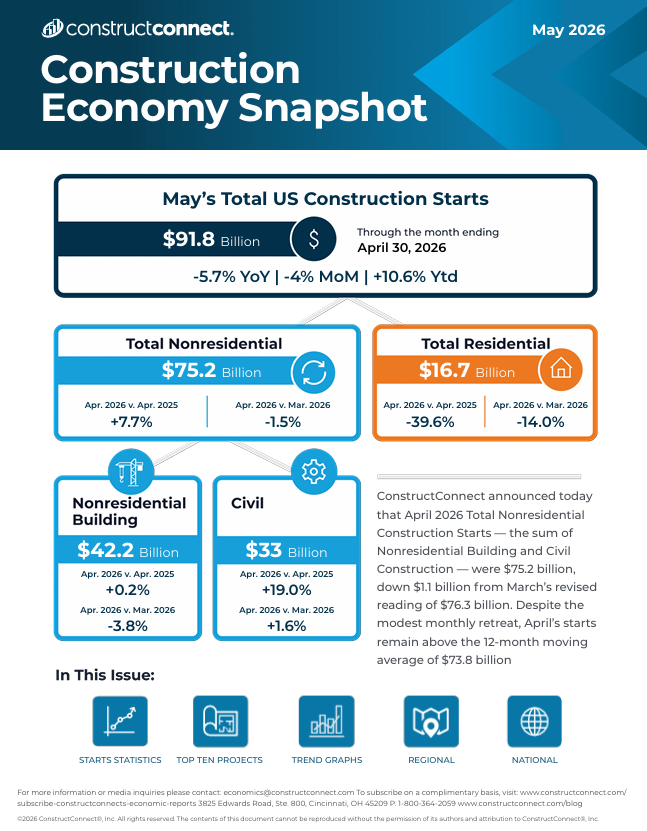
Read the Construction Economy Snapshot for more details on construction starts, trends, and regional analysis.
About ConstructConnect
At ConstructConnect, our software solutions provide the information construction professionals need to start every project on a solid foundation. For more than 100 years, our insights and market intelligence have empowered commercial firms, manufacturers, trade contractors, and architects to make data-driven decisions and maximize productivity.
ConstructConnect is a business unit of Roper Technologies (Nasdaq: ROP), part of the Nasdaq 100, S&P 500, and Fortune 1000.
For more information, visit constructconnect.com