KEY POINTS
-
Nonresidential construction was strongest in the East North Central and South Atlantic divisions, with solid gains in the West North Central and Middle Atlantic.
-
Modest to weak performance in New England, and continued, though less dramatic, growth in the Pacific and Mountain divisions.
-
Civil construction showed broader weakness, with three divisions below prior-year levels.
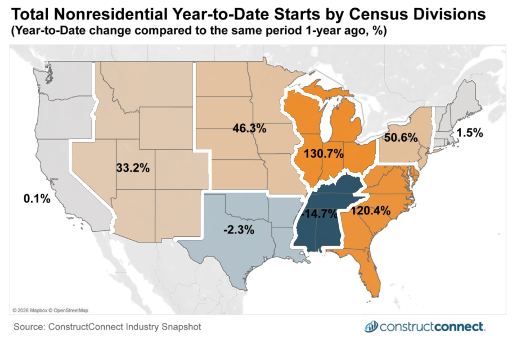
In January, the Pacific Census division saw a slight increase in nonresidential starts, while the Mountain division experienced significant growth.
The southern divisions were divided, with the East South Central and West South Central declining compared to year-ago levels, while the South Atlantic surged by 120.4%.
This growth was second only to the East North Central division, which led all regions with a 130.7% increase. The West North Central and Middle Atlantic divisions also posted strong gains, growing in the mid-40% to mid-50% range.
In contrast, New England saw more modest growth. Nonresidential building trends largely mirrored overall patterns. The Pacific and Mountain divisions remained positive, with both showing stronger gains than their overall totals.
The South divisions continued to diverge, as the West South Central joined the South Atlantic in growth, while the East South Central lagged.
The East North Central division led again, while the West North Central saw moderate expansion. New England experienced a notable contraction, while the Middle Atlantic remained strongly positive.
Civil Construction
Heavy Engineering (Civil) starts saw wider contractions in January, with three census divisions falling below year-ago levels.
Note: Limited data and natural variations in monthly spending at the subcategory level at the start of the calendar year can cause YTD results to appear highly volatile.
The Pacific division fell over 14%, while the Mountain division maintained strong growth. In the South, Civil growth was mixed.
The East South Central and South Atlantic expanded by 23.1% and 3.9%, respectively, while the West South Central declined. In the Midwest, Civil starts diverged, with the East North Central contracting and the West North Central posting strong gains.
New England led Civil starts growth with a 146.4% increase, while the Middle Atlantic saw more modest growth at 6.4%.
Stay Connected
Stay connected with ConstructConnect News for construction industry news and construction market analysis to stay ahead of what’s building next.
About ConstructConnect
At ConstructConnect, our software solutions provide the information that construction professionals need to start every project on a solid foundation. For more than 100 years, our keen insights and market intelligence have empowered commercial firms, building product manufacturers, trade contractors, and architects to make data-driven decisions, streamline preconstruction workflows, and maximize their productivity. Our newest offerings—including our comprehensive, AI-assisted software—help our clients find, bid on, and win more projects.
ConstructConnect operates as a business unit of Roper Technologies (Nasdaq: ROP), a constituent of the Nasdaq 100, S&P 500, and Fortune 1000.
For more information, visit constructconnect.com