KEY POINTS
-
April year-on-year construction materials inflation slowed to 6.7%, down from February’s 7.1%, even as iron and steel products remained up 10.3%.
-
The slowdown reflects tougher comparisons against higher post-tariff prices from last year, not a clear easing of cost pressure across the sector.
-
On a two-year basis, construction materials prices are up 9%, a level reached only a few times in the past 20 years and a signal that firms should stay disciplined on costs.
Year-on-Year (YoY) measures of many construction materials slowed in April, according to the Bureau of Labor Statistics. The YoY price change for Iron and Steel Products was 10.3%, while the broader composite price index for construction materials rose 6.7%.
For reference, in February 2026, YoY prices were up 15.3% and 7.1%, respectively — the composite’s highest reading since August 2022. Considering that the latest 70% surge in oil prices has not yet been fully reflected in prices, it seems irrational that construction inflation is slowing.
The reason for this apparent contradiction has to do with the timing of last year’s Liberation Day tariffs. Inflation readings as recently as February and March captured inflation from both the Liberation Day tariffs and the early weeks of the Iran War.
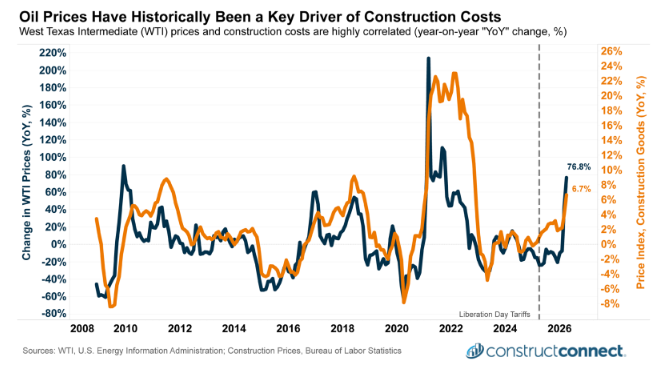
Oil prices have historically been a key driver of construction costs. Image: ConstructConnect
In contrast, the April 2026 YoY price change calculation is comparing higher post-tariff prices against the latest price hikes caused by the Iran War. In short, April data is capturing more of the impact from the Iran War, but also less of the Liberation Day tariffs.
Two-Year Inflation Puts April in Context
One way to measure the combined impact of the Liberation Day tariffs and the Iran War through present can be achieved by observing the two-year change in the composite index for construction materials prices.
Over the past two years, the composite has increased by 9%. By this measure, there have only been three times in the last 20 years when construction inflation approached or exceeded 9%.
The most recent was during COVID, and before that during 2018, when both high energy prices and tariffs on steel and aluminum brought the two-year construction inflation rate to 11%.
One then needs to go back to the Great Recession of 2007-2009 to find the third time that two-year inflation exceeded 9%.
Vigilance Still Matters for Cost Control
Considering that the Iran War remains unresolved at the time of writing, and with energy inventories and one-time maneuvers to help manage global prices rapidly drying up, construction firms should continue to be vigilant in their cost control efforts despite the recent decline in inflation readings.
Stay Connected
Stay connected with ConstructConnect News for construction industry news and construction market analysis to stay ahead of what’s building next.
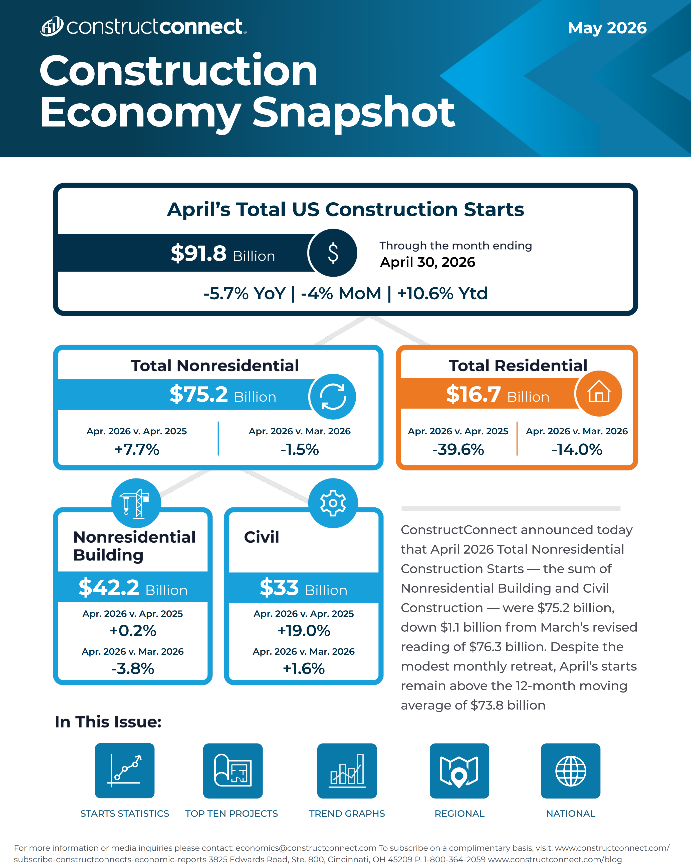
Read the Construction Economy Snapshot for more details on construction starts, trends, and regional analysis.
About ConstructConnect
At ConstructConnect, our software solutions provide the information construction professionals need to start every project on a solid foundation. For more than 100 years, our insights and market intelligence have empowered commercial firms, manufacturers, trade contractors, and architects to make data-driven decisions and maximize productivity.
ConstructConnect is a business unit of Roper Technologies (Nasdaq: ROP), part of the Nasdaq 100, S&P 500, and Fortune 1000.
For more information, visit constructconnect.com