KEY POINTS
-
Traditional bank lending is undergoing a structural shift as more construction and development capital flows through nonbank financial intermediaries.
-
Nonbank lenders now play a larger role in originating and servicing construction and commercial real estate loans, potentially offering flexibility but at higher borrowing costs.
-
Large unfunded commitments from banks to nonbank lenders raise the possibility of liquidity strains that may disrupt new construction and development loans in a downturn.
Since the 2008 Global Financial Crisis, traditional bank lending has undergone a profound structural transformation, as detailed in the February 2026 FDIC report, “Banking Issues in Focus”. This shift in lending practices is poised to impact the construction industry as alternative funding sources often come with higher costs and less transparency for owners and developers, potentially heightening stress on project funding.
Nonbank Intermediaries Show Rising Importance for Construction Lending
From 2010 to 2024, bank lending to Non-Depository Financial Institutions (NDFIs)—including private credit funds, mortgage intermediaries, and specialty lenders—expanded nearly three times faster than any other major loan category.
During this period, loans to NDFIs grew at an average annual rate of 21.9%, outpacing lending in multifamily, commercial and industrial, as well as acquisition, development, and construction sectors.
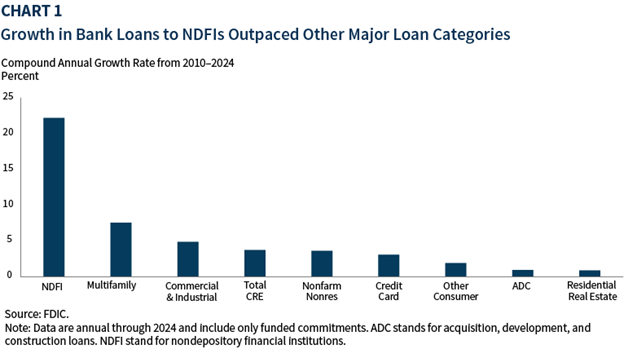
Nearly half of all NDFI lending flows to mortgage and business credit intermediaries, including direct lenders, private debt funds, and finance companies. These entities are playing an increasingly central role in originating commercial real estate financing for project owners and developers, offering faster approvals and more flexible terms.
What are the Potential Risks of NDFIs
The role of NDFIs in the construction lending market raises some concerns. While their quicker approvals and greater flexibility are appealing, these benefits often come with higher borrowing costs that can erode developer margins. This, in turn, may lead to project delays or even cancellations.
In addition to higher borrowing costs, nonbank lenders operate outside the regulatory framework that governs conventional lending standards, making it harder to detect emerging financial issues in the construction sector.
This lack of transparency increases the risk of capital flight, when even small fears might drive investors “for the exits”, along with their capital.
The opacity also extends to the broader banking system’s exposure to these institutions. Banks currently hold $987 billion in unfunded commitments to NDFIs.
While this figure represents a relatively small portion of total bank assets, a scenario in which multiple nonbank lenders simultaneously draw on these commitments could create liquidity pressures for banks, potentially limiting the capital available for new construction loans.
The Tradeoffs and Considerations Facing Construction Firms
The shift toward nonbank lending has broadened financing options for owners and developers. Importantly, it helped fill the gap left by traditional banks, which were hesitant in recent years to provide additional CRE loans, especially in the face of rising costs.
However, this comes with trade-offs, including higher borrowing costs and reduced oversight and transparency, which could lead to greater swings in annual construction starts and higher Project Stress Index readings.
For contractors, understanding the source and stability of project capital has become critical as project financing has shifted following the Great Recession. A growing segment of owners and developers is seeking funds from a more volatile and opaque lending method, possibly heightening the risk of project delays or abandonments.
Stay Connected
Stay connected with ConstructConnect News for construction industry news and construction market analysis to stay ahead of what’s building next.
About ConstructConnect
At ConstructConnect, our software solutions provide the information that construction professionals need to start every project on a solid foundation. For more than 100 years, our keen insights and market intelligence have empowered commercial firms, building product manufacturers, trade contractors, and architects to make data-driven decisions, streamline preconstruction workflows, and maximize their productivity. Our newest offerings—including our comprehensive, AI-assisted software—help our clients find, bid on, and win more projects.
ConstructConnect operates as a business unit of Roper Technologies (Nasdaq: ROP), a constituent of the Nasdaq 100, S&P 500, and Fortune 1000.
For more information, visit constructconnect.com