KEY POINTS
-
Australian construction tech company Luyten says its new ASCEND system can print concrete structures up to 100 meters (328 feet) tall within a 45-meter (148-feet) working radius, extending 3D construction beyond the low-rise projects that have defined much of the sector to date.
-
The company is pitching the platform as a way to cut labor dependency, reduce formwork, and improve material use by combining tower crane architecture with robotic concrete printing, AI path planning, and digital workflows.
-
Luyten is trying to automate around equipment already common on urban jobsites rather than asking builders to adopt an entirely separate printing setup.
Australian construction technology company Luyten has launched ASCEND, a tower crane-mounted 3D concrete printing system the company says can build structures up to 328 feet tall, pushing additive construction further into the multistory and high-rise market.
Melbourne-based Luyten described ASCEND in company materials as the world’s first robotic tower crane platform. The company says the system combines standard tower crane architecture with robotic concrete extrusion, AI-generated print paths and digital construction controls to support high-rise residential, commercial and infrastructure work.
According to Luyten, ASCEND can operate within a 148-feet radius and reach heights of up to 328 feet. The company also says the 3D printing system can be installed and commissioned in one to two days, a detail that suggests it is aiming to reduce one of the practical frictions that often slows adoption of advanced jobsite technology.
Built for Vertical Reach
That vertical reach is the main distinction in Luyten’s launch. Much of the current 3D concrete printing market has centered on lower-rise applications, temporary structures or horizontally constrained systems.
Luyten’s approach is that ASCEND uses the familiar geometry and jobsite footprint of a tower crane to move additive construction higher without requiring a wholly separate site layout.
On its product page, the company says the system was developed for multistory buildings, high-rise developments and large-scale infrastructure. In its launch announcement, Luyten framed ASCEND as a response to labor shortages, rising housing demand, productivity pressure and material waste.
Luyten founder and CEO Ahmed Mahil said in the company’s release that the idea was not to automate around the tower crane, but to turn the crane itself into a robotic construction system capable of building directly from digital designs.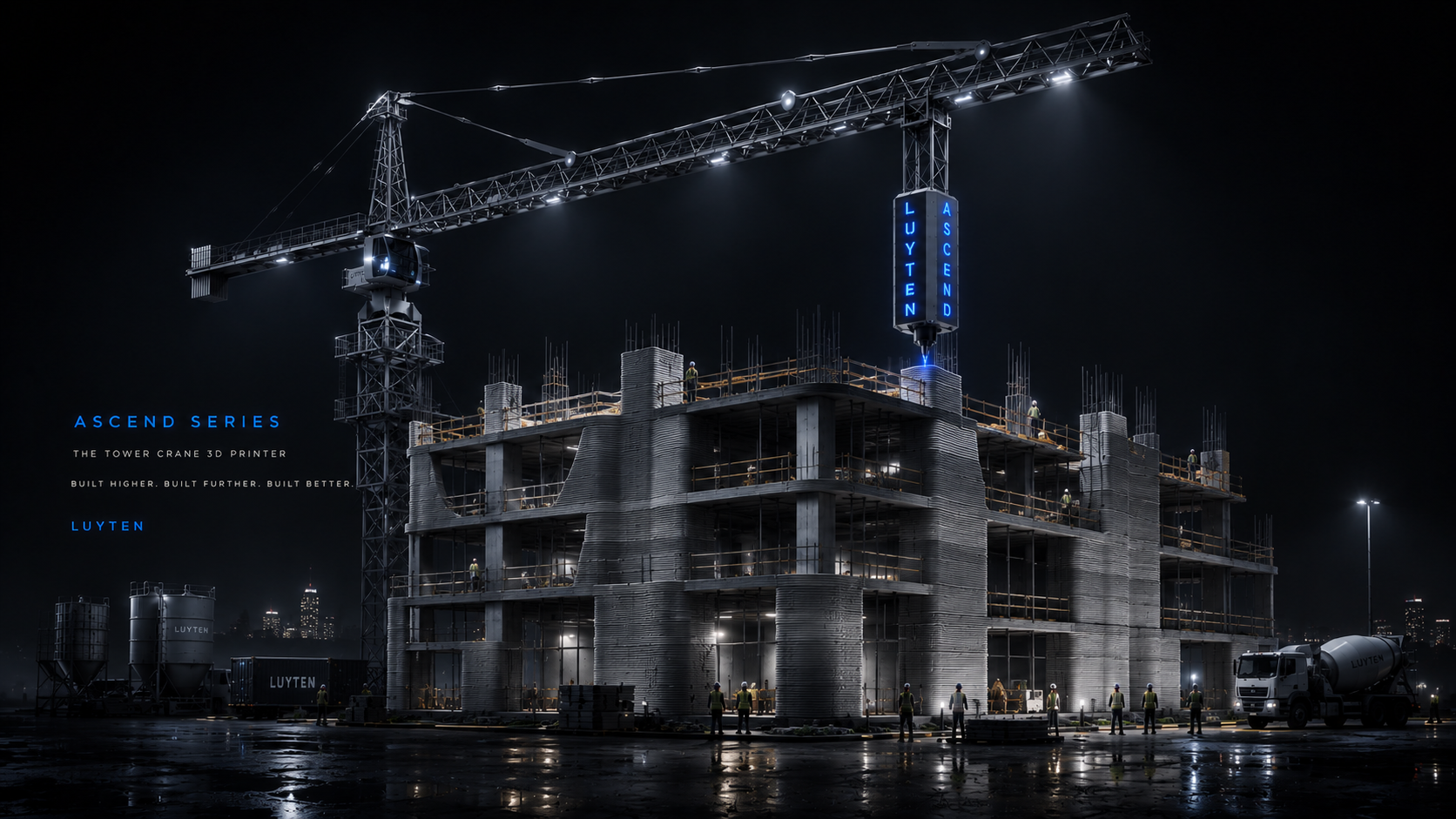
In this company-supplied image, Luyten’s ASCEND is shown as a tower crane-mounted 3D concrete printing system built for vertical construction and large-scale development. Company materials say the platform can reach 100 meters (328 feet) in height, cover a 45-meter (148-foot) working radius, deploy in one to two days, and use AI-driven automation to reduce labor dependency. Image: Luyten
A Familiar Machine, Recast as a Robot
Tower cranes are already embedded in dense urban settings, dotting construction sites worldwide. Rather than asking contractors to make room for a separate gantry-style printer, Luyten is positioning ASCEND as a way to layer automation onto a machine class the industry already understands.
The company says the platform is designed to reduce labor dependency, minimize formwork, and improve material usage. It also says the printer is supported by its proprietary Ultimatecrete printable concrete mix, which it describes as engineered for large-scale manufacturing with controlled flow properties and stronger layer-to-layer bonding for multistory work.
Luyten further said the system uses AI to generate print paths, optimize workflows, and monitor progress in real time.
If those capabilities perform as advertised in the field, they could make the platform more relevant to contractors balancing schedule pressure, labor constraints, and repeatability on larger jobs.
What Construction Should Watch
Luyten is trying to align automation with existing site infrastructure instead of replacing it. That could make the concept more appealing on projects where crane access, vertical reach, and site congestion already shape execution.
The larger question now is how quickly and effectively the system moves from launch into project use. Luyten’s announcement lays out a value proposition for high-rise and infrastructure work. The next test will be whether contractors see enough schedule, labor, and material upside to move tower crane-based printing from concept to procurement.
One additional question for the U.S. market is availability. Public launch materials do not clearly say whether ASCEND is already commercially available in the United States. ConstructConnect reached out to company officials for comment. Although Luyten has established some North American presence through earlier agreements to supply its Ultimatecrete material for projects in the United States and Canada.
Stay Connected
Stay connected with ConstructConnect News for construction industry news and construction market analysis to stay ahead of what’s building next.
About ConstructConnect
At ConstructConnect, our software solutions provide the information that construction professionals need to start every project on a solid foundation. For more than 100 years, our keen insights and market intelligence have empowered commercial firms, building product manufacturers, trade contractors, and architects to make data-driven decisions, streamline preconstruction workflows, and maximize their productivity. Our newest offerings—including our comprehensive, AI-assisted software—help our clients find, bid on, and win more projects.
ConstructConnect operates as a business unit of Roper Technologies (Nasdaq: ROP), a constituent of the Nasdaq 100, S&P 500, and Fortune 1000.
For more information, visit constructconnect.com