KEY POINTS
-
The Franklin at 11th Street Station is the state’s first Transit-Oriented Development, transforming Michigan City into a hub for young professionals and creative-class residents.
-
The $101-million project has spurred downtown growth, including new housing, restaurants, and urban developments, with 5,000 newcomers expected within a decade.
-
The South Shore Line’s double-tracking has cut commute times to Chicago to 65 minutes, making Michigan City a competitive alternative to Chicago's suburbs.
A Game-Changing Development for Michigan City
Michigan City, on the southern shore of Lake Michigan, 60 miles from Chicago, has been a sleepy working-class town that sees a population surge in the summer as middle- and upper-class vacationers return to their beachfront cottages.
Now it’s on the cusp of a demographic and downtown boom, as the first of several developments – a catalyst for others – is set to open in a few months.
The Franklin: A Modern Urban Living Experience
The Franklin at 11th Street Station is new and different for several reasons.
It’s the first large-scale apartment complex to be built in northwest Indiana in decades and one of only three of its kind now going up in the entire state.
It will bring younger professionals to a more relaxed, natural destination than living in urban Chicago. And, linked to that, it is the state’s first Transit-Oriented Development (TOD).
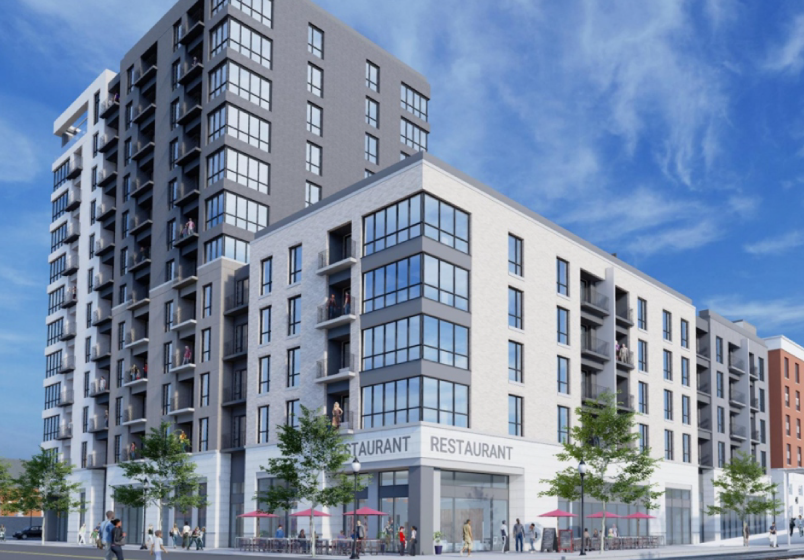
An artist’s rendering of The Franklin at 11th St. Station in Michigan City. Image: Economic Development Corp. of Michigan City
The project wouldn’t have been possible without the South Shore Line, a commuter railway linking Indiana to Chicago, and its double tracking of the Michigan City line, shortening the commute to the Windy City to 65 minutes.
The previous ride took at least two hours.
Concordant with this, a new station at 11th Street was built, and The Franklin is now integrated into it.
Clarence Hulse, executive director of the Economic Development Corp. of Michigan City, said the double tracking was undoubtedly a “game changer” for the just over 30,000 population community.
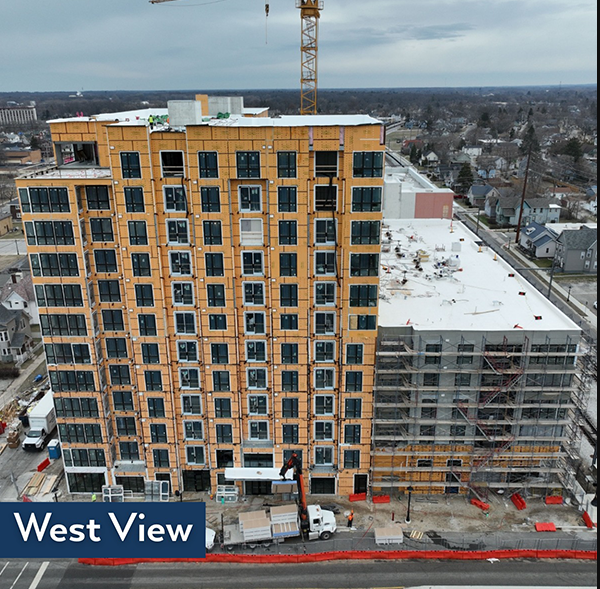
West view of the partially completed The Franklin. Image: Economic Development Corp. of Michigan City
“I think what you’ll start seeing is much more middle class with more financial and IT approach,” he said. “People who are moving here are much more into that creative class and have higher incomes.”
And the commute is really no different, time-wise, from suburban Chicago itself.
South Shore Line: Connecting Indiana to Chicago Faster
“If you live in north Chicago, Evanston, Schaumburg, Niles, Libertyville, you’re an hour, hour-and-a-half away anyway, by car, by train,” he said, “So, we are in the same timeframe as being in north or west Illinois, into downtown Chicago.”
Meanwhile, the tax rates are lower in Indiana – “that difference between the two states makes it attractive.”
The $101-million, 430,000-square-foot, 12-storey Franklin will offer 220 market-rate rental apartments and 5,600 square feet of ground-floor retail and restaurant space.
The 1.5-acre site includes a 500-plus-space parking garage.
The building includes contemporary big-city amenities such as heated swim spas, an outdoor movie screen and lounge, a coworking cafe, conference rooms, a pet spa and dog park, a gym, fire pits and grilling decks, and EV charging stations.
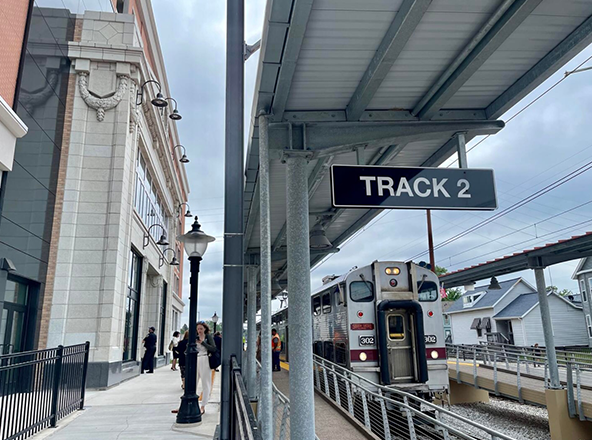
South Shore Line train station linking Michigan City, IN, with downtown Chicago. Image: Economic Development Corp. of Michigan City
Units will have modern finishes, stainless steel appliances, quartz countertops, LED lights, washers and dryers, and private balconies. There’s also a rooftop lounge affording panoramic views of Lake Michigan.
Newer Urban Developments
Meanwhile, there have been new urban developments, such as the lakeside Blue Chip Casino Hotel Spa and the Uptown Arts District.
Hulse says The Franklin has already spawned many new apartments, townhomes, condos, and $5 million in rehabs alone in downtown, along with a dozen new restaurants. Hulse expects some 5,000 newcomers to be living downtown within a decade.
“We have over 2,000 housing units in the city right now being developed,” including the first new subdivision in 50 years with 115 homes, Hulse explains.
Moreover, infill is taking place in the core, “you know, five, 10, 20 acres are being bought and turned into homes, whether it’s single family, duplex, or townhomes.”
Hulse admits it was a long process to get financiers on board, as there were next to no “comps” or comparable buildings for reference, so those had to be drawn from a wider radius.
The state itself came on board with $33 million in tax incentives.
Stay Connected
Stay connected with ConstructConnect News for construction industry news and construction market analysis to stay ahead of what’s building next.
About ConstructConnect
At ConstructConnect, our software solutions provide the information construction professionals need to start every project on a solid foundation. For more than 100 years, our keen insights and market intelligence have empowered commercial firms, building product manufacturers, trade contractors, and architects to make data-driven decisions, streamline preconstruction workflows, and maximize their productivity. Our newest offerings—including our comprehensive, AI-assisted software—help our clients find, bid on, and win more projects.
ConstructConnect operates as a business unit of Roper Technologies (Nasdaq: ROP), a constituent of the Nasdaq 100, S&P 500, and Fortune 1000.
For more information, visit constructconnect.com

.jpg?width=180&height=180&name=RON%20STANG%20(2).jpg)