KEY POINTS
-
Through the end of Q1 2026, hospitality, health care, and civil infrastructure construction starts posted sizable gains.
-
Over the same period, venues, manufacturing, and some civil work are in retreat, as major sports, airport, factory, warehouse, and amusement starts decrease.
-
Through Q1 2026, starts data show a more varied opportunity mix by subcategory, even as private offices including data centers remain the dominant growth engine and main focus of owner spending.
The standout story in 2026 construction starts is the nearly fourfold surge in Private Office projects, which include Data Centers, compared to the average of the previous two years. This growth outpaces the next strongest category by more than two and a half times, underscoring the massive capital investment in digital infrastructure and AI facilities.
Data center developments require extensive electrical production, distribution, and backup systems, as well as advanced water and cooling capabilities, and significant structural and site work. Companies specializing in concrete, structural steel, and electrical work are well-positioned to capitalize on the opportunities emerging in this booming segment.
Hospitality and Healthcare Rebound
Beyond the data center-driven Office subcategory, the Hospitality and Healthcare sectors are showing impressive growth. Hotels and Motels have surged by 149.8% year-to-date compared to the same period last year, with Hospitals and Clinics not far behind with a 116.5% increase. These figures highlight a rise in investment across lodging and healthcare construction.
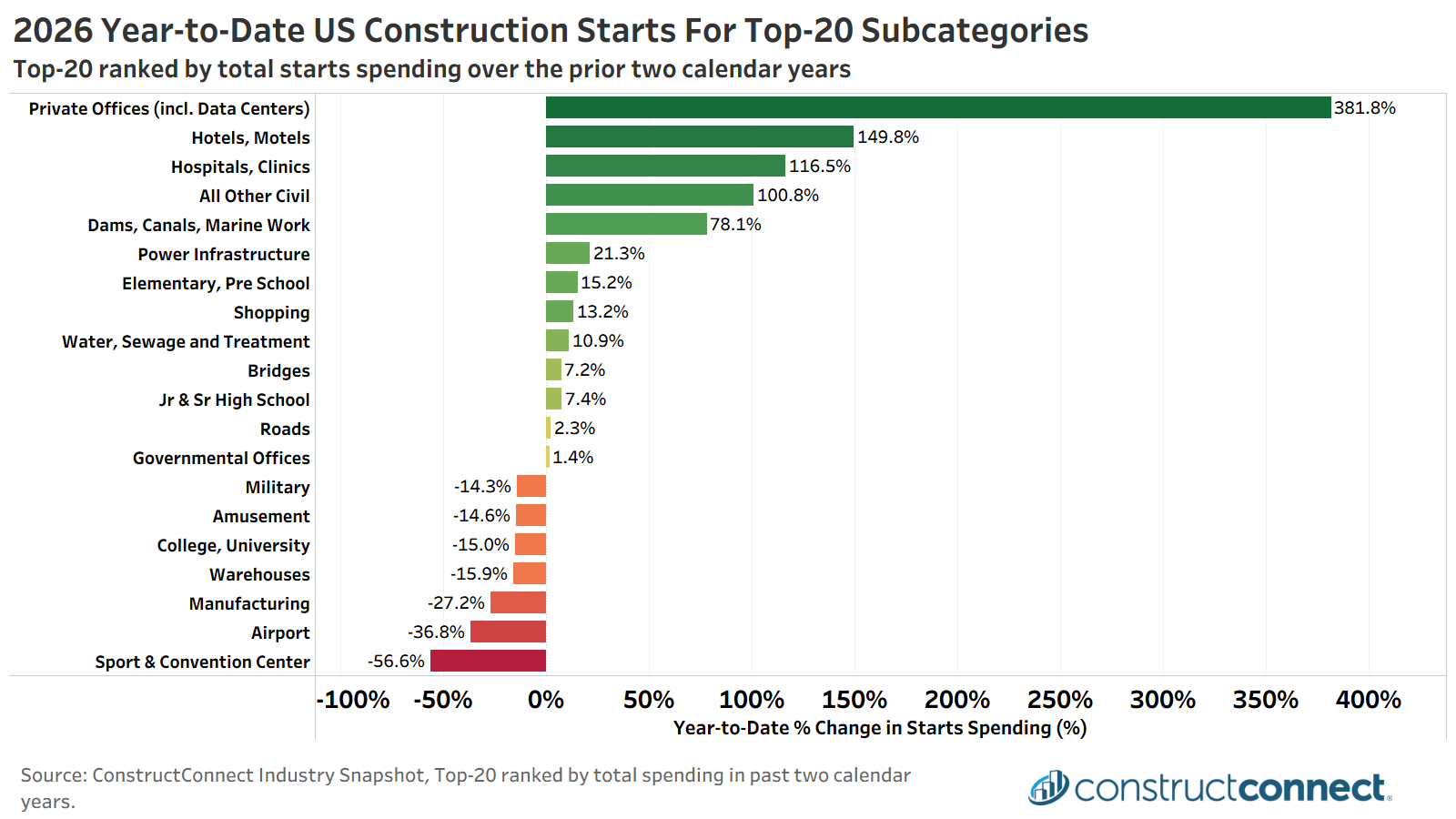
Year-to-date 2026 construction starts for the top-20 subcategories by total spending over the prior two calendar years. Image and Data: ConstructConnect Industry Snapshot.
Civil Work and Power Infrastructure Provide a Steady Backbone
Several Civil construction categories are experiencing notable growth, including a 100.8% increase in All Other Civil starts, a 78.1% rise in Dams, Canals, and Marine work, and a 21.3% uptick in Power Infrastructure starts.
Together, these gains suggest that infrastructure spending remains strong for contractors focused in the area. Further, work tied to water management, coastal and river systems, and the electrical grid have continued to convert to actual starts.
For firms active in sitework, heavy civil, and utility specialties, these segments provide strength as general demand and frequent connections to data centers and industrial facilities provide continued need for these types of construction.
Education, Shopping, and Public Offices: Modest but Positive
A mixed bag of other construction subcategories is also showing growth, albeit at a more moderate pace. Elementary and Preschool facilities are up 15.2%, Shopping Centers have increased by 13.2%, and Water, Sewage, and Treatment work has risen by 10.9%. Bridges are up 7.2%, Junior and Senior High Schools have grown by 7.4%, Roads by 2.3%, and Government offices by 1.4%.
These figures underscore how several less prominent construction subcategories are achieving solid year-to-date growth, even if they are receiving less attention.
Manufacturing, Warehouses, Airports, and Venues Pullback
On the downside, several subcategories are experiencing double-digit declines. Sports and Convention Centers are down 56.6%, Airports have dropped 36.8%, Manufacturing is down 27.2%, Warehouses have declined 15.9%, College and University projects are down 15.0%, Amusement work has decreased 14.6%, and Military construction has fallen 14.3%.
Following multiple years of substantial investment in manufacturing, warehouses, and airports, the year-to-date data for 2026 suggests a period of contraction for these subcategories.

What It Means for Construction
The year-to-date landscape for 2026 reveals an uneven yet opportunity-rich market for construction firms.
For those seeking growth, investment has been concentrated in the data center-driven office subcategory, alongside strong performance in the healthcare and hospitality sectors. Several other subcategories, including certain educational, retail, and civil construction sectors, are poised for continued expansion.
Conversely, declines in various community, industrial, and civil subcategories highlight the market's unevenness so far in 2026.
ConstructConnect is continuing to closely monitor how data centers and related power infrastructure influence the construction market, as well as whether lagging categories—such as airports, sports venues, and manufacturing—experience a rebound in the second half of the year.
Stay Connected
Stay connected with ConstructConnect News for construction industry news and construction market analysis to stay ahead of what’s building next.
About ConstructConnect
At ConstructConnect, our software solutions provide the information that construction professionals need to start every project on a solid foundation. For more than 100 years, our keen insights and market intelligence have empowered commercial firms, building product manufacturers, trade contractors, and architects to make data-driven decisions, streamline preconstruction workflows, and maximize their productivity. Our newest offerings—including our comprehensive, AI-assisted software—help our clients find, bid on, and win more projects.
ConstructConnect operates as a business unit of Roper Technologies (Nasdaq: ROP), a constituent of the Nasdaq 100, S&P 500, and Fortune 1000.
For more information, visit constructconnect.com