KEY POINTS
-
Orlando, Florida, commissioners approved a $160M financing plan to fund downtown revitalization projects, including walkability improvements and the transformation of underused spaces.
-
Key projects include The Canopy, Church Street upgrades, Lake Eola enhancements, and two-way street conversions on Orange and Rosalind Avenues.
-
Construction is expected to start in 2026, with major projects expected to be completed by 2027 - 2028.
The city of Orlando, FL, has taken a step toward reshaping its downtown area by approving a $160 million financing plan to fund several multimillion-dollar projects.
According to a report from WFTV9 on February 9, 2026, city commissioners voted on Monday to use Tax Increment Revenue Bonds to finance a series of projects aimed at increasing foot traffic, improving walkability, and revitalizing underused spaces in downtown Orlando.
The Canopy Aims to Transform Underused Space
One of the centerpiece projects funded by the bonds is the Canopy, a $30 million initiative to transform 10 acres beneath I-4 into a multifunctional urban space.
The Canopy will feature at least 300 parking spaces, a rideshare hub, and a landscaped gathering area. Construction is set to begin this summer, with completion anticipated in 2027 or early 2028.
David Barilla, executive director of the Downtown Development Board, expressed optimism about the upcoming developments. “I jokingly say that this year in downtown, it will be shovel after shovel, but that couldn’t be more spot on,” Barilla said.
He noted that the city’s plans are the result of years of research and community feedback. “We used all of that combined with very high-level research to kind of set the course for us,” he added. You can view some of that research from the Orlando Downtown Development Board here.
Funding for Multiple Construction Projects
In addition to the Canopy, the $160 million in CRA bonds will fund several other projects, including roadway improvements along Church Street, enhancements to Lake Eola Park, and the conversion of Orange Avenue and Rosalind Avenue into two-way streets.
These efforts, according to officials, aim to create a more pedestrian-friendly and vibrant downtown environment.
City officials also provided an update on the nearby Church Street infrastructure project during Monday’s meeting, according to WFTV9. The project will introduce landscaping, slow vehicle traffic, and create a curbless, walkable corridor. Construction is slated to begin in 2026, with completion expected in 2027.
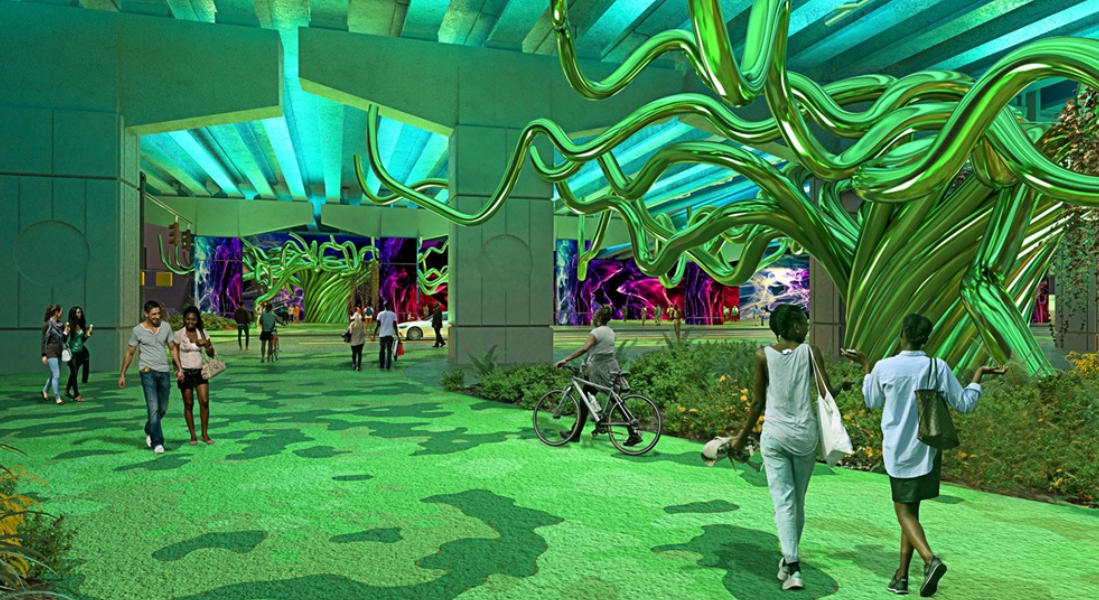
The Canopy, shown in this rendering, draws inspiration from Orlando’s natural tree canopy, combining nature and technology to create a “sustainable urban oasis that reflects the spirit of downtown Orlando,” according to developers. Image: Downtown Orlando
With these projects on the horizon, city leaders are hopeful that downtown Orlando will see a surge in activity and economic growth. However, the timeline for these improvements has left some business owners questioning whether the changes will arrive in time to address their current challenges.
The funding will be drawn from future tax revenue generated within the Downtown Community Redevelopment Agency (CRA), a district established in 1980 to rejuvenate 1,664 acres of the city’s core.
Stay Connected
Stay connected with ConstructConnect News, your source for construction economy insights, market trends, and project news.
About ConstructConnect
At ConstructConnect, our software solutions provide the information construction professionals need to start every project on a solid foundation. For more than 100 years, our insights and market intelligence have empowered commercial firms, manufacturers, trade contractors, and architects to make data-driven decisions and maximize productivity.
ConstructConnect is a business unit of Roper Technologies (Nasdaq: ROP), part of the Nasdaq 100, S&P 500, and Fortune 1000.
For more information, visit constructconnect.com