KEY POINTS
-
February 2026 Total Nonresidential Construction Starts fell to $49.4 billion, down $32.9 billion from January’s revised $82.3 billion and well below the 12-month moving average of $70.4 billion.
-
In the latest year-to-date (YTD) results, the Pacific, Mountain, and West North Central census divisions all reported healthy gains.
-
From California through Missouri and Wisconsin, Total Nonresidential Construction reported double-digit gains of up to 27%. Only New England, along with both southern central divisions, reported contracting activity.
ConstructConnect reported that February 2026 Total Nonresidential Construction Starts fell to $49.4 billion, down $32.9 billion from January’s revised $82.3 billion and well below the 12-month moving average of $70.4 billion.
In the latest year-to-date (YTD) results, the Pacific, Mountain, and West North Central census divisions all reported healthy gains. From California through Missouri and Wisconsin, Total Nonresidential Construction reported double-digit gains of up to 27%.
Looking further eastward, gains were even greater as the East North Central, along with the Middle and Southern Atlantic divisions, reported gains of as much as 176% and not less than 36%. Only New England, along with both southern central divisions, reported contracting activity.
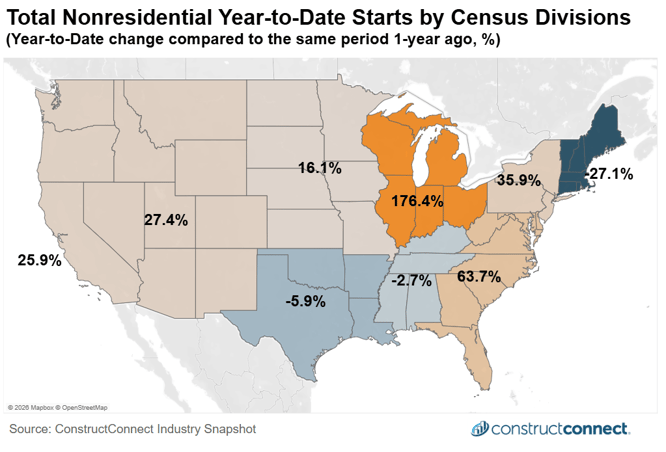
The map of Total Nonresidential Construction Starts shows the year-to-date percentage change through February 2026, compared to the same period one year ago, by US Census Divisions. From The Construction Economy Snapshot, March 2026. Image: ConstructConnect
Early YTD results for many divisions show NRB spending offsetting weakness in Civil construction, including the East Central North, South Atlantic, and West Coast. In fewer locations, the situation is reversed, such as the West North Central and East South Central divisions.
Strong NRB starts powered much of the above-mentioned growth along the East North Central and Atlantic seaboard, with growth spiking at 500% from Wisconsin through Ohio. Similarly, the South Atlantic reported triple-digit growth. From the plains westward, construction activity accelerated.
Western plains growth was negligible, but then increased to 19% in the Mountains and climaxed at 54% along the West Coast. Civil starts reported the greatest amount of volatility between expansion and contraction.
Several divisions reported challenging conditions led by the East North Central states from Wisconsin through Ohio, with a decline of 45%. This was distantly followed by the West South Central region from Texas through Alabama, which fell by 13%, and the New England, South Atlantic, and West Coast divisions, all of which fell by modest single-digit rates.
In contrast, the Middle Atlantic and Mountain regions reported strong double-digit gains of 53% and 39%, respectively.
Following behind were the West North Central divisions with 29% growth and the East South Central with more distant growth of just 12%.
Read the Construction Economy Snapshot for a clear, data-driven snapshot of the construction economy with key trends, expert commentary, and the latest project statistics.
Stay Connected
Stay connected with ConstructConnect News for construction industry news and construction market analysis to stay ahead of what’s building next.
About ConstructConnect
At ConstructConnect, our software solutions provide the information that construction professionals need to start every project on a solid foundation. For more than 100 years, our keen insights and market intelligence have empowered commercial firms, building product manufacturers, trade contractors, and architects to make data-driven decisions, streamline preconstruction workflows, and maximize their productivity. Our newest offerings—including our comprehensive, AI-assisted software—help our clients find, bid on, and win more projects.
ConstructConnect operates as a business unit of Roper Technologies (Nasdaq: ROP), a constituent of the Nasdaq 100, S&P 500, and Fortune 1000.
For more information, visit constructconnect.com