KEY POINTS
-
The U.S. Department of Energy said it issued a conditional $17.5 billion loan commitment to finance long-lead nuclear components for up to 10 new large-scale reactors at five U.S. project sites.
-
The financing is meant to rebuild domestic nuclear manufacturing capacity, cut procurement costs, and move reactor deployment ahead by as much as three years if projects meet required conditions.
-
ConstructConnect’s project pipeline shows the demand drivers behind the push for new generation: AI, data centers, energy expansion, and manufacturing reshoring, all of which are increasing pressure on the power grid.
The U.S. Department of Energy (DOE) announced June 23, 2026, that its Office of Energy Dominance Financing issued a conditional loan commitment for $17.5 billion to help finance long-lead components for a new wave of large-scale nuclear construction in the United States.
Financing Targets Long-Lead Nuclear Components
According to the DOE announcement, the financing would support up to five projects sponsored by utilities and energy companies, with each project covering two Westinghouse AP1000 reactors.
In total, the package is designed to accelerate deployment of 10 large commercial reactors and could shorten delivery timelines by as much as three years.
DOE said the move is intended to help rebuild the domestic nuclear supply chain, where specialized components require long manufacturing and delivery schedules. Long-lead items can include major plant equipment and other complex systems that must be ordered well before full construction ramps up.
Supply Chain Efficiency and Schedule Risk Reduction
The department said bulk purchasing and fixed-price procurement could lower component costs, improve supply chain efficiency and reduce schedule risk across multiple projects.
Energy Secretary Chris Wright, in the DOE announcement, framed the financing as part of the administration’s push to restart large-scale reactor construction. DOE said the effort supports President Trump’s executive order aimed at having 10 new large nuclear reactors with complete designs under construction by 2030.
The announcement said each AP1000 reactor would generate about 1.1 gigawatts of power. Combined, the 10 reactors would provide enough electricity to serve nearly 10 million U.S. households, DOE estimated.
Westinghouse, DOE said, has signed letters of intent with seven potential partners that already have identified project sites, although the financing would support only up to five eligible loans under the current structure.
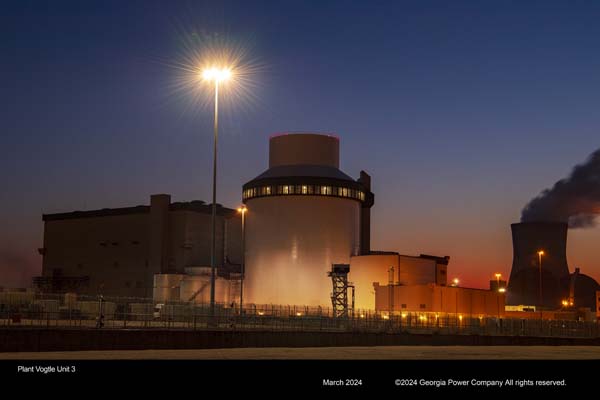
Plant Vogtle in Waynesboro, Ga. has four total reactors including Units 3 (shown) and 4 with Westinghouse AP1000 power plants, the first new U.S. nuclear units built in 30 years. Image: Georgia Power Company
Safety, Design, and Procurement are Central to the Plan
Westinghouse’s AP1000 units are the only licensed large-scale advanced commercial reactors operating in the United States today. The department said the loan commitment is focused on long-lead items, or complex nuclear plant components that require the longest manufacturing and delivery timelines.
According to Westinghouse, the AP1000 was designed to take advantage of modern, modular construction methods, allowing more construction activity to move in parallel while shifting more manufacturing and assembly into factory settings.
The company said that approach can improve quality and efficiency while reducing field complexity.
The AP1000 also uses passive safety features that rely on natural circulation, gravity and convection rather than operator actions or alternating-current power, according to Westinghouse documentation. The design, the company said, allows the reactor to shut down safely and remain cool even during a station blackout like the 2011 event at Fukushima.
Westinghouse also said lessons from the construction of six operating AP1000 pressurized water reactors have been systematically captured to improve delivery certainty on current and future projects.
That operating history is a key part of the company’s argument that earlier procurement of major components can help reduce schedule pressure on a new generation of U.S. reactor builds.
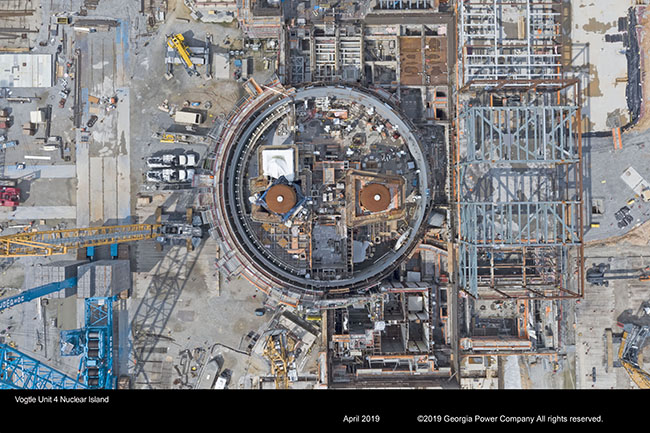
The nuclear island of Plant Vogtle Unit 4, under construction, in a 2019 image. Manufacturer Westinghouse said the AP1000 was designed to take advantage of modern, modular construction methods, allowing more construction activity to move in parallel while shifting more manufacturing and assembly into factory settings. Image: Georgia Power Company
Commitment Hinges on Final Conditions
The DOE also emphasized that the commitment is conditional, not final. Before any loan funds are disbursed, the department and participating companies must satisfy technical, legal, environmental and financial requirements.
Under the proposed structure, Westinghouse and each utility or energy company partner would have to commit $500 million in project equity upfront, or $1 billion per project, before accessing DOE financing.
Power Demand is Driving the Broader Buildout
The announcement arrives as electricity demand is becoming a more visible constraint across several heavy-investment sectors as reported here and in other building industry trade publications.
Kristy O’Brien, director of content acquisition at ConstructConnect, said the company’s project pipeline increasingly reflects how power availability is shaping project activity. “Power is a big part of that story too — utility and grid work is moving because electricity availability has become a gating issue,” O’Brien said.
Many of the large projects entering the pipeline trace back to a concentrated group of drivers, O'Brien added. “A lot of the new entries we’re publishing trace back to the same handful of themes: AI, data centers, energy, and manufacturing reshoring,” she said. “These are large-scale, capital-intensive investments.”
Why the Construction Market Is Watching
That backdrop helps explain why the federal government is putting supply chain financing at the center of its nuclear strategy. A broader nuclear buildout would support demand for heavy industrial fabrication, electrical equipment, utility infrastructure and specialized site work, while also tying into a wider build cycle driven by energy-intensive development.
If the loans close and project sponsors move ahead, the package could mark a significant coordinated effort to restore U.S. capacity to build large commercial nuclear plants at scale.
Stay Connected
Stay connected with ConstructConnect News for construction industry news and construction market analysis to stay ahead of what’s building next.
About ConstructConnect
At ConstructConnect, our software solutions provide the information that construction professionals need to start every project on a solid foundation. For more than 100 years, our keen insights and market intelligence have empowered commercial firms, building product manufacturers, trade contractors, and architects to make data-driven decisions, streamline preconstruction workflows, and maximize their productivity. Our newest offerings—including our comprehensive, AI-assisted software—help our clients find, bid on, and win more projects.
ConstructConnect operates as a business unit of Roper Technologies (Nasdaq: ROP), a constituent of the Nasdaq 100, S&P 500, and Fortune 1000.
For more information, visit constructconnect.com