
KEY POINTS
-
The Iran war rattled aluminum markets and raised fears of a severe global shortage, but emergency rerouting and added Asian supply helped prevent the worst-case price spike.
-
Aluminum futures eased from peak-crisis forecasts, but that does not guarantee lower delivered costs for contractors, fabricators, and building product manufacturers.
-
The next pricing question is not just about supply disruption. It is also whether tougher North American trade enforcement keeps aluminum costs high across the region.
Aluminum prices have backed away from the most extreme war-driven forecasts, but that has not translated into fast relief for U.S. construction buyers.
Bloomberg reported Sunday that the Iran war triggered one of the largest supply disruptions the aluminum market has faced in decades, as traders feared shipping through the Strait of Hormuz would be disrupted long enough to starve Gulf smelters of alumina and other key inputs.
At the height of the panic, some analysts suggested aluminum could surge past $4,000 per metric ton.
That scenario has not played out as the chart below shows.
According to Bloomberg, producers in the Gulf found alternate routes for raw materials, increased imports through other channels and leaned on inventories to keep metal flowing.
The market also got help from Asia, where Chinese smelters boosted output and Indonesia expanded production.
Aluminum futures were trading around $3,400 a ton, below the peak-crisis forecasts that circulated earlier in the conflict.
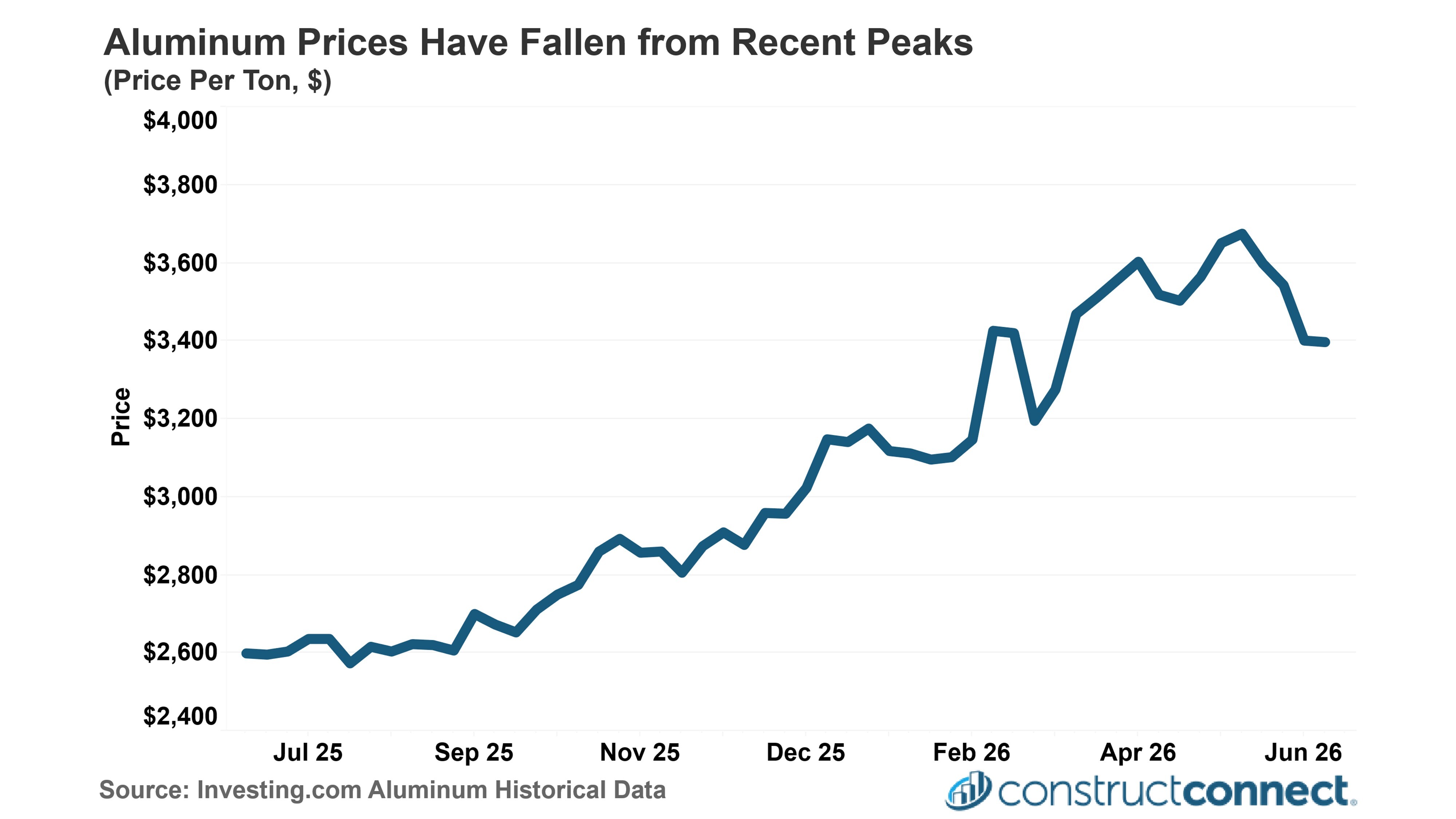
Aluminum prices have retreated from recent highs. Shown is a chart of aluminum prices per ton over the last 12-months. Image: ConstructConnect
What It Means for Construction
Easing global turmoil does not automatically translate into lower delivered costs. The volatility around the potential opening of the Strait of Hormuz continued after the memorandum of understanding was signed Friday between the US and Iran.
The aluminum inputs to manufacturing, fabricated products and systems, still carry exposure to tariffs, premiums, processing costs, and lead times.
That matters for aluminum-dependent scopes such as curtain wall, storefront framing, architectural panels, windows, doors, railings, canopies, electrical components, and some HVAC-related products.
Even before the war with Iran began, Reuters reported in January that U.S. aluminum consumers were paying record-high prices above $5,200 per metric ton as 50% tariffs, low U.S. inventories and tight global supply compounded pricing pressure.
That suggests construction buyers could continue facing elevated delivered costs even if broader exchange-traded aluminum prices cool.

Why Trade Policy Matters Now
The next chapter in the aluminum story may be written less by the impact of war than by trade.
In a June 17 statement, The Aluminum Association urged U.S. negotiators to put aluminum at the center of the United States-Mexico-Canada Agreement (USMCA) review.
The group, which represents US aluminum producers and jobs, said North America needs stronger tariff alignment, tighter import monitoring, updated rules of origin and tougher enforcement to keep unfairly traded aluminum from entering through regional loopholes.
The Association’s trade framework argues that outdated USMCA rules have allowed subsidized aluminum, much of it tied to non-market economies, to move through transshipment routes including Mexico.
The U.S. Commerce Department separately reported in April that Mexico published a new automatic import notice for aluminum products, a move designed to improve traceability and address possible third-country transshipment.
That policy push could support domestic aluminum producers and recyclers over time. The Aluminum Association says the U.S. industry supports more than 871,000 direct, indirect and induced jobs, generates more than $326 billion in economic output, and has invested more than $11 billion in domestic manufacturing since 2016.
A more tightly enforced North American aluminum market may strengthen regional supply chains, but it could also keep pricing firm for buyers already struggling to estimate aluminum-heavy work.
That means continued risk around bid accuracy, margin protection, and procurement timing. The immediate crisis in global aluminum may have eased, but the risk has not.
Stay Connected
Stay connected with ConstructConnect News for construction industry news and construction market analysis to stay ahead of what’s building next.
About ConstructConnect
At ConstructConnect, our software solutions provide the information that construction professionals need to start every project on a solid foundation. For more than 100 years, our keen insights and market intelligence have empowered commercial firms, building product manufacturers, trade contractors, and architects to make data-driven decisions, streamline preconstruction workflows, and maximize their productivity. Our newest offerings—including our comprehensive, AI-assisted software—help our clients find, bid on, and win more projects.
ConstructConnect operates as a business unit of Roper Technologies (Nasdaq: ROP), a constituent of the Nasdaq 100, S&P 500, and Fortune 1000.
For more information, visit constructconnect.com





.jpg)