KEY POINTS
-
Effective acoustical strategies in hospitals are essential for patient healing, staff well-being, and reliable equipment performance. Beyond noise reduction, acoustics are now recognized as integral to overall health and wellness.
-
Mockups, early testing, and isolated wall assemblies are critical for achieving sound isolation.
-
Urban hospital projects face unique challenges from external noise and vibrations. Solutions such as air-spring-supported concrete bases or advanced vibration testing ensure sensitive equipment operates effectively without unnecessary costs.
Judging by the number of architects, builders, acoustic professionals, and others who waited patiently to ask questions of a speaker at the Toronto Buildings Show after he concluded his formal talk, acoustic performance in buildings is of vital concern to the design and construction professions.
“I spent about an hour answering questions,” said Eric Salt, an acoustical engineer and associate with Aercoustics Engineering Limited.
While there were a lot of “overlapping questions” in the post-session about a mix of different projects, the focus of his presentation was the role of acoustical performance in health care facilities.
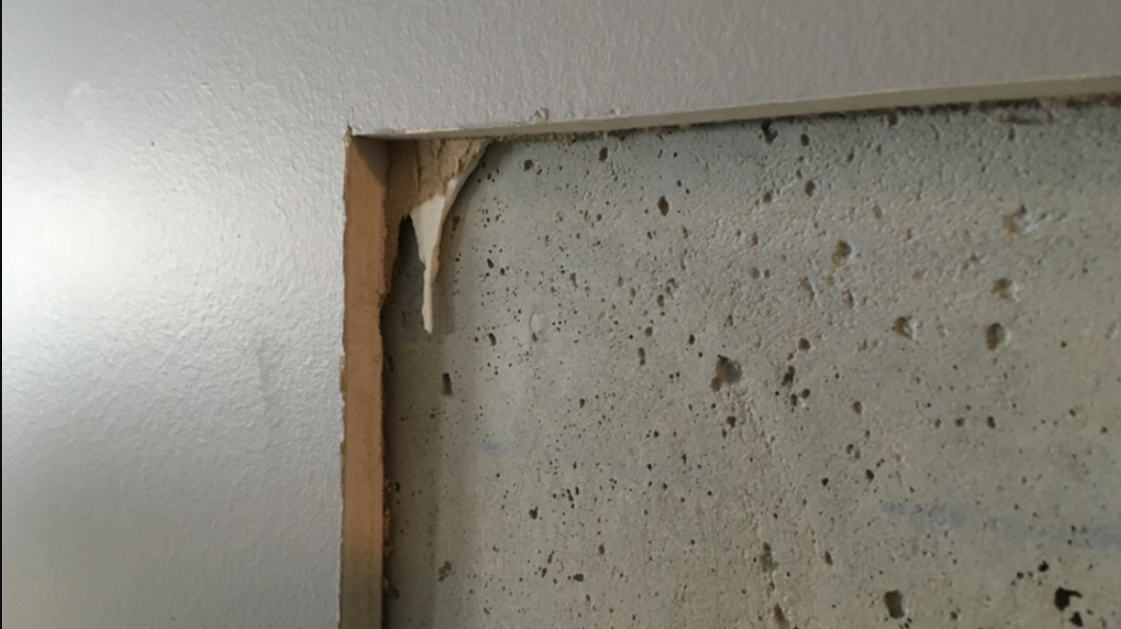
Shown is a cutaway of a gypsum board installation showing an air gap between the gypsum and the concrete. This gap reduces the wall’s acoustic performance. Image: Aercoustics Engineering Limited
Why Acoustics Matter in Healthcare Design
Acoustical design strategies are critical to ensure hospitals support healing, reduce staff burnout, and ensure equipment performs reliably, he said.
And as hospital design approaches evolve beyond basic noise reduction, “acoustics are increasingly being recognized as essential to overall health and wellness.”

Health care projects are complex and require a diverse range of knowledge/experience in acoustics, noise, and vibration to ensure patient comfort, control of sensitive diagnostic equipment, and vibration monitoring during both new construction and renovation, he said.
“Hospitals are noisy places,” said Salt, citing American Association of Medical Colleges studies which show excessive noise in hospitals results in elevated heart rates and blood pressure, headaches, fatigue, sleep disturbances, disrupted hospital team communication, and increased risk of patient care errors.

Eric Salt of Aercoustics Engineering Limited
However, the association also maintains that more than 60 percent of all hospital ward noises are preventable, he pointed out.
Common Noise Challenges in Hospitals and How to Address Them
Elaborating on the latest strategies in healthcare acoustics with a focus on cost-effective, high-impact solutions for both new construction and retrofits, Salt provided the audience with a range of design and construction procedures on how that 60 percent noise-preventable target can be achieved.
For instance, during the design and planning stage, it is advisable to avoid relying solely on project specifications, which often define acoustic targets as simple numbers or Sound Transmission Class (STC) ratings.
Both the Canadian Standards Association and the Facility Guidelines Institute provide “great guidelines for what is an acceptable level of sound isolation.” [Editor’s Note: see Occupational Noise Exposure for an overview of US standards]
Innovative Solutions for Noise Control in Urban Hospitals
Mockups and early testing are prerequisites in the design stage because they help identify coordination challenges and solutions. However, there must be two complete mockup rooms with walls, HVAC systems, seals, and finishes to accurately measure and gauge the sound isolation. Most large hospitals now require mockups, he said.
“But we [Aercoustics] recommend them for even smaller projects.”
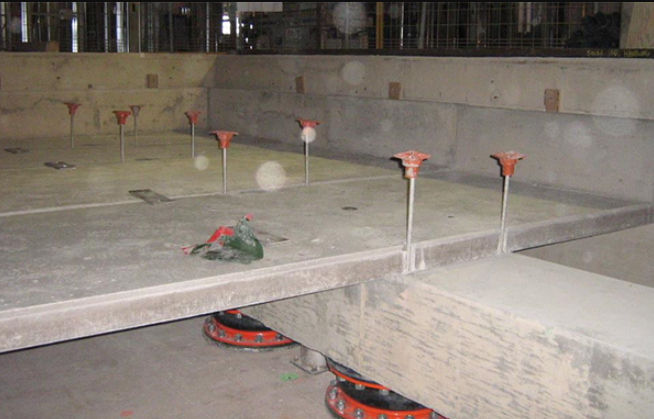
Pictured is a floating floor under construction at the Marotta Family Hospital in St. Catharines, Ont. The concrete base was built to sit on air springs (black and orange), which help isolate the diagnostic imaging department from vibrations from a nearby freight rail line. Image: Aercoustics Engineering Limited
Wall and ceilings with a specific STC can provide a measurement of their ability to absorb airborne noise. Contractors can also take advantage of the headwalls, which are the built-in wall assemblies with critical utilities in patient rooms.
But builders also have to be careful not to install back-to-back headwalls, as that will actually increase the risk of sound migration.
“This (back-to-back) is a very common source of failure during commissioning.”
The Aercoustics’ drop rig is used to test how vibrations travel through different materials to accurately predict how a structure will respond to forces.
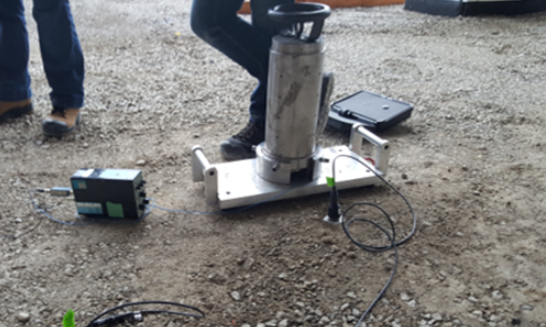
The Aercoustics’ drop rig is used to test how vibrations travel through different materials to accurately predict how a structure will respond to forces. Image: Aercoustics Engineering Limited
Isolated wall assemblies, such as double stud walls and walls built with resilient channels, are specifically designed to maximize acoustic isolation by breaking the physical pathways that sound uses to travel, he said.
“Their performance relies on one fundamental principle: Keep the layers separated.”
When these assemblies are built correctly, the decoupling they provide can significantly improve sound isolation performance in sensitive spaces like patient rooms, meeting rooms, diagnostic imaging suites, and staff areas.
However, even small installation tasks can unintentionally bridge those isolated layers and undermine the entire system. Some examples include mounting shelves directly into the wrong stud line or using screws that penetrate resilient channels and hit the studs, said Salt.
A major part of his talk was devoted to addressing the not insignificant hospital site planning challenges in urban settings close to rail lines, highways, industry, and other sources of noise and vibration.
The Importance of Collaboration in Healthcare Acoustics Projects
As a result, the placement of sensitive vibration equipment becomes “a delicate balance,” said Salt, who highlighted two projects where that balance was achieved.
At the Marotta Family Hospital in St. Catharines, Ont., the diagnostic imaging department is less than 200 meters [656 feet] from a railway freight line. However, a concrete base built on air springs isolates the department from vibrations.
That somewhat costly solution wasn’t necessary at the Cortellucci Vaughan Hospital, where the diagnostic imaging department is right above the loading dock. New vibration equipment used by Aercoustics showed floating floors weren’t required, said Salt.
A major theme of his approximately one-hour talk was the necessity for close cooperation by all project partners.
“Effective coordination is essential in health care projects because hospitals are some of the most complex buildings we design and construct. With so many competing systems, mechanical, electrical, medical gases, structure, ICT, infection control, and more, it’s critical for designers, owners, and trades to work as a unified team.”
Stay Connected
Stay connected with ConstructConnect News, your source for construction economy insights, market trends, and project news.
About ConstructConnect
At ConstructConnect, our software solutions provide the information that construction professionals need to start every project on a solid foundation. For more than 100 years, our keen insights and market intelligence have empowered commercial firms, building product manufacturers, trade contractors, and architects to make data-driven decisions, streamline preconstruction workflows, and maximize their productivity. Our newest offerings—including our comprehensive, AI-assisted software—help our clients find, bid on, and win more projects.
ConstructConnect operates as a business unit of Roper Technologies (Nasdaq: ROP), a constituent of the Nasdaq 100, S&P 500, and Fortune 1000.
For more information, visit constructconnect.com