
KEY POINTS
- U.S. Army testing 3D-printed concrete at Fort McCoy using local soil.
- A portable mixer, additive printer, and design software create field-ready structures.
- It looks promising, but it’s not ready yet; more testing needed.
Fort McCoy, in Wisconsin, is known as the U.S. military’s “Total Force Training Center,” equipping service members of all branches with new skills, strengths, and tools to improve readiness. It’s also the site of an interesting experiment to develop building materials in adverse conditions.
Why would the U.S. military 3D print concrete?
As first reported on DVIDS, the U.S. Army Engineer Research and Development Center (ERDC) recently tested ways to create walls, culverts, and Jersey barriers using concrete made with local soil, mimicking conditions where service members need shelter and security but cannot carry building materials in.
“This technology will enable the Army to go into a remote area, harvest local materials, and use those materials to make concrete sufficient to produce these items without carrying the logistical burden of transporting all these different things,” Jeb Tingle, a senior scientific technical manager with the ERDC, said.
How does the 3D printing of concrete work?
The process, developed through a collaboration among ERDC, Applied Research Associates, Robotic Construction Technologies, the University of Arkansas, and Iowa State University, involves a unique portable concrete mixer and an “additive construction printer,” both developed for military use.
Service members would dig soil, filter out unwanted material, and feed the processed soil into the special mixer. Then they would turn to the construction printer.
“We’ve got several different things that we can build with [the soil mix],” Jim Mantis, a program manager with Applied Research Associates, explained. “They can select items from this pre-engineered design catalog software that we’ve developed, which enables them to print those objects in the field near the point of need.”
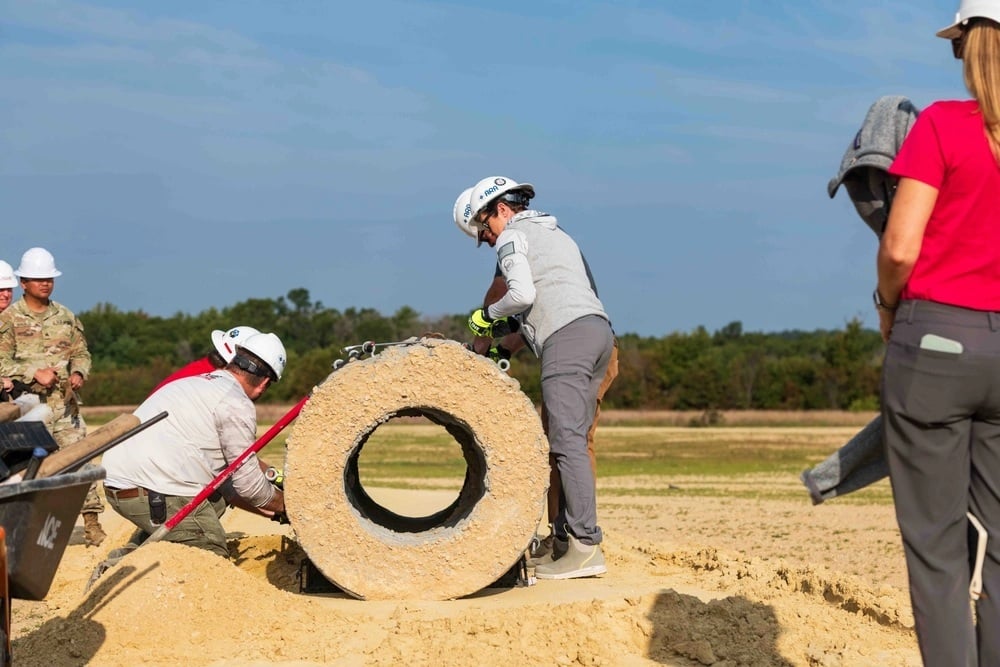 Workers handle a 3D-printed concrete culvert, part of the U.S. Army's experiment with using local soil to create foundational building materials. Image: Amanda Clark, DVIDS
Mantis adds that using 3D models and digital drafting files to build foundational materials almost anywhere is a tech‑forward way to lighten the load for deployed troops.
“It minimizes the amount of materials we have to transport overseas. We can bring just a little bit of cement with us. We can mix it with the local materials. We can make concrete that’s strong enough to support the design and construction of all these different items,” he said.
When will this 3D printing technology be available?
While the results are promising, the technology is not yet ready to go live. Soldiers from both the Maryland and Wisconsin National Guard took part in the experiments to give the project team firsthand feedback.
“We’ll take [the soldiers’ thoughts], we’ll modify the system, and then we’ll refine that and we’ll come back and we’ll do a final demonstration next year,” Tingle said. “Then we’ll use that to inform an acquisition decision by the Army acquisition offices.”
Stay Connected
Stay connected with ConstructConnect News, your source for construction economy insights, market trends, and project news.
About ConstructConnect
At ConstructConnect, our software solutions provide the information that construction professionals need to start every project on a solid foundation. For more than 100 years, our keen insights and market intelligence have empowered commercial firms, building product manufacturers, trade contractors, and architects to make data-driven decisions, streamline preconstruction workflows, and maximize their productivity. Our newest offerings—including our comprehensive, AI-assisted software—help our clients find, bid on, and win more projects.
ConstructConnect operates as a business unit of Roper Technologies (Nasdaq: ROP), a constituent of the Nasdaq 100, S&P 500, and Fortune 1000.
For more information, visit constructconnect.com



.jpg)
.jpg)