KEY POINTS
- Agentic AI is revolutionizing construction by enabling autonomous systems to plan, monitor, and update tasks, offering multi-step reasoning and decision-making beyond traditional AI workflows and Large Language Models (LLMs).
- Tools simplify software development by generating, modifying, and testing code from written requirements, reducing manual coding time and empowering non-coders to create apps and automations.
- While agentic AI accelerates innovation, one expert suggested that users must maintain a “human in the loop.”
What a difference a year makes in the world of construction tech.
Delegates attending day two of the recent Buildings Show in Toronto heard how agentic AI is rapidly emerging as construction’s third wave of AI, moving beyond Large Language Models (LLMs) and automated workflows to create a world of autonomous systems that plan, monitor, and update project tasks, as well as write code.
Digital innovation specialist Mahir Dheendsa of Amrize (formerly Lafarge), host of a session titled “AI Agents and the Robotic Workforce: Reimagining the Future of Construction,” said the use of agentic AI is accelerating. So rapidly that the preview of the session he wrote for the show program months ago was already out of date.
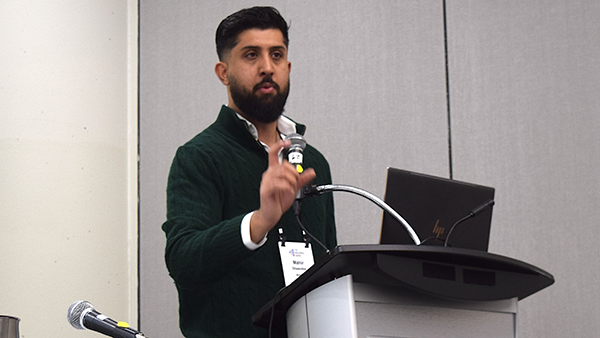
Digital innovation specialist Mahir Dheendsa of Amrize spoke about AI agents at the Buildings Show in Toronto, Dec. 4. Dheendsa took a moment to outline how Amrize represents the new brand for Lafarge. Image: Don Wall
“Agentic AI has been the talk of the town and the major headline in the AI space this year,” said Dheendsa. “We haven’t really seen any major advancements in robotics, so I’m willing to sort of skip over that.”
Platforms offering AI agents, such as n8n, Gemini Agent Studio, Make.com and Zapier, democratize agent development, Dheendsa said, enabling construction professionals to build custom automations without extensive coding expertise.
Generative development tools like Lovable AI and Cursor take it a step further by generating, modifying, and testing software directly from written requirements, dramatically reducing the time typically spent on planning and manual coding.

Multi-Step Reasoning
LLMs offer a single-step response with no tools or actions, he explained. AI workflows follow a fixed sequence of steps and can connect multiple apps, but with no reasoning or judgment. An AI agent acts as autonomous intelligence, utilizing multi-step reasoning and tools and APIs to evaluate, retry, and create.
Dheendsa offered an example of a supply chain coordination function with a problem: a crew of 20 is standing around doing nothing because the steel beams haven’t arrived.
The agent can track supplier GPS data and manufacturing status updates in real-time, potentially predicting a delay three days in advance and suggesting rescheduling the crane rental.
Another example is with a change order. A subcontractor might send bills for “extra work,” and nobody remembers if it was approved, said Dheendsa. The agent scans thousands of emails, contracts, and meeting minutes automatically and verifies if the extra work was actually part of the original contract scope.
“An AI agent has the ability to make decisions,” said Dheendsa. “The AI agent monitors and reports. It will detect an issue, and it will decide if this is an issue worthy of being brought up based on a criteria that you can provide it.
“And then it will figure out which team or which person needs to be notified.”
He has used Replit, Lovable, and Cursor, and all can work to generate responses to RFPs, he said.
“You just copy the RFP into the Lovable app, and the software is done,” said Dheendsa.
“If you have an idea, if you want to build an app, you don’t even need to know how to code. You just put your idea in there, and it’ll just generate you an app or a web app, website, whatever you need.”
Human in the Loop
Dheendsa stressed that users still need to keep a “human in the loop.”
“It is prone to making mistakes. It is prone to hallucinations, (but) it’s getting better.”
With Gemini 3, for example, “I’d say it’s 85 per cent there. It’s very good.”
Another caveat is that users should not venture into AI solutions if the original process is flawed: “Don’t automate broken processes,” Dheendsa said.
Among various risks he identified, “over-trust risk” is highly dangerous, he said. Al confidence does not equal correctness. Always verify technical outputs and cross-check against standards and codes, he said.
Microsoft has reported construction jobs in the field are among the least threatened by AI, Dheendsa noted in an interview, for a couple of reasons.
For one, dredge operators or crane operators represent a lot of “moving parts.” Second, he said, there hasn’t been enough data collected in the field for AI to automate.
“The low-hanging fruit is here with the administrative stuff, like data entry and all the repetitive workflows. So let’s just start there,” said Dheendsa.
“The barrier to entry is lower than ever before…I encourage people to start doing that, because even if it’s not going to get you 100 per cent of the way there, it’ll at least get you 80 per cent.”
About ConstructConnect
At ConstructConnect, our software solutions provide the information construction professionals need to start every project on a solid foundation. For more than 100 years, our insights and market intelligence have empowered commercial firms, manufacturers, trade contractors, and architects to make data-driven decisions and maximize productivity.
ConstructConnect is a business unit of Roper Technologies (Nasdaq: ROP), part of the Nasdaq 100, S&P 500, and Fortune 1000.
For more information, visit constructconnect.com