KEY POINTS
-
Ford, Bloomberg Philanthropies, and Lowe’s Foundation are putting new money into skilled-trades training as employers confront persistent shortages of mechanics, electricians and other technical workers.
-
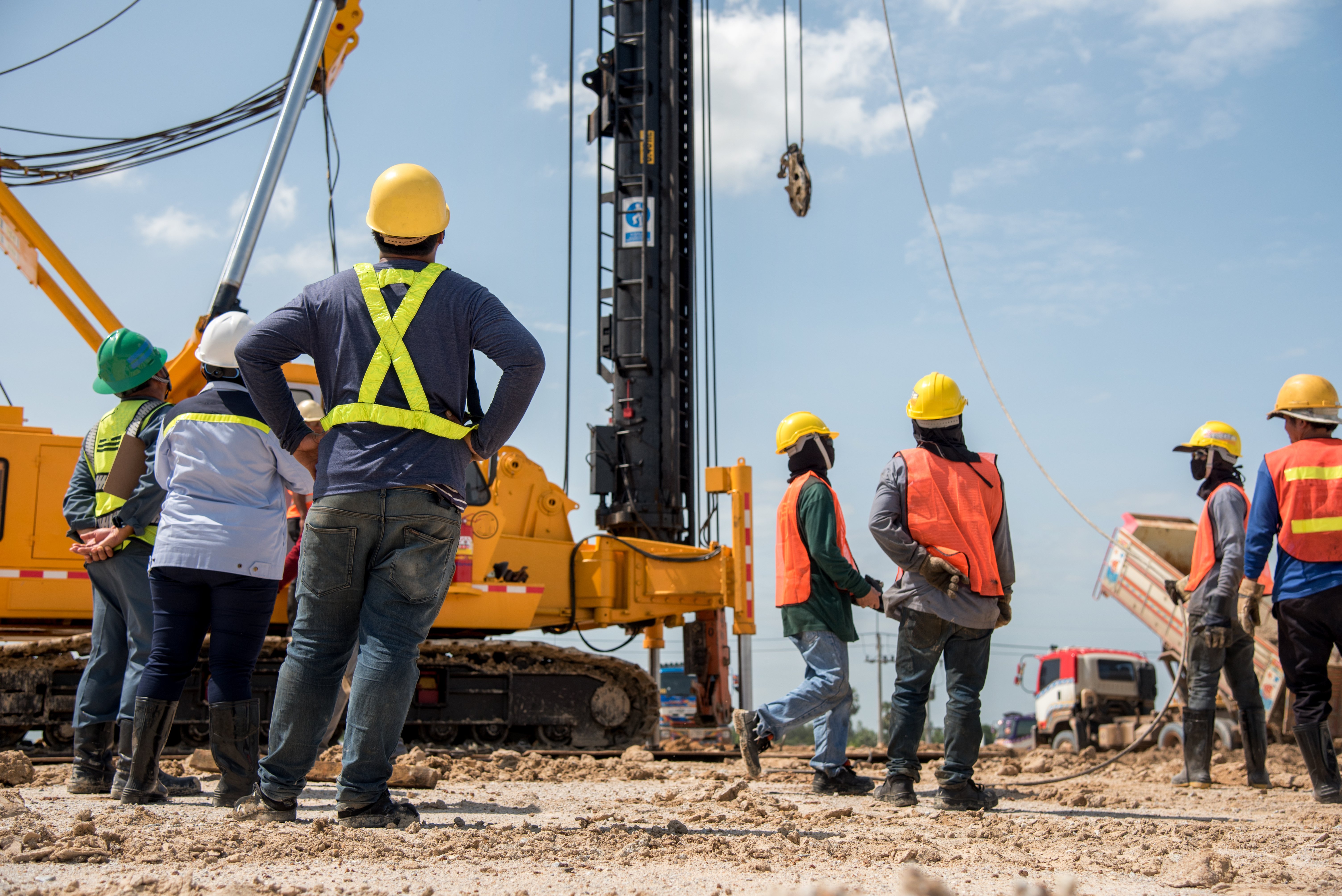
The labor push matters for construction because demand is being amplified by data center growth, advanced manufacturing investment, and a steep need for electricians and other trade talent.
-
The issues are not only wages and hiring pressure, but whether training capacity can expand to keep projects, maintenance work, and service schedules on track.
Big employers and philanthropies are stepping up spending on skilled-trades training as labor shortages deepen across service, manufacturing and construction-linked occupations, according to a Wall Street Journal report.
The renewed investment comes as employers struggle to fill jobs for mechanics, electricians and other technical workers whose roles are essential to keeping equipment operating, construction projects moving, and customer backlogs under control.
Ford Motor Co. CEO Jim Farley told the Journal he tracks the technician shortage at the automaker’s dealerships every morning, with the gap recently hovering around 5,000 positions nationwide. Farley said the shortage is raising labor costs, delaying repairs, and hitting customers directly.
Investment Targets Training Capacity
The Journal reported that new skilled-trades efforts announced this year already total about $400 million.
Bloomberg Philanthropies is launching a $90 million initiative focused on helping more high-school students move into trade careers. In Detroit, Bloomberg and Ford are each contributing $2.5 million, in part to fund new auto-repair bays for high school students. The stated goal is to train 300 auto mechanics over the next three years who would be eligible to move directly into dealership jobs after high school.
Ford separately said it is spending $300 million this year on efforts aimed at filling critical roles. Bloomberg said its broader spending will support programs in six states, including classroom renovations and paid apprenticeship stipends.
The Lowe’s Foundation has pledged $250 million to support the trades, with much of that funding announced this spring, the Journal reported. Its target is to help train 250,000 people by 2035, including through more instructors and mobile classrooms serving rural areas.
BlackRock Foundation, as reported on ConstructConnect News, announced a $100 million commitment to skilled-trades training in March, including programs in Texas where electricity demand tied to new data centers is increasing the need for qualified workers. The goal there is to help train about 12,000 electricians over three years.
Labor-Market Forces Bearing Down
For contractors, owners, suppliers and manufacturers tracking project execution, the significance goes beyond dealership repair bays or individual workforce programs. The same labor-market forces are bearing down on project delivery, especially in trades connected to power, mechanical systems and advanced facilities.
The Journal cited the Associated Builders and Contractors estimates showing the construction industry must add 349,000 net new workers this year to meet demand. That pressure is being intensified by rapid expansion in data centers and advanced manufacturing, both of which require large volumes of specialized labor and put a premium on electricians.
Those premiums are evident in the construction labor data.
ConstructConnect Chief Economist Michael Guckes noted in the May 2026 Construction Economy Snapshot that the average construction wage in April rose to $40.97 per hour, while total private-sector wages ended the month at $37.41 per hour.
The difference in average weekly hours worked also remains historically elevated: construction workers averaged 39.3 hours per week, a premium of 5.0 hours above the total private-sector average of 34.3 hours.
Guckes reported that the higher hourly rate and additional weekly hours bring total weekly construction compensation to $1,610, a premium of $327, or about 26%, above the average total private-sector worker’s weekly earnings of $1,283.
"This durable earnings advantage continues to make construction one of the most attractive employment options for hourly wage earners," Guckes reported.
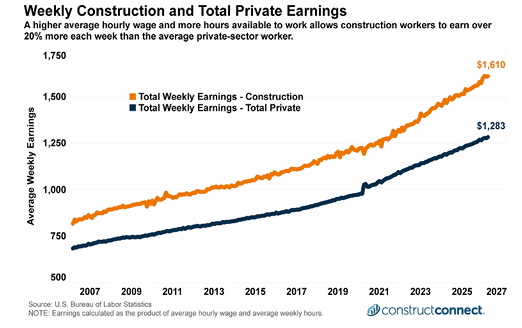
Chief Economist Michael Guckes noted in the May 2026 Construction Economy Snapshot that the average construction wage in April rose to $40.97 per hour, while total private-sector wages ended the month at $37.41 per hour. Image: ConstructConnect
When labor pipelines cannot keep pace, the pressure might show up in wage competition, extended schedules, tighter subcontractor availability, and a smaller margin for execution error.
The workforce issue also is becoming more structural. Farley told the Journal that many Ford technicians are older, underscoring the aging profile of the skilled workforce.
That same demographic challenge is familiar across construction, where retirement risk and replacement difficulty are converging at the same time projects are increasing labor intensity.
High School Pipelines Gain Attention
One notable thread in the Journal’s reporting is the shift toward training workers earlier, particularly in high school. Employers, philanthropies and unions appear increasingly aligned around the idea that earlier exposure could widen the labor pool before workers choose other career paths.
The Eastern Atlantic States Regional Council of Carpenters has agreed to reserve 75 apprenticeship slots for high-school graduates trained through the Bloomberg program, while also expanding carpentry coursework and summer boot camps for students.
Anthony Abrantes, an executive board member with the union, told the Journal that interest in apprenticeships has outstripped supply in recent years and that high-school training may produce workers more likely to stay in the trades over the long term.
The Journal also reported that Gen Z interest in blue-collar careers is rising, helping revive shop classes in some districts. Lowe’s CEO Marvin Ellison told the publication that the larger cultural challenge is overcoming the idea that a four-year college degree is the only route to success.
What It Means for Construction
The AI power-infrastructure buildout, mechanical service talent, and apprenticeship throughput shape what kinds of projects can move quickly and where. Firms active in data centers, manufacturing, healthcare, energy, and other systems-heavy segments may need to watch local training pipelines as closely as they track material costs and bid volume.
The Journal’s reporting suggests the bottleneck is not a lack of interest alone. Claire Chamberlain, global head of social impact at BlackRock Foundation, said interested workers and available jobs exist, but training systems often lack the capacity employers need.
For construction, that points to a familiar constraint. That is the demand can be strong, but without enough instructors, seats, apprenticeships and field-ready candidates, labor shortages remain a ceiling on growth.
If the latest funding commitments succeed, they could begin to ease some of that pressure. But in the near term, the market signal is that competition for skilled tradespeople remains intense, and the industries willing to invest earliest in workforce development may be best positioned to secure capacity.
Stay Connected
Stay connected with ConstructConnect News for construction industry news and construction market analysis to stay ahead of what’s building next.
About ConstructConnect
At ConstructConnect, our software solutions provide the information that construction professionals need to start every project on a solid foundation. For more than 100 years, our keen insights and market intelligence have empowered commercial firms, building product manufacturers, trade contractors, and architects to make data-driven decisions, streamline preconstruction workflows, and maximize their productivity. Our newest offerings—including our comprehensive, AI-assisted software—help our clients find, bid on, and win more projects.
ConstructConnect operates as a business unit of Roper Technologies (Nasdaq: ROP), a constituent of the Nasdaq 100, S&P 500, and Fortune 1000.
For more information, visit constructconnect.com