KEY POINTS
-
A Pennsylvania pre-apprenticeship program is aiming to widen access to trades and support the future construction workforce.
-
Employment growth has remained slow in recent years, yet Pennsylvania is still projected to see record activity in 2026.
-
Labor development and retention have become key to the construction industry as some programs aim to address the issue.
Projections from the Pennsylvania Department of Education and Department of Labor & Industry indicate that the state will require 300,000 skilled trade workers across sectors such as energy, technology, manufacturing, and healthcare by 2030.
To address this workforce gap, the Pennsylvania Commission for Community Colleges (PCCC) and TradesFutures have formalized a partnership through a memorandum of understanding aimed at expanding access to construction trade careers.
TradesFutures supports the construction trades by developing curriculum for Apprenticeship Readiness Programs, training educators, assisting schools and community organizations in establishing and maintaining those programs, and backing research aimed at expanding access to registered apprenticeships.
The PCCC - TradesFutures initiative comes at a critical juncture. Both nationally and within Pennsylvania, the construction industry has faced persistent challenges in growing its labor force. At the same time, the state’s construction sector is poised for significant expansion.
For construction professionals, this creates a unique dynamic where demand for construction work is expected to surge, yet the labor market remains constrained. This highlights the vital role of apprenticeship programs and the need for proactive labor management strategies to ensure the industry can meet its growing demands.
Construction Activity Strengthens While Hiring Lags
The United States construction labor market has faced persistent challenges in workforce growth over the past two years, expanding by just 1.8% from March 2024 to March 2026, according to Federal Reserve Economic Data (FRED) data. In Pennsylvania, employment growth has been even more sluggish, increasing by only 1.3% during the same period.
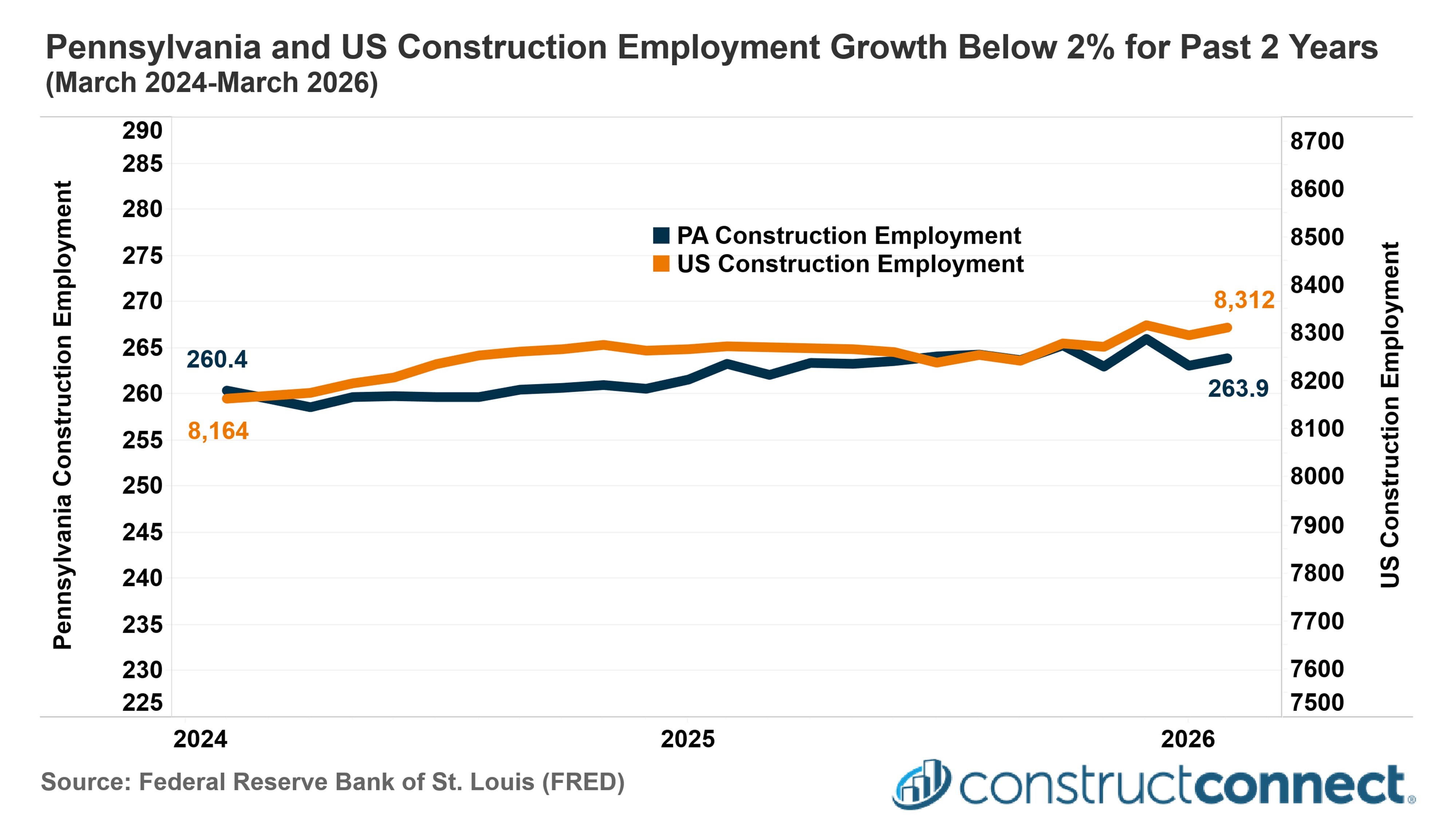
A chart shows the United States construction labor market has faced persistent challenges in workforce growth over the past two years, expanding by just 1.8% from March 2024 to March 2026, according to FRED data. In Pennsylvania, employment growth has been even more sluggish, increasing by only 1.3% during the same period. Image: ConstructConnect
These labor challenges coincide with record-breaking nonresidential construction activity in Pennsylvania. Nonresidential building, driven by sectors such as Offices—including data centers—and Manufacturing, along with Civil construction led by Roads and Bridges, is projected to reach record levels of construction starts in 2026 in the Commonwealth.
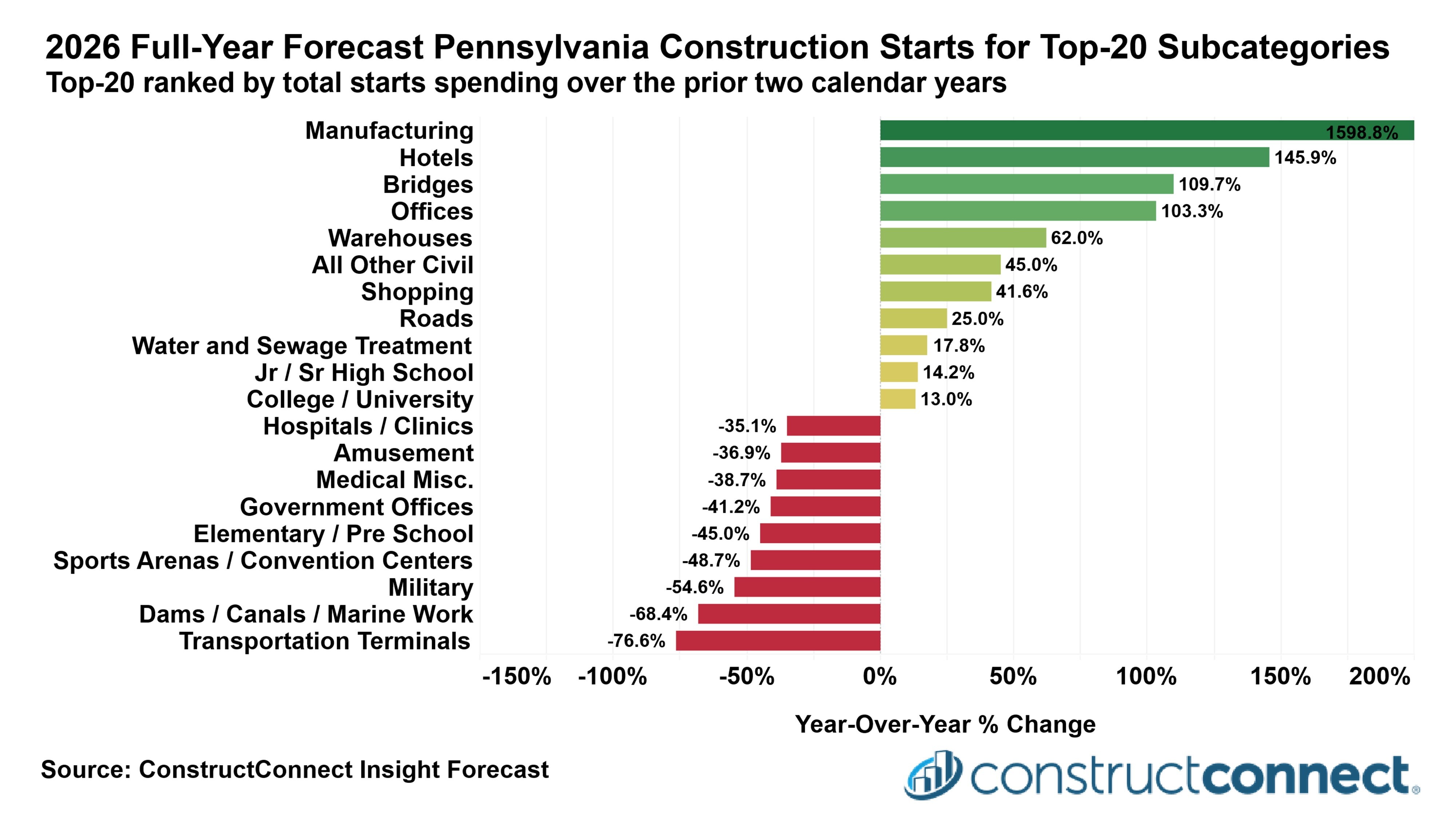
A chart shows the 2026 full-year forecast for Pennsylvania nonresidential construction starts in the Top-20 subcategories. Note: In smaller construction markets, a single sizable project or initiative can have an outsized impact on annual totals, producing dramatic year-over-year percentage swings. Image and data: ConstructConnect
New Workforce Partnership Targets Workforce Gap
The agreement between the PCCC and TradesFutures will introduce the MC3 program, a building and construction trades pre-apprenticeship initiative registered with the Pennsylvania Department of Labor & Industry, to community colleges across Pennsylvania.
This program has the potential to significantly expand the pipeline of workers entering the construction trades, addressing the critical labor gap the state is projected to face. Without a sufficient workforce, sustaining the momentum forecasted for Pennsylvania’s construction sector in 2026 will be a challenge, underscoring the increasingly vital role of labor in the industry’s outlook.
Labor at the Center of Construction Planning
For construction professionals, labor has become a critical factor in the industry’s success. Nationally, job growth in construction has been sluggish, with Pennsylvania lagging even further behind. Coupled with steady 4% annual wage growth in the sector, labor costs and availability have emerged as pivotal considerations for construction projects.
This emphasizes the importance of investing in workforce development and retention. The partnership between PCCC and TradesFutures marks a positive step toward bringing more individuals into the trades.
However, firms must also prioritize retaining their existing workforce. Investing in employee development and retention is typically far more cost-effective than the expense of recruiting and training replacements.
Stay Connected
Stay connected with ConstructConnect News for construction industry news and construction market analysis to stay ahead of what’s building next.
About ConstructConnect
At ConstructConnect, our software solutions provide the information that construction professionals need to start every project on a solid foundation. For more than 100 years, our keen insights and market intelligence have empowered commercial firms, building product manufacturers, trade contractors, and architects to make data-driven decisions, streamline preconstruction workflows, and maximize their productivity. Our newest offerings—including our comprehensive, AI-assisted software—help our clients find, bid on, and win more projects.
ConstructConnect operates as a business unit of Roper Technologies (Nasdaq: ROP), a constituent of the Nasdaq 100, S&P 500, and Fortune 1000.
For more information, visit constructconnect.com