KEY POINTS
-
Work has reached a critical phase in North Bergen as crews excavate the 600-foot-long, roughly 80-foot-deep launch box where the Hudson Tunnel Project’s tunnel boring machines (TBM) will be assembled before starting the Palisades Tunnel drive.
-
Officials said the TBMs will bore through very hard, abrasive rock at roughly 25 to 30 feet a day, with crews also monitoring for fault-related water leakage and using grout to manage infiltration risks.
-
The Palisades segment is one part of a larger, tightly sequenced project linking New Jersey to Manhattan. Staying on schedule is critical because each section must connect cleanly with the next phase of Hudson Tunnel Project work.
Work on New York City’s Hudson Tunnel Project (HTP) is at a pivotal phase in North Bergen, where massive tunnel boring machines (TBMs) are being assembled for the start of the Palisades Tunnel, a roughly one-mile section of the 2.4-mile twin tunnelling project between New Jersey and Manhattan.
Launch Box Excavation Starts in North Bergen
Excavation is underway on the TBM “launch box”— a 600‑foot‑long, roughly 80‑foot‑deep excavation with its walls supported by soldier piles and lagging.
Shotcrete is required to stabilize the exposed walls.
A 300-ton crane supported on concrete pads will move the heaviest parts of the 500-foot-long German-made TBMs into the launch box for assembly to start the twin tunnel job, says Hamed Nejad, chief engineer with the Gateway Development Commission, the bi‑state agency responsible for delivering, funding and overseeing the HTP.
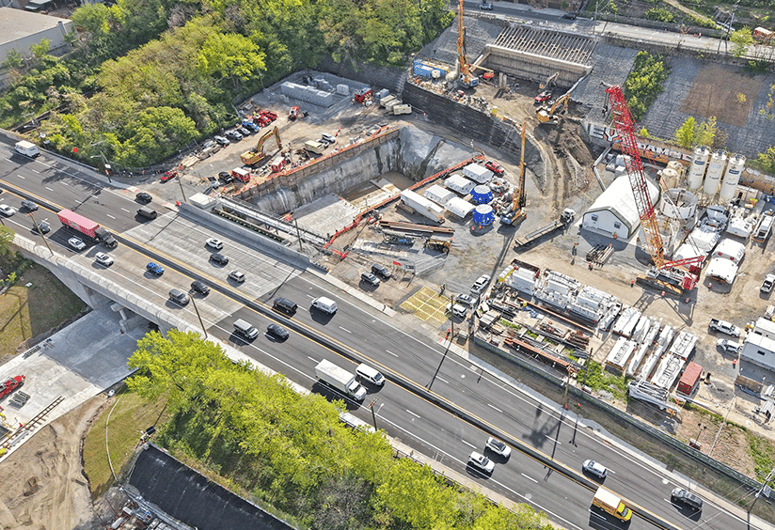
Excavation is underway on the tunnel boring machine “launch box”— a 600 foot long, roughly 80-foot-deep excavation with its walls supported by soldier piles and lagging. Shotcrete is required to stabilize the exposed walls. This will be a critical point for the Hudson Tunnel Project. Image: Gateway Development Commission
The tunnels commence about 80 feet below grade and at the point of the “highest overburden” called the Palisades the tunnels will be about 280-feet below grade.
“It’s not that steep. It is per the standards of Amtrak,” says Nejad, adding the TBMs will excavate roughly 25 to 30 feet a day.
Rock and Water Risks Shape the Tunnel Drive
Each of the giant machines will be boring through “very hard” rock (averaging 35,000 psi). That rock is so abrasive that maintenance and parts changing on the cutterhead might be required every two days, rather than once weekly in normal soil conditions, says Gateway’s chief engineer.
Based on the geotechnical report, the work crew will also deal with a fault that could be a source of potential water leakage. To prevent problems arising the TBMs are equipped with probes that drill every 150 feet in front of the machinery to monitor for water leaks. Grout is employed to mitigate leakage.
Calling the TBM “like a self-contained underground factory,” Nejad says the machinery serves multiple purposes, including grouting, installation of a liner and providing fresh air and exhaust bad air from gantries for its roughly 40-worker crew.
The two excavation tunnels are under 29-feet in diameter and will be 25-feet and 4-inches in diameter once the liners are installed. Each tunnel will be roughly 50 feet apart.
Nejad says the highest safety standards are critical throughout and the project must be in compliance with a number of federal Occupational Safety and Health Administration regulations for underground work.
Crews work under the TBM’s protective shield until the liner is installed.
In case of a tunnel collapse, workers have a large “refuge chamber” in the TBM equipped with oxygen, food and a communications support to the outside, he says.
Nejad, who has experience on about half-a-dozen tunnels on four continents, says each segment within the bigger multi-mile HTP has its own challenges and complexities.
Tunnelling under the Hudson River, for example, has “complicated rock and soil” conditions that will require variable density TBMs that can operate in slurry and rock conditions.
The HTP also involves a surface alignment segment that includes bridges and a viaduct which connect to the tunnel and eventually to Penn Station in Manhattan.
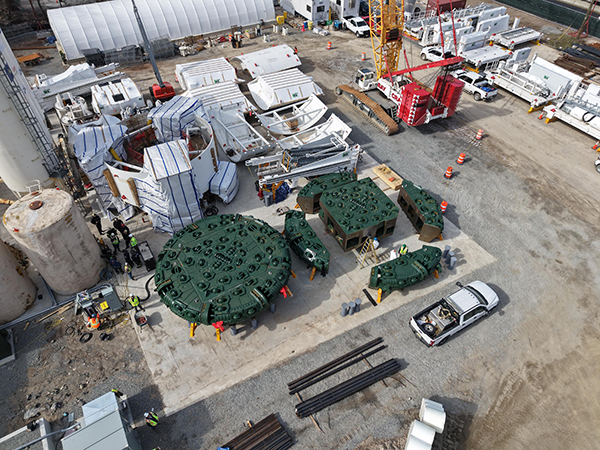
Massive tunnel boring machines are being assembled for the start of the Palisades Tunnel, a roughly one-mile section of the 4.5-mile twin tunnelling project between New Jersey and Manhattan that is all a part of New York City’s Hudson Tunnel Project. Image: Gateway Development Commission
Schedule Pressure Builds Across the Project
What stands out about the overall development is that each section must interface with others, explains Nejad.
“It is very critical to stay on schedule and make sure those milestones are met so we can have a smooth transition to the next projects.
“That’s the challenge,” he says, adding “to date we have made them all happen.”
Right from the outset the Palisades job was a big and time-consuming task.
From time the TBMs were ordered from Germany to the completion of factory acceptance tests took 18 months. Most of the TBM parts were then shipped to ports in Baltimore and Newark where they were trucked to the site. Two 185-ton bearings required special transport and regulatory approvals, explains the chief engineer.
The major contractor on the Palisades section of the HTP is the joint venture Schiavone – Dragados –Lane.
Under the HTP agenda the existing 2.76‑mile North River Tunnel, which was severely damaged during Hurricane Sandy, will be rehabilitated.
About ConstructConnect
At ConstructConnect, our software solutions provide the information construction professionals need to start every project on a solid foundation. For more than 100 years, our insights and market intelligence have empowered commercial firms, manufacturers, trade contractors, and architects to make data-driven decisions and maximize productivity.
ConstructConnect is a business unit of Roper Technologies (Nasdaq: ROP), part of the Nasdaq 100, S&P 500, and Fortune 1000.
For more information, visit constructconnect.com

.jpg?width=180&height=180&name=DON%20PROCTER%20(1).jpg)