KEY POINTS
-
In December 2025, the ConstructConnect Expansion Index posted a 1.08 reading, indicating 8% growth in ideated US construction investment compared to December 2024.
-
December’s reading marks five straight months of expansion, pointing to potential opportunities ahead despite a turbulent macroeconomic environment.
- Results indicate potential growth is not evenly distributed across the construction market by sector or geography.
Overall Performance
In December 2025, the ConstructConnect Expansion Index posted a 1.08 reading, indicating 8% growth in ideated US construction investment compared to December 2024. December’s reading marks five straight months of expansion, pointing to potential opportunities ahead despite a turbulent macroeconomic environment.
Select Sector Results
Only three sectors have achieved expansion over the past several months: Industrial, Commercial, and Military. In December, Industrial posted the strongest reading at 1.95, followed by Commercial at 1.27 and Military at 1.24, indicating near-term construction opportunities for firms capable of operating in these markets.
In contrast, Residential and Community both fell below 0.85, reflecting sharp declines in planned investment compared to year-ago levels. The Civil, Educational, Government, Medical, and Retail sectors also experienced contraction. These seven construction verticals recorded multiple consecutive months with a value below 1.0, indicating potentially constrained project pipelines in the future.
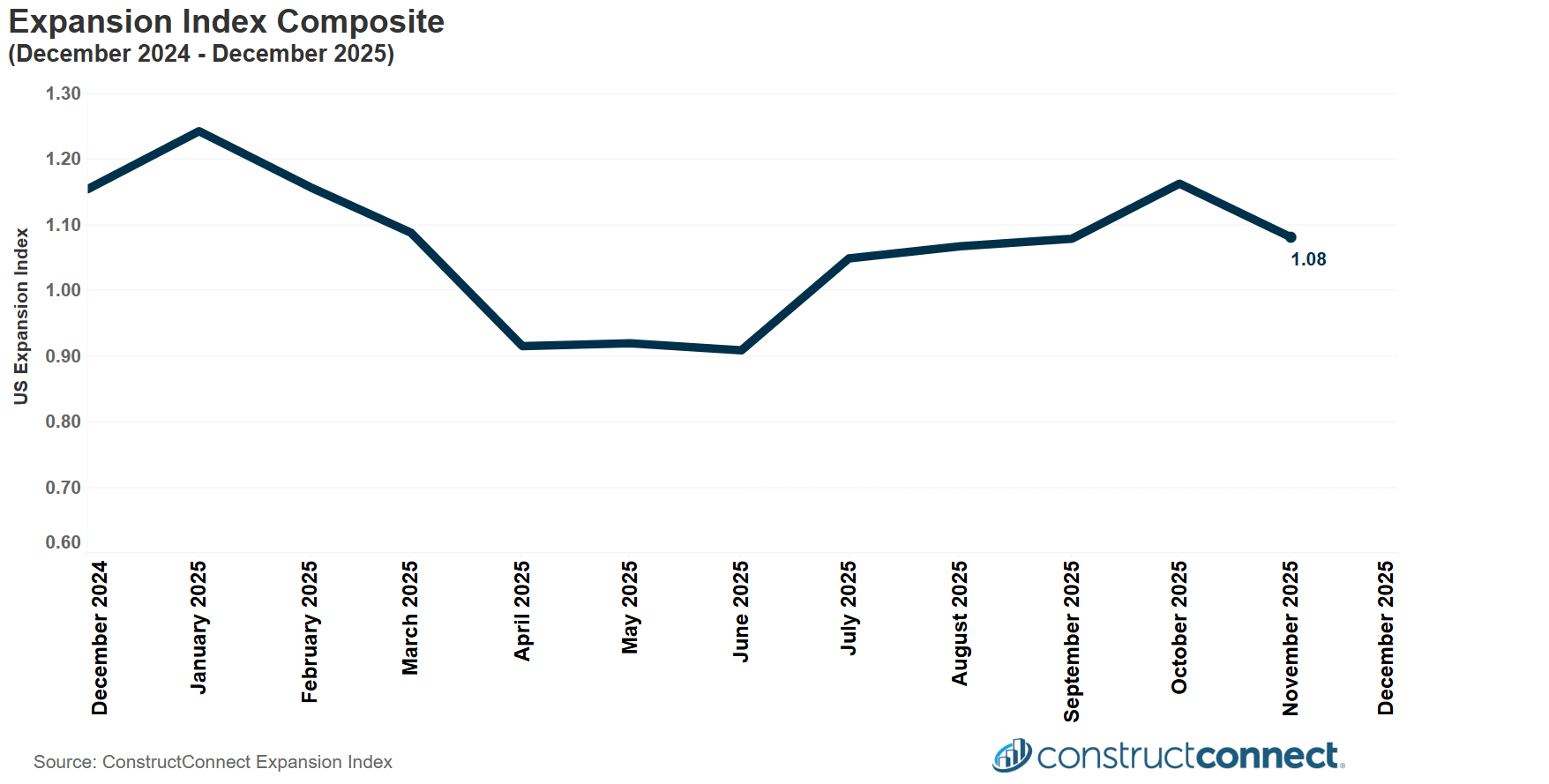
In December 2025, the ConstructConnect Expansion Index posted a 1.08 reading, indicating 8% growth in ideated US construction investment compared to December 2024. Image: ConstructConnect
Geographic Highlights
Sixteen states posted Expansion Index readings above 1.0 in December, up from 14 states in November. Arizona led at 5.35, followed by Wyoming at 3.06 and North Dakota at 1.79.
Only three additional states exceeded 1.2: Alabama at 1.29, Georgia at 1.30, and Delaware at 1.20. It is worth noting that high readings reflect growth in planned investment dollars rather than the number of projects, meaning a single large project can significantly elevate a state’s index, particularly in smaller construction markets.
On the other hand, 34 states and the District of Columbia experienced contractions in their ideated construction spending. Regionally, the Northeast and Midwest posted the lowest average Expansion Index readings at 0.91 and 0.96, respectively, marking continued weakness in planned construction pipelines in these regions.
Trend Watch
The December Expansion Index indicates that potential growth is not evenly distributed across the construction market. With only three of ten verticals reaching expansion and ideated activity concentrated in select states, future success increasingly depends on identifying the right combination of construction type and location.
Firms positioned in expanding sectors within strategic geographies could see stronger project pipelines, while those competing in contracting verticals or weaker regions may face competition for fewer potential projects.
Stay Connected
Stay connected with ConstructConnect News, your source for construction economy insights, market trends, and project news.
What is the ConstructConnect Expansion Index?
The ConstructConnect Expansion Index compares the total dollar value of construction projects in planning for the current month to the value of projects in planning for that same calendar month in the prior year.
The Expansion Index measures the dollar volume of pre-bid projects in ConstructConnect’s extensive database for states and metropolitan statistical areas (MSAs) across the United States and Provinces/Territories and census metropolitan areas (CMAs) in Canada. This reflects all stages of preparation prior to construction field-work at the beginning of any given month this year, versus what was calculated at the same time last year. The types of structures included in these calculations are multi-family residential, nonresidential building, and civil/heavy engineering.
An index value less than 1.0 indicates a market potential that is flat or declining, while an index value above 1.0 speaks of market potential that is increasing. An Index value of 2.0 or more indicates the market potential is significantly greater than a year ago.
About ConstructConnect
At ConstructConnect, our software solutions provide the information that construction professionals need to start every project on a solid foundation. For more than 100 years, our keen insights and market intelligence have empowered commercial firms, building product manufacturers, trade contractors, and architects to make data-driven decisions, streamline preconstruction workflows, and maximize their productivity. Our newest offerings—including our comprehensive, AI-assisted software—help our clients find, bid on, and win more projects.
ConstructConnect operates as a business unit of Roper Technologies (Nasdaq: ROP), a constituent of the Nasdaq 100, S&P 500, and Fortune 1000.
For more information, visit constructconnect.com