KEY POINTS
-
Data center construction has rapidly accelerated, with the year-to-date total already surpassing last year’s full-year figure.
-
Average new data center projects have risen significantly in costs, while only growing modestly in size.
-
Many of the key inputs that make up 90% of a data center’s construction cost have seen significant price increases.
Data Centers have become a massive part of the US construction industry, already totaling $81.5 billion in starts just through June 2026. This figure surpasses the full-year 2025 Data Center construction spending of $72.5 billion, which itself was a record and well over double the previous year's activity.
The acceleration and continued momentum in Data Center construction starts show how quickly capital is materializing to build out these facilities. However, that demand, along with broader geopolitical factors, has pushed up the cost of construction.

Electrical systems have seen some of the steepest data center construction input price increases. Copper wire, a key resource for power generation and transmission, has increased 17.9% compared to year-ago levels. Image: ConstructConnect
On a twelve-month-moving-average basis, the average data center project has reached $1 billion, over double the $438 million seen at the same point last year. In the same period, new facilities have not grown in physical size at the same rate, with the average new development only 9.2% larger in square footage compared to a year ago.
The divergence in price and size likely reflects rising material costs, as well as increasing complexity in new buildouts. This leaves developers and owners, backed by significant capital, facing higher project input costs.
What Goes into a Data Center
Turner and Townsend's 2025 Data Center Cost Index breaks down the different inputs into four categories, split between air-cooled and liquid-cooled facilities: Electrical systems, Mechanical systems, Core and Shell, and General Contractor fees.
-
Electrical systems account for 48-54% of construction costs, mechanical systems make up 22-33%, and core and shell make up 9-14%.
-
General contractor (GC) fees make up the remaining 10% in both the air- and liquid-cooled facilities.

HVAC and commercial refrigeration equipment has risen 4.5% compared to year-ago levels, while steel pipe and tube, a core piece that moves cooling fluid through these systems, has climbed a sharper 11.1%. Image: ConstructConnect
The largest of these categories, electrical systems, have also seen some of the steepest input price increases. Copper wire, a key resource for power generation and transmission, has increased 17.9% compared to year-ago levels.
That pressure has carried into finished electrical goods too, with electric power and transformer manufacturing up 7.8%, switchgear manufacturing up 8.5%, and electric bulk power transmission and control up 14.1% year-over-year.
Mechanical systems, the next largest bucket, are seeing similar material price increases. HVAC and commercial refrigeration equipment has risen 4.5% compared to year-ago levels, while steel pipe and tube, a core piece that moves cooling fluid through these systems, has climbed a sharper 11.1%.
Even core and shell inputs haven't escaped price increases. Steel, which is integral to the structural shape of most data centers, has seen mill product prices rise 22.5% over the past year.
Concrete, another key shell input, has also increased, albeit a more modest 3.5%.
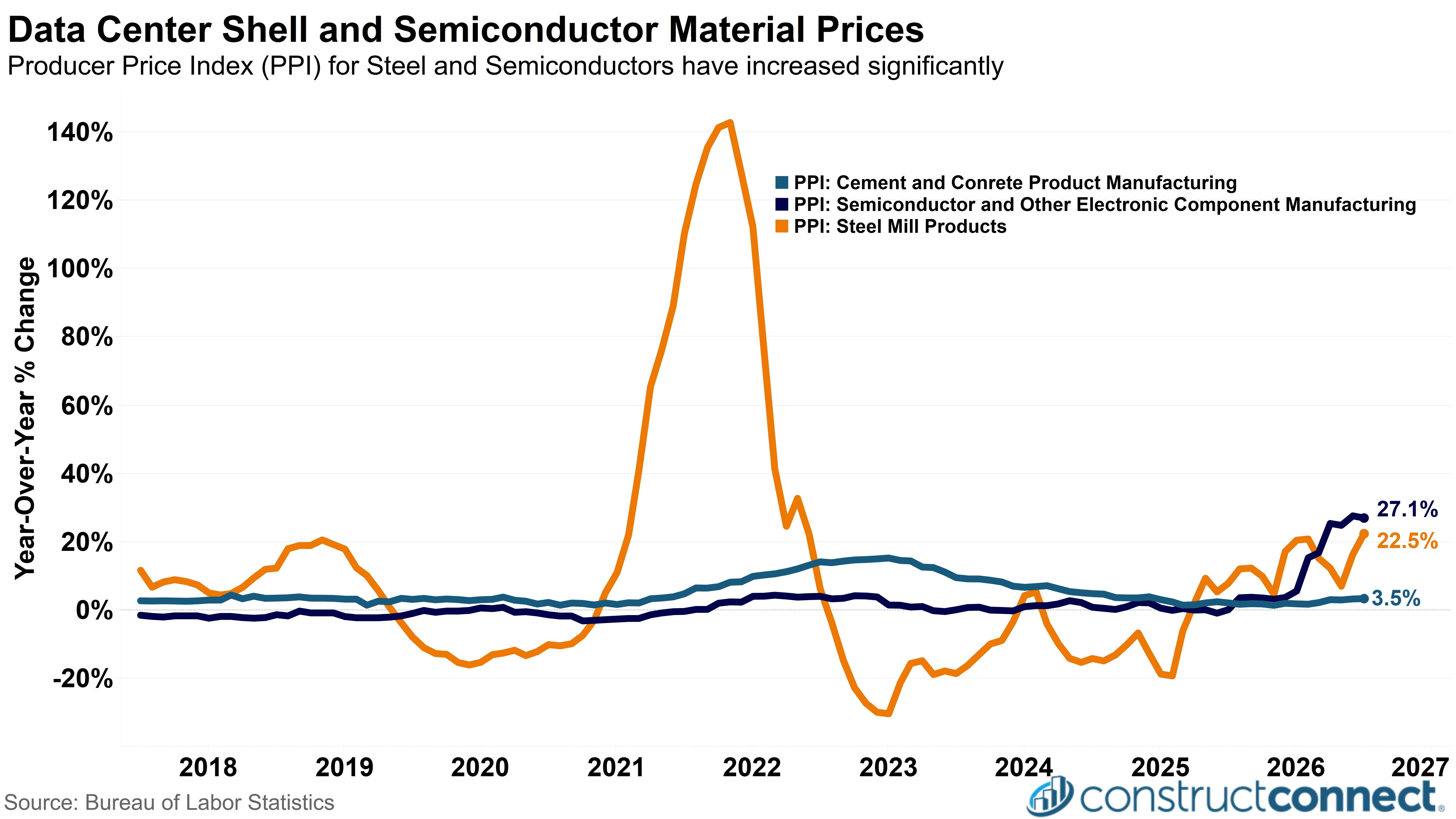
Core and shell inputs haven't escaped price increases. Steel, which is integral to the structural shape of most data centers, has seen mill product prices rise 22.5% over the past year. Concrete, another key shell input, has also increased, albeit a more modest 3.5%. Image: ConstructConnect
Finally, while not a part of construction costs, semiconductor prices have jumped 27.1% over the past year. Semiconductors enable the data centers to do their core functions of processing, storing, and transmitting data.

What it Means to Construction
Many of the inputs to data center construction have climbed over the past year, across electrical systems, mechanical systems, and the outer shell of the development.
Together, these inputs make up 90% of data center construction costs, meaning a significant portion of a typical data center project's budget is exposed to rising material prices.
Even though those costs are rising, they're unlikely to dampen data center spending in the near term due to the sheer amount of investment backing the current buildout.
However, developers and owners will need to protect against further cost increases by locking in prices early or including escalation clauses in contracts.
Stay Connected
Stay connected with ConstructConnect News for construction industry news and construction market analysis to stay ahead of what’s building next.
About ConstructConnect
At ConstructConnect, our software solutions provide the information that construction professionals need to start every project on a solid foundation. For more than 100 years, our keen insights and market intelligence have empowered commercial firms, building product manufacturers, trade contractors, and architects to make data-driven decisions, streamline preconstruction workflows, and maximize their productivity. Our newest offerings—including our comprehensive, AI-assisted software—help our clients find, bid on, and win more projects.
ConstructConnect operates as a business unit of Roper Technologies (Nasdaq: ROP), a constituent of the Nasdaq 100, S&P 500, and Fortune 1000.
For more information, visit constructconnect.com