KEY POINTS
-
Chicago's United Center is building Music Hall, a 6,000-seat, single-purpose concert venue with a flexible, multi-level layout.
-
It is part of the $7 billion, 55-acre 1901 Project expansion on the Near West Side. Ground was broken this summer, with a tentative 2028 opening.
-
Audiences will view performers from three levels, with sweeping sightlines and dramatic lighting. Acoustics and design aim to make music felt throughout the venue.
It may be the most innovative performance space currently being built.
What is Chicago's Music Hall
It's called Music Hall and it's part of Chicago's United Center's $7 billion 55-acre multidimensional expansion, known as the 1901 Project, so named because it is the United Center's Park Avenue address.
The 1901 Project, in several phases, will fill out what used to be a sea of parking lots around the near West Side Arena, home to Chicago Blackhawks and Chicago Bulls.
Why the Location was Picked
The United Center itself dates from 1994 and has been the scene of numerous concerts, though obviously in a mixed-use auditorium. The site's legacy goes back to the old Chicago Stadium, also home to those professional teams and located across the street.
With the new Music Hall, United Center management wanted to continue that "legacy" but in a single purpose venue that will not just be a premium home for musicians but for fans as well and integrate some of that musical experience into the overall new commercial and residential neighborhood.
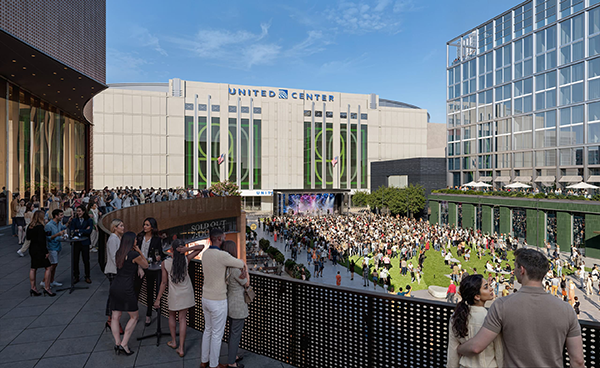 A rendering shows the close proximity of new the Music Hall to the United Center and surrounding new developments. Image: United Center 1901 Project
When will Music Center Open
Ground was broken this summer with a tentative opening in 2028.
But with Music Hall this just isn't any typical concert hall, albeit updated; the entire concept of presenting music has been reimagined.
What will the concert experience look like
The 6,000-seat venue will have a "flexible, multi-level" configuration, say developers, to give "the opportunity to shape every element around the relationship between artist, audience and sound."
Audiences will be able to view performers from three levels. There will be "sweeping sightlines, dramatic lighting and spaces designed to bring guests closer to the stage."
All facets, from design to hard construction like acoustics, have one goal: "Music should be felt throughout the entire venue, not only heard from the stage."
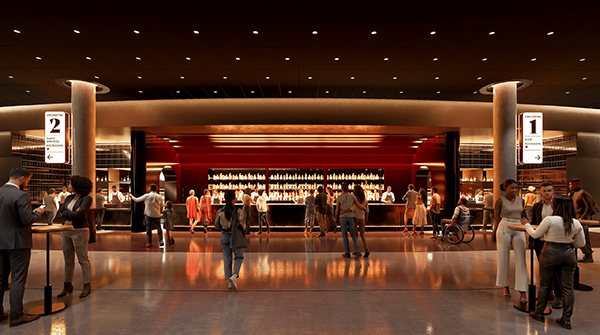 Expansive bars and "premium hospitality spaces" will also be part of the Music Hall concert experience. Image: United Center 1901 Project
Management says the design is meant to be "intentionally fluid" with areas flowing into one another with the musical experience felt not just immediately in front of the stage but in ancillary areas like expansive bars, "premium hospitality spaces," restaurants and retail, even outside proximate to a new hotel.
It will be "in harmony" with the surrounding 1901 neighborhood.
Danny Wirtz, chairman and CEO of the Chicago Blackhawks and co-chair of the United Center Joint Venture, said in a statement Music Hall will pay tribute to the glory days of the Chicago Stadium.
“My great-grandfather, Arthur, put Miles Davis and Ella Fitzgerald on a stage at the Chicago Stadium in 1959. Led Zeppelin played four nights on that same block in 1977. The musical history of this address is not incidental to what we're building."
How Does Music Hall Fit the Wider 1901 Project
Music Hall will not just create an expansive type of experience but is characteristic of what the entire 1901 Project envisions.
Said Michael Reinsdorf, president and CEO of the Chicago Bulls and co-chair of the United Center Joint Venture: "The 1901 Project is about creating a place that is active well beyond an event or game night, and the Music Hall embodies that vision.”

What will Performers Get
The venue is being created based on lessons learned from decades of promoting United Center concerts, specifically around the conditions do and don't optimize the experience. That goes for audiences and musicians.
For example, it will offer performers a more "welcoming" environment with programming scaled to both multi-concert and one-off performances from well-establishedstablished groups to rising artists.
"We’re building a room that can serve artists at different points in their careers, give them reasons to come back to Chicago and, most importantly, create the kind of connection between artist and audience that makes a show memorable,” Matt Rucins, director of content and programming, a veteran Chicago promoter, said.
Even backstage will be conducive to touring, all with a Windy City theme, "making the hours surrounding a performance as considered as the time spent on stage."
What Does the Community Say
Ward 27 alderman Walter "Red" Burnett said Music Hall as part of the 1901 Project "should create opportunity for those who already live here."
As for the otherwise formerly underused area around United Center he said the project will "give people hope that there’s life in the city of Chicago, there’s life on the West Side, and it’s going to drive more development on the West Side."
About ConstructConnect
At ConstructConnect, our software solutions provide the information construction professionals need to start every project on a solid foundation. For more than 100 years, our insights and market intelligence have empowered commercial firms, manufacturers, trade contractors, and architects to make data-driven decisions and maximize productivity.
ConstructConnect is a business unit of Roper Technologies (Nasdaq: ROP), part of the Nasdaq 100, S&P 500, and Fortune 1000.
For more information, visit constructconnect.com