KEY POINTS
-
The Kansas City Royals plan a 34,000-seat, open-air ballpark at Crown Center near downtown.
-
It is the centerpiece of a mixed-use district developed with Hallmark Cards across more than 85 acres. The project is billed as the largest public-private partnership in the city's history, with phase one exceeding $3 billion.
-
Populous is architect of record for the 1.25-million-square-foot, four-deck stadium. A Mortenson and McCownGordon joint venture will lead construction, and JE Dunn will help shape the surrounding district. The Royals intend to break ground in 2027.
The Kansas City Royals are preparing to bring baseball back into the heart of downtown with an ambitious $3 billion stadium and mixed-use development billed as the largest public-private partnership in the city’s history.
What are the Royals planning for downtown?
The Major League Baseball club plans to build a 34,000-seat, open-air ballpark at Crown Center near downtown as the centerpiece of an expansive sports-anchored district being developed in partnership with Hallmark Cards.
Renderings of the proposed stadium have now been unveiled, offering a closer look at a ballpark designed specifically around the city’s architectural character while putting spectators closer to the action.
When will construction begin?
The Royals intend to break ground in 2027, with the new stadium planned as the successor to Kauffman Stadium, the team's home since 1973 and currently the fifth-oldest ballpark in the major leagues.
Royals chairman and CEO John Sherman says the project is the product of a lengthy process to find a new home for the franchise.
“Patience has given us an outcome that we could never have imagined. There's no script … no playbook, no blueprint, no roadmap,” he said.
He called the development “a narrative of community, of trust, of courage and vision, and a passion for doing something special for the city we love.”
What will the Crown Center district include?
The partnership with Hallmark will reshape more than 85 acres of Crown Center, creating a major new mixed-use neighborhood built around baseball.
Plans envision sports, entertainment, retail, hospitality, residential and public spaces, with the development connecting to nearby Union Station and the Crossroads district.
“We're bringing baseball downtown, we are bringing a second crown downtown,” Sherman said. “We will build a project that will be the largest public-private partnership in Kansas City history, with a total investment that will exceed $3 billion just in phase one.”
Who is paying for it?
The project is expected to be majority privately funded, with at least two-thirds of the investment coming from the Royals and private partners.
The team estimates construction alone could generate 20,000 jobs.
The stadium will be built on the site of Hallmark's current corporate headquarters. Hallmark executive chairman Don Hall Jr. has said the company will relocate its headquarters elsewhere within Crown Center, keeping another longtime Kansas City institution rooted in the area.
Kansas City-based global design firm Populous is the architect of record for the 1.25-million-square-foot stadium.
What will the ballpark look like?
Rather than create a ballpark that could be transplanted into another city, the design draws from Kansas City's landscape and architectural heritage, including Municipal Auditorium, Union Station and the Liberty Memorial.
The four-deck stadium will be built roughly 90 feet into the ground and fitted into the site's existing limestone bluff. It is intended to feel integrated into its surroundings instead of towering over them.
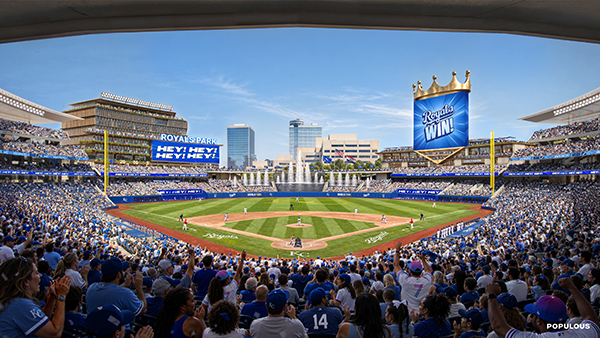 Renderings of the new Kansas City Royals stadium show an oval-shaped structure surrounded by plaza areas and greenspace. Construction of the stadium will be led by a joint venture between Mortenson and Kansas City-based McCownGordon, while JE Dunn has been selected to help shape the surrounding mixed-use district. Image: Kansas City Royals
The main entrance of the structure will feature limestone framed by layers of light-colored materials, metal and terracotta. Above the stands, a lightweight fabric canopy will maintain the feel of open-air baseball while providing protection from Kansas City's summer heat.
The design is expected to shade about 65 per cent of seats during late-afternoon conditions.
Renderings of the new stadium show an oval-shaped structure surrounded by plaza areas and greenspace.
What is inside the seating bowl?
Inside, a more intimate seating bowl will bring spectators closer to the field. Two continuous 360-degree concourses will connect a right-field entertainment building and a left-field Royals headquarters building while opening the stadium to views of the Kansas City skyline.
Renderings show an expansive display of fountains beyond the outfield wall.
The design also carries forward some of Kauffman Stadium's most recognizable features and traditions, including the Royals’ crown, Little K and CrownVision scoreboard.
Populous has significant experience designing major-league ballparks and has worked in some capacity with 29 of MLB’s 30 clubs. About 90 percent of the design team for the Royals project will be based in Kansas City.
Construction of the stadium will be led by a joint venture between Mortenson and Kansas City-based McCownGordon, while JE Dunn, another Kansas City-headquartered firm, has been selected to help shape the surrounding mixed-use district.
Beyond the ballpark itself, Crown Center already offers significant infrastructure for a downtown stadium, including about 9,000 parking spaces and access to Kansas City streetcar stops along Main Street.
For Sherman, the scale of the development represents an opportunity extending well beyond baseball.
“Together, we will rethink, reimagine, redefine and redevelop Crown Center in an 85-acre-plus setting here that will instantly become the largest sports-anchored downtown development of its kind,” he said.
“This is a partnership between two Kansas City treasured institutions - Hallmark Cards and the Kansas City Royals.”

What does it mean for baseball in Kansas City?
The move also carries historical significance for baseball in Kansas City.
Bob Kendrick, president of the Negro Leagues Baseball Museum, said returning the game to the urban core connects the city’s baseball future with a significant part of its past.
“To have the opportunity to see baseball return to its roots where so much history was made back in the urban core is extremely exciting to all of us who are involved with this project,” he said.
His assessment of what the project means for the city was even more succinct.
“Kansas City baseball is back at the center of the universe.”
Stay Connected
Stay connected with ConstructConnect News for construction industry news and construction market analysis to stay ahead of what’s building next.
About ConstructConnect
At ConstructConnect, our software solutions provide the information construction professionals need to start every project on a solid foundation. For more than 100 years, our insights and market intelligence have empowered commercial firms, manufacturers, trade contractors, and architects to make data-driven decisions and maximize productivity.
ConstructConnect is a business unit of Roper Technologies (Nasdaq: ROP), part of the Nasdaq 100, S&P 500, and Fortune 1000.
For more information, visit constructconnect.com